Intent: Interviewing the resident or designated individuals places the resident or their family at the center of decision-making. The items in this section are intended to record the participation and expectations of the resident, family members, or significant other(s) in the assessment, and to understand the resident’s overall goals. Discharge planning follow-up is already a regulatory requirement (CFR 483.21(c)(1)). Section Q of the MDS uses a person-centered approach to ensure that all individuals have the opportunity to learn about home- and community-based services and to receive long term care in the least restrictive setting possible. This may not be a nursing home. This is also a civil right for all residents.
Q0110: Participation in Assessment and Goal Setting 
DEFINITION
RESIDENT’S PARTICIPATION IN ASSESSMENT
The resident actively engages in interviews and conversations to meaningfully contribute to the completion of the MDS 3.0.
Interdisciplinary team members should engage the resident during assessment in order to determine the resident’s expectations and perspectives during assessment.
DEFINITION
RESIDENT’S PARTICIPATION IN ASSESSMENT
The resident actively engages in interviews and conversations to meaningfully contribute to the completion of the MDS 3.0.
Interdisciplinary team members should engage the resident during assessment in order to determine the resident’s expectations and perspectives during assessment.


Residents who actively participate in the assessment process and in development of their care plan through interview and conversation often experience improved quality of life and higher quality care based on their needs, goals, and priorities.
Each care plan should be individualized and resident- driven. Whenever possible, the resident should be actively involved—except in unusual circumstances such as if the individual is unable to understand the proceedings or is comatose. Involving the resident in all assessment interviews and care planning meetings is also important to address dignity and self-determination
survey and certification requirements (CFR §483.24 Quality of Life).
DEFINITIONS
FAMILY OR SIGNIFICANT OTHER
A spousal, kinship (e.g., sibling, child, parent, nephew), or in-law relationship; a partner, housemate, primary community caregiver or close friend. Significant other does not include staff at the nursing home.
GUARDIAN/LEGALLY AUTHORIZED REPRESENTATIVE
A person who is authorized, under applicable law, to make decisions for the resident, including giving and withholding consent for medical treatment.
DEFINITIONS
FAMILY OR SIGNIFICANT OTHER
A spousal, kinship (e.g., sibling, child, parent, nephew), or in-law relationship; a partner, housemate, primary community caregiver or close friend. Significant other does not include staff at the nursing home.
GUARDIAN/LEGALLY AUTHORIZED REPRESENTATIVE
A person who is authorized, under applicable law, to make decisions for the resident, including giving and withholding consent for medical treatment.
During the care planning meetings, the resident should be made comfortable and verbal communication should be directly with them.
Residents should be asked about inviting family members, significant others, and/or guardian/legally authorized representatives to participate, and if they desire that they be involved in the assessment process.
If the individual resident is unable to understand the process, their family member, significant other, and/or guardian/legally authorized representative, who represents the individual, should be invited to attend the assessment process whenever possible.
When the resident is unable to participate in the assessment process, a family member or significant other, and/or guardian or legally authorized representatives can provide information about the resident’s needs, goals, and priorities on the resident’s behalf.
Review the clinical record for documentation that the
resident, family member and/or significant other, and guardian or legally authorized representative participated in the assessment process.
Ask the resident, the family member or significant other (when applicable), and the guardian or legally authorized representative (when applicable) if they actively participated in the assessment process.
Ask staff members who completed the assessment whether or not the resident, family or significant other, or guardian or legally authorized representative participated in the assessment process.
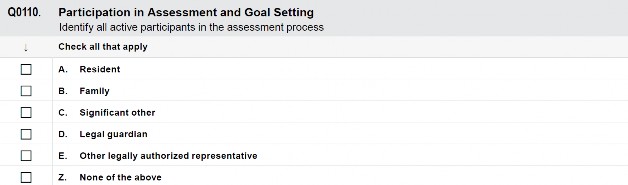
Coding Instructions for Q0110, Participation in Assessment and Goal Setting
Record the participation of all those who participated in the assessment process. Check all that apply.
Record the participation of all those who participated in the assessment process. Check all that apply.
Code A, Resident: if the resident actively participated in the assessment process.
Code B, Family: if a member of the resident’s family actively participated in the assessment process.
Code C, Significant other: if a significant other of the resident actively participated in the assessment process.
Code D, Legal guardian: if a legal guardian actively participated in the assessment process.
Code E, Other legally authorized representative: if a legally authorized representative actively participated in the assessment process.
Code Z, None of the above: if none of the above actively participated in the assessment process.
While family, significant others, or, if necessary, the guardian or legally authorized representative can be involved, the response selected must reflect the resident’s perspective if they are able to express it, even if the opinion of family member/significant other or guardian/legally authorized representative differs.
Significant other does not include nursing home staff.
Q0310: Resident’s Overall Goal 
This item identifies the resident’s general expectations and goals for nursing home stay. The resident should be asked about their own expectations regarding return to the community and goals for care. The resident may not be aware of the option of returning to the community and that services and supports may be available in the community to meet their individual long-term care needs. Additional assessment information may be needed to determine whether the resident requires additional community services and supports.
Some residents have very clear and directed expectations that will change little prior to discharge. Other residents may be unsure or may be experiencing an evolution in their thinking as their clinical condition changes or stabilizes.
DEFINITION
DISCHARGE
To release from nursing home care. Can be to home, another community setting, or a healthcare setting.
DEFINITION
DISCHARGE
To release from nursing home care. Can be to home, another community setting, or a healthcare setting.
Unless the residents’ goals for care are understood, their needs, goals, and priorities are not likely to be met.
The resident’s goals should be the basis for care planning.
Great progress has been made in this area. This progress allows individuals more choices when it comes to care options and available support options to meet care preferences and needs in the least restrictive setting possible. This progress resulted from the 1999 U.S. Supreme Court decision in Olmstead v. L.C., which states that residents needing long term services and supports have a civil right to receive services in the least restrictive and most integrated setting appropriate to their needs.
Ask the resident about their overall expectations and goals to be sure that they have participated in the assessment process and have an understanding of their current situation and the implications of choices such as returning home or moving to another appropriate community setting such as an assisted living facility or an alternative healthcare setting.
Ask the resident to consider their current health status, expectations regarding improvement or worsening, social supports and opportunities to obtain services and supports in the community.
If goals have not already been stated directly by the resident and documented since admission, ask the resident directly about what their expectation is regarding the outcome of this nursing home admission and expectations about returning to the community.
The resident’s stated goals should be recorded here. The goals for the resident, as described by the family, significant other, guardian, or legally authorized representative, may also be recorded in the clinical record.
Because of a temporary (e.g., delirium) or permanent (e.g., profound dementia) condition, some residents may be unable to provide a clear response. If the resident is unable to communicate their preference either verbally or nonverbally, the information can be obtained from the family or significant other, as designated by the individual. If family or the significant other is not available, the information should be obtained from the guardian or legally authorized representative.
Encourage the involvement of family or significant others in the discussion, if the resident consents. While family, significant others, or the guardian or legally authorized representative can be involved if the resident is uncertain about their goals, the response selected must reflect the resident’s perspective if they are able to express it.
In some guardianship situations, the decision-making authority regarding the individual’s care is vested in the guardian. But this should not create a presumption that the individual resident is not able to comprehend and communicate their wishes.
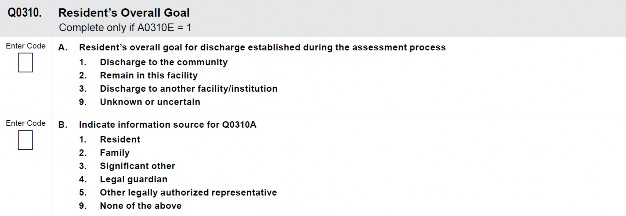
Coding Instructions for Q0310A, Resident’s overall goal for discharge established during the assessment process
Record the resident’s expectations as expressed by them. It is important to document their expectations.
Record the resident’s expectations as expressed by them. It is important to document their expectations.
Code 1, Discharge to the community: if the resident indicates an expectation to return home, to assisted living, or to another community setting.
Code 2, Remain in this facility: if the resident indicates that they expect to remain in the nursing home.
Code 3, Discharge to another facility/institution: if the resident expects to be discharged to another nursing home, rehabilitation facility, or another institution.
Code 9, Unknown or uncertain: if the resident is uncertain or if the resident is not able to participate in the discussion or indicate a goal, and family, significant other, or guardian or legally authorized representative do not exist or are not available to participate in the discussion.
DEFINITION
DESIGNATED LOCAL CONTACT AGENCY (LCA)
Each state has community contact agencies that can provide individuals with information about community living options and available community-based supports and services. These local contact agencies may be a single entry point agency, an Aging and Disability Resource Center (ADRC), an Area Agency on Aging (AAA), a Center for Independent Living (CIL), or other state designated entities.
DEFINITION
DESIGNATED LOCAL CONTACT AGENCY (LCA)
Each state has community contact agencies that can provide individuals with information about community living options and available community-based supports and services. These local contact agencies may be a single entry point agency, an Aging and Disability Resource Center (ADRC), an Area Agency on Aging (AAA), a Center for Independent Living (CIL), or other state designated entities.


The response to this item should be individualized and resident-driven rather than what the nursing home staff judge to be in the best interest of the resident. This item focuses on exploring the resident’s expectations, not whether or not the staff considers them to be realistic. Coding other than the resident’s stated expectation is a violation of the resident’s civil rights.
Q0310A, Code 1 “Discharge to the community” may include newly admitted residents with a facility- arranged discharge plan or those residents with adequate supports already in place that would not require referral to a local contact agency (LCA). It may also include residents who ask to talk to someone about the possibility of leaving this facility and returning to live and receive services in the community (Q0500B, Code 1, Yes).
Avoid trying to guess what the resident might identify as a goal or to judge the resident’s goal. Do not infer a
response based on a specific advance directive, e.g., “do not resuscitate” (DNR).
The resident should be provided options, as well as access to information that allows them to make the decision and to be supported in directing their care planning.
If the resident is unable to communicate their preference either verbally or nonverbally, or has been legally determined incompetent, the information can be obtained from the family or significant other, as designated by the individual. Families, significant others or legal guardians should be consulted as part of the assessment.
Code 1, Resident: if the resident is the source for completing this item.
Code 2, Family: if a family member is the source for completing this item because the resident is unable to respond.
Code 3, Significant other: if a significant other of the resident is the source for completing this item because the resident is unable to respond.
Code 4, Legal guardian: if a legal guardian of the resident is the source for completing this item because the resident is unable to respond.
Code 5, Other legally authorized representative: if a legally authorized representative of the resident is the source for completing this item because the resident is unable to respond.
Code 9, None of the above: if the resident cannot respond and the family or significant other, or guardian or legally authorized representative does not exist or cannot be contacted or is unable to respond (Q0310A = 9).
Resident F is a 55-year-old married individual who had a cerebrovascular accident (CVA, also known as stroke) 2 weeks ago. They were admitted to the nursing home 1 week ago for rehabilitation, specifically for transfer, gait, and wheelchair mobility training. Resident F is extremely motivated to return home. Their spouse is supportive and has been busy adapting their home to promote their independence. Resident F’s goal is to return home once they have completed rehabilitation.
Coding: Q0310A would be coded 1, Discharge to the community.
Q0310B would be coded 1, Resident.
Rationale: Resident F has clear expectations and a goal to return home.
Resident W is a 73-year-old individual who has severe heart failure and renal dysfunction. They also have a new diagnosis of metastatic colorectal cancer and were readmitted to the nursing home after a prolonged hospitalization for lower gastrointestinal (GI) bleeding. They rely on nursing staff for all activities of daily living (ADLs). They indicate that they are “strongly optimistic” about their future and only want to think “positive thoughts” about what is going to happen and need to believe that they will return home.
Coding: Q0310A would be coded 1, Discharge to the community.
Q0310B would be coded 1, Resident.
Rationale: Resident W has a clear goal to return home. Even if the staff believe this is unlikely based on available social supports and past nursing home residence, this item should be coded based on the resident’s expressed goals.
Resident T is a 93-year-old individual with chronic renal failure, oxygen dependent chronic obstructive pulmonary disease (COPD), severe osteoporosis, and moderate dementia. When queried about their care preferences, they are unable to voice consistent preferences for their own care, simply stating that “It’s such a nice day.” When their adult child is asked about goals for their parent’s care, they state that “We know her time is coming. The most important thing now is for her to be comfortable. Because of monetary constraints, the level of care that she needs, and other work and family responsibilities we cannot adequately meet her needs at home. Other than treating simple things, what we really want most is for her to live out whatever time she has in comfort and for us to spend as much time as we can with her.” The assessor confirms that the adult child wants care oriented toward making their parent comfortable in their final days, in the nursing home, and that the family does not have the capacity to provide all the care the resident needs.
Coding: Q0310A would be coded 2, Remain in this facility.
Q0310B would be coded 2, Family.
Rationale: Resident T does not respond appropriately to the question of their care preferences, but their adult child has clear expectations that their parent will remain in the nursing home where they will be made comfortable for their remaining days.
Resident G, an 84-year-old individual with severe dementia, is admitted by their adult child for a 7-day period. Their adult child stated that they “just need to have a break.” Their parent has been wandering at times and has little interactive capacity. The adult child is planning to take their parent back home at the end of the week.
Coding: Q0310A would be coded 1, Discharge to the community.
Q0310B would be coded 2, Family.
Rationale: Resident G is not able to respond but their adult child has clear expectations that their parent will return home at the end of the 7-day respite visit.
Resident C is a 72-year-old individual who had been living alone and was admitted to the nursing home for rehabilitation after a severe fall. Upon admission, they were diagnosed with moderate dementia and were unable to voice consistent preferences for their own care. They have no living relatives and no significant other who is willing to participate in their care decisions. The court appointed a legal guardian to oversee their care. Community-based services, including assisted living and other residential care situations, were discussed with the guardian. The guardian decided that it is in Resident C’s best interest that they be discharged to a nursing home that has a specialized dementia care unit once rehabilitation was complete.
Coding: Q0310A would be coded 3, Discharge to another facility/institution.
Q0310B would be coded 4, Legal guardian.
Rationale: Resident C is not able to respond and has no family or significant other available to participate in their care decisions. A court-appointed legal guardian determined that it is in Resident C’s best interest to be discharged to a nursing home that could provide dementia care once rehabilitation was complete.
Resident K is a 40-year-old with cerebral palsy and a learning disability. They lived in a group home 5 years ago, but after a hospitalization for pneumonia they were admitted to the nursing home for respiratory therapy. Although their group home bed is no longer available, they are now medically stable and there is no medical reason why they could not transition back to the community. Resident K states they want to return to the group home. Their legal guardian agrees that they should return to the community to a small group home.
Coding: Q0310A would be coded 1, Discharge to the community
Q0310B would be coded 1, Resident
Rationale: Resident K understands and is able to respond and says they would like to go back to the group home. Their expression of choice should be recorded. When the legal guardian, with legal decision-making authority under state law, was told that Resident K is medically stable and would like to go back to the community, the legal guardian confirmed that it is in Resident K’s best interest to be transferred to a group home. Small group homes are considered community settings. This information should also be recorded in the individual’s clinical record.
Q0400: Discharge Plan

Returning home or to a non-institutional setting can be very important to a resident’s health and quality of life.
For residents who have been in the facility for a long time, it is important to discuss with them their interest in talking with LCA experts about returning to the community. Community resources and supports exist that may benefit these residents and allow them to return to a community setting.
Being discharged from the nursing home without adequate discharge planning occurring (planning and implementation of a plan before discharge) could result in the resident’s decline and increase the chances for re-hospitalization and aftercare, so a thorough examination of the options with the resident and local community experts is imperative.
Q0400: Discharge Plan (cont.)
Many nursing home residents may be able to return to the community if they are provided appropriate assistance and referral to community resources.
The care plan should include the name and contact information of a primary care provider chosen by the resident, family, significant other, guardian or legally authorized representative, arrangements for durable medical equipment (if needed), formal and informal supports that will be available, the person(s) and provider(s) in the community who will meet the resident’s needs, and the place the resident is going to be living.
Each situation is unique to the resident, their family, and/or guardian/legally authorized representative. A referral to the LCA may be appropriate for many individuals, who could be maintained in the community homes of their choice for long periods of time, depending on the residential setting and support services available. For example, a referral to the LCA may be appropriate for some individuals with Alzheimer’s disease. There are many individuals with this condition being maintained in their own homes for long periods of time, depending on the residential setting and support services available. The interdisciplinary team should not assume that any particular resident is unable to be discharged. A successful transition will depend on the services, settings, and sometimes family support services that are available.
Discharge instructions should include at a minimum:
the individuals preferences and needs for care and supports;
personal identification and contact information, including Advance Directives;
contact information of primary care physician, pharmacy, and community care agency including personal care services (if applicable) etc.;
brief medical history;
current medications, treatments, therapies, and allergies;
arrangements for durable medical equipment;
arrangements for housing;
arrangements for transportation to follow-up appointments; and
contact information at the nursing home if a problem arises during discharge
A follow-up appointment with the designated primary care provider in the community and other specialists (as appropriate).
Medication education.
Prevention and disease management education, focusing especially on warning symptoms for when to call the doctor.
Who to call in case of an emergency or if symptoms of decline occur.
Nursing home (NH) procedures and discharge planning for sub-acute and rehabilitation community discharges are most often well-defined and efficient.
Q0400: Discharge Plan (cont.)
Section Q has broadened the scope of the traditional boundary of discharge planning for sub-acute residents to encompass long stay residents. In addition to home health and other medical services, discharge planning may include expanded resources such as assistance with locating housing, transportation, employment if desired, and social engagement opportunities.
Asking the resident and family about whether they want to talk to someone about a return to the community gives the resident voice and respects their wishes. This step in no way guarantees discharge but provides an opportunity for the resident to interact with LCA experts.
The NH is responsible for making referrals to the LCAs under the process that the State has set up. The LCA is responsible for contacting referred residents and assisting with providing information regarding community-based services and, when appropriate, transition services planning. The nursing facility interdisciplinary team and the LCA should work closely together. The LCA is the entity that does the community support planning, (e.g., housing, home modification, setting up a household, transportation, community inclusion planning, etc.). A referral to the LCA may come from the nursing facility by phone, by e-mails or by a state’s on-line/website or by other state-approved processes. Each state has a process for referral to an LCA, and it is vital to know the process in your state and for your facility. In most cases, further screening and consultation with the resident, their family and the interdisciplinary team by the nursing home social worker or staff member would likely be an important step in the referral determination process.
Each NH needs to develop relationships with their LCAs to work with them to contact the resident and their family, guardian or significant others concerning a potential return to the community. A thorough review of medical, psychological, functional, and financial information is necessary in order to assess what each individual resident needs and whether or not there are sufficient community resources and finances to support a transition to the community.
Enriched transition resources including housing, in-home caretaking services and meals, home modifications, etc. are more readily available than in the recent past. Resource availability and eligibility coverage varies across States and local communities.
Should a planned relocation not occur, it might create stress and disappointment for the resident and family that will require support and nursing home care planning interventions. However, a referral should not be avoided based upon facility staff judgment of potential discharge success or failure. It is the resident’s right to be provided information if requested and to receive care in the most integrated setting.
Q0400: Discharge Plan (cont.)
Involve community mental health resources (as appropriate) to ensure that the resident has support and active coping skills that will help them to readjust to community living.
Use teach-back methods to ensure that the resident understands all of the factors associated with their discharge.
For additional guidance, see CMS’ Your Discharge Planning Checklist: For patients and their caregivers preparing to leave a hospital, nursing home, or other care setting. Available at https://www.medicare.gov/publications/11376-your-discharge- planning-checklist.pdf.
DEFINITION
ACTIVE DISCHARGE PLANNING
An active discharge plan means a plan that is being currently implemented. In other words, the resident’s care plan has current goals to make specific arrangements for discharge, staff are taking active steps to accomplish discharge, and there is a target discharge date for the near future.
If there is not an active discharge plan, residents should be asked if they want to talk to someone about community living (Q0500B) and then referred to the LCA accordingly. Furthermore, referrals to the LCA are recommended as part of many residents’ discharge plans. Such referrals are a helpful source of information for residents and facilities in informing the discharge planning process.
DEFINITION
ACTIVE DISCHARGE PLANNING
An active discharge plan means a plan that is being currently implemented. In other words, the resident’s care plan has current goals to make specific arrangements for discharge, staff are taking active steps to accomplish discharge, and there is a target discharge date for the near future.
If there is not an active discharge plan, residents should be asked if they want to talk to someone about community living (Q0500B) and then referred to the LCA accordingly. Furthermore, referrals to the LCA are recommended as part of many residents’ discharge plans. Such referrals are a helpful source of information for residents and facilities in informing the discharge planning process.
A review should be conducted of the care plan, the clinical record, and clinician progress notes, including but not limited to nursing, physician, social services, and therapy to consider the resident’s discharge planning needs.
If the resident is unable to communicate their preference either verbally or nonverbally, or has been legally determined incompetent, the information can be obtained from the family or significant other or guardian, as designated by the individual.
Record the resident’s expectations as expressed/communicated, whether NH staff believe that they are realistic or not realistic.
The resident, their interdisciplinary team, and LCA (when a referral has been made) should determine the services and assistance that the resident will need post discharge (e.g., homemaker, meal preparation, ADL assistance, transportation, prescription assistance).
Eligibility for financial assistance through various funding sources (e.g., private funds, family assistance, Medicaid, long-term care insurance) should be considered prior to discharge to identify the options available to the individual (e.g., home, assisted living, board and care, or group homes).
A determination of family involvement, capability and support after discharge should also be made. However, support from the family is not always necessary for a discharge to take place.
Q0400: Discharge Plan (cont.)
Coding Instructions for Q0400A, Is active discharge planning already occurring for the resident to return to the community?
Code 0, No: if there is not active discharge planning already occurring for the resident to return to the community.
Code 1, Yes: if there is active discharge planning already occurring for the resident to return to the community.
Q0490: Resident’s Documented Preference to Avoid Being Asked Question Q0500B
For Quarterly, Correction to Quarterly, and Non-OBRA Assessments. (A0310A=02, 06, or 99)

This item directs a check of the resident’s clinical record to determine if the resident and/or family, etc. have indicated on a previous OBRA comprehensive assessment (A0310A = 01, 03, 04 or 05) that they do not want to be asked question Q0500B until their next comprehensive assessment. Some residents and their families do not want to be asked about their preference for returning to the community and would rather not be asked about it. Item Q0490 allows them to opt-out of being asked question Q0500B on Quarterly (non-comprehensive) assessments. If there is a notation in the clinical record that the resident does not want to be asked again, and this is a Quarterly assessment, then skip to item Q0610, Referral. Q0500B is, however, mandatory on all comprehensive assessments.
Note: Let the resident know that they can change their mind about requesting information regarding possible return to the community at any time and should be referred to the LCA if they voice this request, regardless of schedule of MDS assessment(s).
If this is a comprehensive assessment, do not skip to item Q0610, continue to item Q0500B.
Q0490: Resident’s Documented Preference to Avoid Being Asked Question Q0500B (cont.)
Coding Instructions for Q0490, Does the resident’s clinical record document a request that this question (Q0500B) be asked only on comprehensive assessments?
Code 0, No: if there is no notation in the resident’s clinical record that they do not want to be asked Question Q0500B.
Code 1, Yes: if there is a notation in the resident’s clinical record to not ask Question Q0500B except on comprehensive assessments.
Unless this is a comprehensive assessment (A0310A=01, 03, 04, 05), skip to item Q0610,
Referral. If this is a comprehensive assessment, proceed to the next item, Q0500B.
Carefully review the resident’s clinical record, including prior MDS 3.0 assessments, to determine if the resident or other respondent has previously responded “No” to item Q0550A.
If this is a comprehensive assessment, proceed to item Q0500B, regardless of the previous responses to item Q0550A.
Q0490: Resident’s Documented Preference to Avoid Being Asked Question Q0500B (cont.)
Resident G is a 45-year-old individual weighing 300 pounds who is cognitively intact. They have congestive heart failure and shortness of breath requiring oxygen at all times. Resident G also requires 2 person assistance with bathing and transfers to the commode. They were admitted to the NH 3 years ago after their adult child who was caring for them passed away. During their Quarterly assessment, the NH social worker discussed options in which they could be cared for in the community but Resident G refused to consider leaving the NH. During the review of their clinical record, the assessor found that on their last MDS assessment, Resident G stated that they did not want to be asked again about returning to community living, that they have friends in the NH and really like the activities.
Coding: Q0490 would be coded 1, Yes, skip to Q0610; because this is a Quarterly assessment.
If this was a comprehensive assessment, then proceed to the next item Q0500B.
Rationale: On their last MDS 3.0 assessment, Resident G indicated their preference to not want to be asked again about returning to community living (0. No on Q0550A).
Resident R is an 82-year-old widowed individual with advanced Alzheimer’s disease. They have resided at the nursing home for 4½ years and their family requests that they not be interviewed because they become agitated and upset and cannot be cared for by family members or in the community.
Coding: Q0490 would be coded 1, Yes, skip to Q0610.
If this is a comprehensive assessment proceed to the next item, Q0500B.
Rationale: Resident R’s family requests that they opt out of the return to the community question because they become agitated when asked about return to community. They are only asked with comprehensive assessments.
Q0500: Return to Community 
For Admission, Quarterly, and Annual Assessments.
The goal of follow-up action is to initiate and maintain collaboration between the NH and the LCA to support the resident’s expressed interest in talking to someone about the possibility of leaving the facility and returning to live and receive services in the community. The underlying intention of the return to the community item is to ensure that all individuals have the opportunity to learn about home and community based services and have an opportunity to receive long term services and supports in the least restrictive setting appropriate for their needs. CMS has found that in many cases individuals requiring long term services, and/or their families, are unaware of community based services and supports that could adequately support individuals in community living situations. LCAs are experts in available home and community-based service (HCBS) and can provide both the resident and the facility with valuable information.
Returning home or to a non-institutional setting can be beneficial to the residents’ health and quality of life.
This item identifies the resident’s desire to speak with someone about returning to community living. Based on the Americans with Disabilities Act and the 1999 U.S. Supreme Court decision in Olmstead v. L.C., residents needing long-term care services have a civil right to receive services in the least restrictive and most integrated setting.
Item Q0500B requires that the resident be asked the question directly and formalizes the opportunity for the resident to be informed of and consider their options to return to community living. This ensures that the resident’s desire to learn about the possibility of returning to the community will be honored and appropriate follow-up measures will be taken.
The goal is to obtain the informed choice and preferences expressed by the resident and to provide information about available community supports and services.
Many NH residents may be able to return to the community if they are provided appropriate assistance to facilitate care in a non-institutional setting.
At the initial Admission assessment and in subsequent follow-up assessments (as applicable), make the resident comfortable by assuring them that this is a routine question that is asked of all residents.
Ask the resident if they would like to speak with someone about the possibility of returning to live and receive services in the community. Inform the resident that answering yes to this item signals the resident’s request for more information and will initiate a contact by someone with more information about supports available for living in the community. A successful transition will depend on the resident’s preferences and choices and the services, settings, and sometimes family supports that are available. In many cases individuals requiring long term care services, and/or their families, are unaware of community based services and supports that could adequately support individuals in community living situations. Answering yes does not commit the resident to leaving the NH at a specific time; nor does it ensure that the resident will be able to move back to the community. Answering no is also not a permanent commitment. Also inform the resident that they can change their decision (i.e., whether or not they want to speak with someone) at any time.
Explain that this item is meant to provide the opportunity for the resident to get information and explore the possibility of different settings for receiving ongoing care. This step will help the resident clarify their discharge goals and identify important information for the LCA or, in some instances may indicate that the resident does not want to be referred to the LCA at this time. Also explain that the resident can change their mind at any time.
If the resident is unable to communicate their preference either verbally or nonverbally, the information can then be obtained from family or a significant other, as designated by the individual. If family or significant others are not available, a guardian or legally authorized representative, if one exists, can provide the information.
Ask the resident if they want information about different kinds of supports that may be available to support community living. Responding “yes” will be a way for the individual— and their family, significant other, or guardian or legally authorized representative—to obtain additional information about services and supports that would be available to support community living. It is simply a request for information, not a request for discharge.
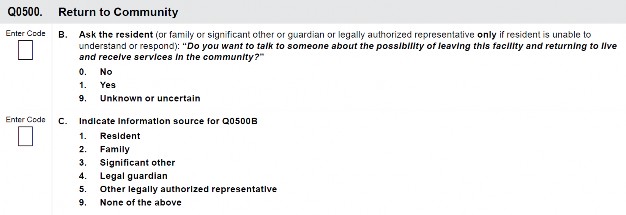
Coding Instructions for Q0500B, Ask the resident (or family or significant other or guardian or legally authorized representative only if resident is unable to understand or respond): “Do you want to talk to someone about the possibility of leaving this facility and returning to live and receive services in the community?”
A response code of 1, Yes, for this item indicates a desire to learn about home and community based services, it is not a request for discharge.
A response code of 1, Yes, for this item indicates a desire to learn about home and community based services, it is not a request for discharge.
Code 0, No: if the resident (or family or significant other, or guardian or legally authorized representative) states that they do not want to talk to someone about the possibility of returning to live and receive services in the community.
Code 1, Yes: if the resident (or family or significant other, or guardian or legally authorized representative) states that they do want to talk to someone about the possibility of returning to live and receive services in the community.
Code 9, Unknown or uncertain: if the resident cannot understand or respond and the family or significant other is not available to respond on the resident’s behalf and a guardian or legally authorized representative is not available or has not been appointed by the court.
Code 1, Resident: if the resident is the source for completing this item.
Code 2, Family: if a family member is the source for completing this item because the resident is unable to respond.
Code 3, Significant other: if a significant other of the resident is the source for completing this item because the resident is unable to respond.
Code 4, Legal guardian: if a legal guardian of the resident is the source for completing this item because the resident is unable to respond.
Code 5, Other legally authorized representative: if a legally authorized representative of the resident is the source for completing this item because the resident is unable to respond.
Code 9, None of the above: if the resident cannot respond and the family, significant other, guardian, or legally authorized representative does not exist or cannot be contacted or is unable to respond (Q0310A = 9).
A “yes” response to item Q0500B will trigger follow-up care planning and contact with the facility’s designated LCA.
Follow-up by the LCA is expected in a “reasonable” amount of time. Each state has its own policy for follow-up. It is important to know your state’s policy. The level and type of response needed by an individual is determined on a resident-by-resident basis. Some States may determine that the LCAs can make an initial telephone contact to identify the resident’s needs and/or set up the face-to-face visit/appointment. However, it is expected that most residents will have a face-to-face visit. In some States, an initial meeting is set up with the resident, facility staff, and LCA together to talk with the resident about their needs and community care options.
Some residents will have a very clear expectation and some may change their expectations over time. Residents may also be unsure or unaware of the opportunities available to them for community living with needed services and supports.
The SNF/NH should not assume that the resident cannot transition out of the SNF/NH due to their level of care needs. The SNF/NH and the resident should talk with the LCA to see what options are available for living and receiving services in the community.
Return to community questions may upset residents who cannot understand what the question means and result in them being agitated or saddened by being asked the question. If the resident’s documented level of cognitive impairment is such that the resident does not understand Q0500, a family member, significant other, guardian and/or legally appointed decision-maker for that individual should be asked the question.
When Q0500B is answered 1 or 9, a care area trigger requires a return to community care area assessment (CAA) and CAA 20 provides a step-by-step process for the facility to use in order to provide the resident an opportunity to discuss returning to the community.
Resident B is an 82-year-old individual with COPD. They were referred to the NH by their physician for end-of-life palliative care. They responded, “I’m afraid I can’t” to item Q0500B. The assessor should ask follow-up questions to understand why Resident B is afraid and explain that obtaining more information may help overcome some of their fears. They should also be informed that someone from an LCA is available to provide them with more information about receiving services and supports in the community. At the close of this discussion, Resident B says that they would like more information on community supports.
Coding: Q0500B would be coded 1, Yes.
Rationale: Coding Q0500B as yes should trigger a visit by the NH social worker to assess fears and concerns, as well as the designated LCA within a specified time frame established according to state policy.
Resident C is a 45-year-old individual with cerebral palsy and a learning disability who has been living in the facility for the past 20 years. They once lived in a group home but became ill and required hospitalization for pneumonia. After recovering in the hospital, Resident C was sent to the NH because they required regular chest physical therapy and were told that they could no longer live in their previous group home because their needs were more intensive. No one had asked them about returning to the community until now. When administered the MDS assessment, they responded yes to item Q0500B.
Coding: Q0500B would be coded 1, Yes.
Rationale: Resident C’s discussions with staff in the NH should be noted in their care plan, and care planning should be initiated to assess their preferences and needs for possible transition to the community. NH staff should contact the designated LCA according to established state guidelines, for them to initiate discussions with Resident C about options for returning to community living.
Resident D is a 65-year-old individual with a severe heart condition and interstitial pulmonary fibrosis. At the last Quarterly assessment, Resident D had been asked about returning to the community and their response was no. They also responded no to item Q0500B. The assessor should ask why they responded no. Depending upon this response, follow-up questions could include, “Is it that you think you cannot get the care you need in the community? Do you have a home to return to? Do you have any family or friends to assist you in any way?” Resident D responds no to the follow-up questions and does not want to offer any more information or talk about it any further.
Coding: Q0500B would be coded 0, No.
Rationale: During this assessment, they were asked about returning to the community and they responded no.
Q0550: Resident’s Preference to Avoid Being Asked Question Q0500B
Some individuals, such as those with cognitive impairments, mental illness, or end-stage conditions, may be upset by asking them if they want to return to the community. CMS pilot tested Q0500 language and determined that respondents would be less likely to be upset by being asked if they want to talk to someone about returning to the community if they were given the opportunity to opt-out of being asked the question every quarter. The intent of the item is to achieve a better balance between giving residents a voice and a choice about the services they receive, while being sensitive to those individuals who may be unable to voice their preferences or be upset by being asked question Q0500B in the assessment process.
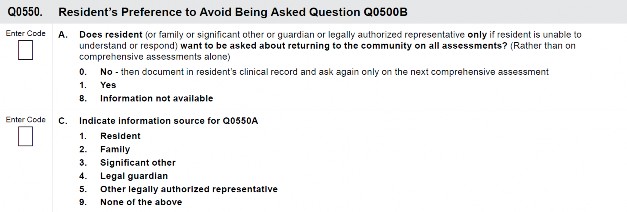
Coding Instructions for Q0550A, Does the resident (or family or significant other or guardian or legally authorized representative only if resident is unable to understand or respond) want to be asked about returning to the community on all assessments? (Rather than on comprehensive assessments alone)
Resident W is an 81-year-old individual who was admitted after a fall that broke their hip, wrist and collar bone. Their recovery is slow and their family visits regularly. Their apartment is awaiting them and they hope within the next 4–6 months to be discharged home. When asked, resident W stated that they would like to be asked about discharging to the community on all assessments.
Coding: Q0550A would be coded 1, Yes.
Q0550C would be coded 1, Resident.
Rationale: Resident W responded yes to item Q0550A, indicating they want to be asked about returning to the community on all assessments.
Q0610: Referral

Returning home or transitioning to a non-institutional setting can be very important to the resident’s health and quality of life.
Some NH residents may be able to return to the community if they are provided assistance and referral to appropriate community resources to facilitate care in a non- institutional setting.
Code 0, No: if a referral has not been made.
Code 1, Yes: if a referral has been made. If a referral has been made skip to V0100. Items From the Most Recent Prior OBRA or Scheduled PPS Assessment.
Q0610: Referral (cont.)
State Medicaid Agencies (SMAs) are required to have designated LCA and a State point of contact (POC). The SMA is responsible for coordinating implementation of Section Q and designating LCAs for their State’s SNFs and NHs. These LCAs may be single entry point agencies, Aging and Disability Resource Centers, Money Follows the Person programs, Area Agencies on Aging, Centers for Independent Living, or other entities the State may designate. LCAs have a Data Use Agreement (DUA) with the SMA to allow them access to MDS data. It is important that each facility know who their LCA and POC are and how to contact them.
Resource availability and eligibility varies across States and local communities and may present barriers to allowing some residents to return to their community. The NH and LCA staff members should guard against raising the expectations of residents and their family members of what can occur until more information is obtained.
Close collaboration between the NH and the LCA is needed to evaluate the resident’s medical needs, finances and available community transition resources.
The LCA can provide information to the SNF/NH on the available community living situations, and options for community based supports and services including the level and scope of what is possible.
The LCA team will explore community care options/supports and conduct appropriate care planning to determine if transition back to the community is possible.
Resident support and interventions by the NH staff may be necessary if the LCA transition is not successful because of unanticipated changes to the resident’s medical condition, problems with securing appropriate caregiving supports, community resource gaps, etc., preventing discharge to the community.
Q0610: Referral (cont.)
Resident S is a 48-year-old individual who suffered a stroke, resulting in paralysis below the waist. They are responsible for their 8-year-old child, who now stays with their grandparent. At the last Quarterly assessment, Resident S had been asked about returning to the community and their response was “Yes” to item Q0500B and they report no contact from the LCA. Resident S is more hopeful they can return home as they become stronger in rehabilitation. They want a location to be able to remain active in their child’s school and use accessible public transportation when they find employment. They are worried whether they can afford or find accessible housing with wheelchair accessible sinks, cabinets, countertops, appliances, doorways, etc. The social worker documented the resident’s responses and made a referral to the LCA.
Coding: Q0500B would be coded 1, Yes; Q0610A would be coded 1, Yes.
Rationale: The social worker or discharge planner would make a referral to the designated LCA for their area and Q0610A would be coded as 1, Yes, because a referral to the designated LCA was made.
Resident V is an 82-year-old individual with right sided paralysis, mild dementia, and diabetes who was admitted by the family because of safety concerns due to falls and difficulties cooking and proper nutrition. Resident V said no to Q0500B, but that they may wish this information at a later date, expressing their feeling that they are not yet ready to plan for community transition. They need to continue their rehabilitation therapy and regain their strength and ability to transfer. The social worker plans to talk to the resident and their family during future Quarterly assessments to determine whether a referral to the LCA is needed for Resident V to return to the community.
Coding: Q0610A would be coded 0, No.
Rationale: Resident V indicated that they wanted to have an opportunity to talk to someone about return to community, but that they were not yet ready. The NH staff will focus on their therapies and talk to them and their family to obtain more information for discharge planning in future months. Q0610A would be coded as 0, No. The Care Area Assessment #20 is triggered and it will be used to guide the follow-up process. Because a referral was not made at this time, care planning and progress notes should indicate the status of discharge planning and why a referral was not initiated to the designated LCA.
Q0620: Reason Referral to Local Contact Agency (LCA) Not Made
Complete only if Q0610 = 0.
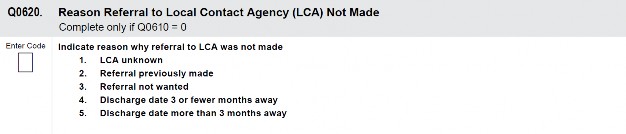
Understanding the reason that referrals to the LCA were not made can help the care team support the resident to receive care that supports them to achieve their highest practicable level of functioning in the least restrictive setting.
Understanding the reason that referrals to the LCA were not made allows for comprehensive care planning by the facility team in conjunction with the resident and their family.
If Q0610: Referral = 0, No, indicate the primary reason that the referral has not been made to the LCA.
Coding Instructions for Q0620, Reason Referral to Local Contact Agency (LCA) Not Made
Code 1, LCA unknown
Code 2, Referral previously made: if a referral has previously been made to the LCA, which is currently working with the resident and facility staff on an active discharge plan to return to the community.
Code 3, Referral not wanted: if the resident (or family, significant other, legal guardian, or other legally authorized representative only if resident doesn’t understand or is unable to respond) responded they do not want a referral (Q0500B = 0).
Q0620: Reason Referral to Local Contact Agency (LCA) Not Made (cont.)
Code 4, Discharge date 3 or fewer months away: if the resident has an expected discharge date of three (3) months or fewer, has an active discharge plan in progress, and the discharge plan could not be improved upon with a referral to the LCA.
Code 5, Discharge date more than 3 months away: if the resident has an expected discharge date of more than three (3) months and discharge plan is actively in progress.
Resident S has been in the nursing home for several months following an automobile accident. They plan to return home after their therapy regime ends, which is expected in three to four weeks. In conjunction with Resident S’s Admission assessment, the facility team made a referral to the LCA but the agency is not currently working with the resident. The interdisciplinary team and the resident have developed a safe discharge plan for Resident S that could not be improved upon with a referral to the LCA.
Coding: Q0620 would be coded 4, Discharge date 3 or fewer months away. Rationale: Resident S’s discharge is expected within three to four weeks, and their discharge plan could not be improved upon with a referral to the LCA.
Resident J is unable to communicate verbally due to severe dementia. Their spouse met with the care team, and the spouse and care team agree that long-term nursing home placement on the secure dementia unit is appropriate for Resident J. The spouse declined a referral to the LCA.
Coding: Q0620 would be coded 3, Referral not wanted.
Rationale: Resident J is unable to communicate verbally due to severe dementia. Their spouse declined a referral to the LCA as they and the care team agree that long-term placement on the secure dementia unit is appropriate for Resident J.