Intent: The intent of the items in this section is to document a number of health conditions that impact the resident’s functional status and quality of life. The items include an assessment of pain which uses an interview with the resident or staff if the resident is unable to participate. The pain items assess the management of pain, the presence of pain, pain frequency, effect of pain on sleep, and pain interference with therapy and day-to-day activities. Other items in the section assess dyspnea, tobacco use, prognosis, problem conditions, falls, prior surgery, and surgery requiring active SNF care.
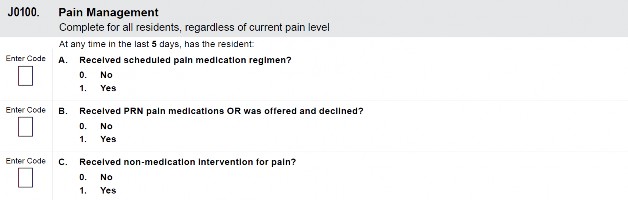
J0100: Pain Management
Item Rationale
DEFINITION
PAIN MEDICATION REGIMEN
Pharmacological agent(s) prescribed to relieve or prevent the recurrence of pain. Include all medications used for pain management by any route and any frequency during the look- back period. Include oral, transcutaneous, subcutaneous, intramuscular, rectal, intravenous injections or intraspinal delivery. This item does not include medications that primarily target treatment of the underlying condition, such as chemotherapy or steroids, although such treatments may lead to pain reduction.
DEFINITION
PAIN MEDICATION REGIMEN
Pharmacological agent(s) prescribed to relieve or prevent the recurrence of pain. Include all medications used for pain management by any route and any frequency during the look- back period. Include oral, transcutaneous, subcutaneous, intramuscular, rectal, intravenous injections or intraspinal delivery. This item does not include medications that primarily target treatment of the underlying condition, such as chemotherapy or steroids, although such treatments may lead to pain reduction.
Health-related Quality of Life


Pain can cause suffering and is associated with inactivity, social withdrawal, depression, and functional decline.
Pain can interfere with participation in rehabilitation.
Effective pain management interventions can help to avoid these adverse outcomes.
Planning for Care
Goals for pain management for most residents should be to achieve a consistent level of comfort while maintaining as much function as possible.
Identification of pain management interventions facilitates review of the effectiveness of pain management and revision of the plan if goals are not met.
Residents may have more than one source of pain and will need a comprehensive, individualized management regimen.
J0100: Pain Management (cont.)
DEFINITIONS
SCHEDULED PAIN MEDICATION REGIMEN
Pain medication order that defines dose and specific time interval for pain medication administration. For example, “once a day,” “every 12 hours.”
PRN PAIN MEDICATIONS
Pain medication order that specifies dose and indicates that pain medication may be given on an as needed basis, including a time interval, such as “every 4 hours as needed for pain” or “every 6 hours as needed for pain.”
NON-MEDICATION PAIN INTERVENTION
Scheduled and implemented nonpharmacological interventions include, but are not limited to, biofeedback, application of heat/cold, massage, physical therapy, nerve block, stretching and strengthening exercises, chiropractic, electrical stimulation, radiotherapy, ultrasound and acupuncture. Herbal or alternative medicine products are not included in this category.
DEFINITIONS
SCHEDULED PAIN MEDICATION REGIMEN
Pain medication order that defines dose and specific time interval for pain medication administration. For example, “once a day,” “every 12 hours.”
PRN PAIN MEDICATIONS
Pain medication order that specifies dose and indicates that pain medication may be given on an as needed basis, including a time interval, such as “every 4 hours as needed for pain” or “every 6 hours as needed for pain.”
NON-MEDICATION PAIN INTERVENTION
Scheduled and implemented nonpharmacological interventions include, but are not limited to, biofeedback, application of heat/cold, massage, physical therapy, nerve block, stretching and strengthening exercises, chiropractic, electrical stimulation, radiotherapy, ultrasound and acupuncture. Herbal or alternative medicine products are not included in this category.
Most residents with moderate to severe pain will require regularly dosed pain medication, and some will require additional PRN (as-needed) pain medications for breakthrough pain.
Some residents with intermittent or mild pain may have orders for PRN dosing only.
Non-medication pain (non-pharmacologic) interventions for pain can be important adjuncts to pain treatment regimens.
Interventions must be included as part of a care plan that aims to prevent or relieve pain and includes monitoring for effectiveness and revision of care plan if stated goals are not met. There must be documentation that the intervention was received and its effectiveness was assessed. It does not have to have been successful to be counted.
Steps for Assessment
Review medical record to determine if a pain regimen exists.
Review the medical record and interview staff and direct caregivers to determine what, if any, pain management interventions the resident received any time during the last 5 days. Include information from all disciplines.
Coding Instructions for J0100A-C
Determine all interventions for pain provided to the resident any time in the last 5 days. Answer these items even if the resident currently denies pain.
Determine all interventions for pain provided to the resident any time in the last 5 days. Answer these items even if the resident currently denies pain.
Coding Instructions for J0100A, Been on a Scheduled Pain Medication Regimen
Code 0, no: if the medical record does not contain documentation that a scheduled pain medication was received.
Code 1, yes: if the medical record contains documentation that a scheduled pain medication was received.
Coding Instructions for J0100B, Received PRN Pain Medication
Code 0, no: if the medical record does not contain documentation that a PRN medication was received or offered.
Code 1, yes: if the medical record contains documentation that a PRN medication was either received OR was offered but declined.
J0100: Pain Management (cont.)
Coding Instructions for J0100C, Received Non-medication Intervention for Pain
Code 0, no: if the medical record does not contain documentation that a non- medication pain intervention was received.
Code 1, yes: if the medical record contains documentation that a non-medication pain intervention was scheduled as part of the care plan and it is documented that the intervention was actually received and assessed for efficacy.
Coding Tips
Code only pain medication regimens without PRN pain medications in J0100A. Code receipt of PRN pain medications in J0100B.
For J0100B code only residents with PRN pain medication regimens here. If the resident has a scheduled pain medication J0100A should be coded.
Examples
The resident’s medical record documents that they received the following pain management in the last 5 days:
Hydrocodone/acetaminophen 5/500 1 tab PO every 6 hours. Discontinued on day 1 of the look-back period.
Acetaminophen 500mg PO every 4 hours. Started on day 2 of the look-back period.
Cold pack to left shoulder applied by PT BID. PT notes that resident reports significant pain improvement after cold pack applied.
Coding: J0100A would be coded 1, yes.
Rationale: Medical record indicated that resident received a scheduled pain medication in the last 5 days.
Coding: J0100B would be coded 0, no.
Rationale: No documentation was found in the medical record that resident received or was offered and declined any PRN medications in the last 5 days. Coding: J0100C would be coded 1, yes.
Rationale: The medical record indicates that the resident received scheduled non- medication pain intervention (cold pack to the left shoulder) in the last 5 days.
J0100: Pain Management (cont.)
The resident’s medical record includes the following pain management documentation:
Morphine sulfate controlled-release 15 mg PO Q 12 hours: Resident refused every dose of medication in the last 5 days. No other pain management interventions were documented.
Coding: J0100A would be coded 0, no.
Rationale: The medical record documented that the resident did not receive scheduled pain medication in the last 5 days. Residents may refuse scheduled medications; however, medications are not considered “received” if the resident refuses the dose.
Coding: J0100B would be coded 0, no.
Rationale: The medical record contained no documentation that the resident received or was offered and declined any PRN medications in the last 5 days. Coding: J0100C would be coded 0, no.
Rationale: The medical record contains no documentation that the resident received non-medication pain intervention in the last 5 days.
J0200: Should Pain Assessment Interview Be Conducted?

Item Rationale
Health-related Quality of Life
Most residents who are capable of communicating can answer questions about how they feel.
Obtaining information about pain directly from the resident, sometimes called “hearing the resident’s voice,” is more reliable and accurate than observation alone for identifying pain.
Planning for Care
Interview allows the resident’s voice to be reflected in the care plan.
Information about pain that comes directly from the resident provides symptom-specific information for individualized care planning.
J0200: Should Pain Assessment Interview Be Conducted? (cont.)
Steps for Assessment
Interact with the resident using their preferred language. Be sure they can hear you and/or have access to their preferred method for communication. If the resident appears unable to communicate, offer alternatives such as writing, pointing, sign language, or cue cards.
Determine whether or not the resident is rarely/never understood verbally, in writing, or using another method. If the resident is rarely/never understood, skip to item J0800, Indicators of Pain or Possible Pain.
Review Language item (A1110) to determine whether or not the resident needs or wants an interpreter.
If the resident needs or wants an interpreter, complete the interview with an interpreter.
Coding Instructions
Attempt to complete the interview with all residents.
Code 0, no: if the resident is rarely/never understood or an interpreter is required but not available. Skip to Indicators of Pain or Possible Pain item (J0800).
Code 1, yes: if the resident is at least sometimes understood and an interpreter is present or not required. Continue to Pain Presence.
Coding Tips and Special Populations
Attempt to conduct the interview with ALL residents. This interview is conducted during the look-back period of the Assessment Reference Date (ARD) and is not contingent upon item B0700, Makes Self Understood.
If the resident interview should have been conducted, but was not done within the look- back period of the ARD (except when an interpreter is needed/requested and unavailable), item J0200 must be coded 1, Yes, and the standard “no information” code (a dash “—”) entered in the Pain Assessment Interview items (J0300–J0600). Item J0700, Should the Staff Assessment for Pain be Conducted?, is coded 0, No.
Do not complete the Staff Assessment for Pain items (J0800–J0850) if the Pain Assessment Interview should have been conducted but was not done.
If it is not possible for an interpreter to be present during the look-back period, code J0200 = 0 to indicate the Pain Assessment Interview was not attempted, skip the Pain Assessment Interview items (J0300–J0600), and complete the Staff Assessment of Pain item (J0800).

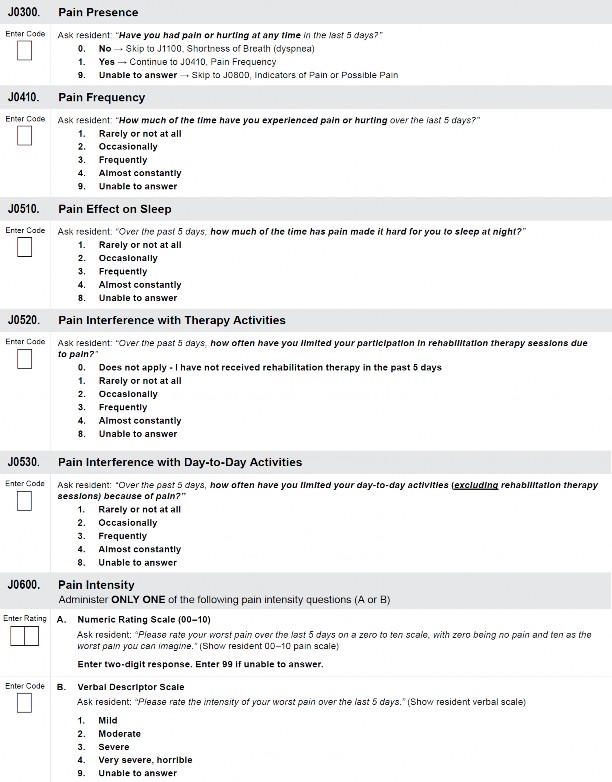
J0300–J0600: Pain Assessment Interview
Health-related Quality of Life
The effects of unrelieved pain impact the individual in terms of functional decline, complications of immobility, skin breakdown and infections.
Pain significantly adversely affects a person’s quality of life and is tightly linked to depression, diminished self-confidence and self-esteem, as well as an increase in behavior problems, particularly for cognitively impaired residents.
Some older adults limit their activities in order to avoid having pain. Their report of lower pain frequency may reflect their avoidance of activity more than it reflects adequate pain management.
Planning for Care
Directly asking the resident about pain rather than relying on the resident to volunteer the information or relying on clinical observation significantly improves the detection of pain.
Resident self-report is the most reliable means for assessing pain.
Pain assessment provides a basis for evaluation, treatment need, and response to treatment.
Assessing whether pain interferes with sleep or activities provides additional understanding of the functional impact of pain and potential care planning implications.
Assessment of pain provides insight into the need to adjust the timing of pain interventions to better cover sleep or preferred activities.
The assessment of pain is not associated with any particular approach to pain management. Since the use of opioids is associated with serious complications, an array of successful nonpharmacologic and nonopioid approaches to pain management may be considered. There are a range of pain management strategies that can be used, including but not limited to non-opioid analgesic medications, transcutaneous electrical nerve stimulation (TENS) therapy, supportive devices, acupuncture, biofeedback, application of heat/cold, massage, physical therapy, nerve block, stretching and strengthening exercises, chiropractic, electrical stimulation, radiotherapy, and ultrasound.
Pain assessment prompts discussion about factors that aggravate and alleviate pain.
Similar pain stimuli can have varying impact on different individuals.
Consistent use of a standardized pain intensity scale improves the validity and reliability of pain assessment. Using the same scale in different settings may improve continuity of care.
Pain intensity scales allow providers to evaluate whether pain is responding to pain medication regimen(s) and/or nonpharmacological intervention(s).
Steps for Assessment: Basic Interview Instructions for Pain Assessment Interview (J0300-J0600)
Interview any resident not screened out by the Should Pain Assessment Interview be Conducted? item (J0200).
The Pain Assessment Interview for residents consists of seven items: the primary question Pain Presence item (J0300) and six follow-up questions. If the resident is unable to answer the primary question on Pain Presence item J0300, skip to the Staff Assessment for Pain beginning with Indicators of Pain or Possible Pain item (J0800).
Conduct the interview in a private setting.
Be sure the resident can hear you.
Residents with hearing impairment should be tested using their usual communication devices/techniques, as applicable.
Try an external assistive device (headphones or hearing amplifier) if you have any doubt about hearing ability.
Minimize background noise.
Sit so that the resident can see your face. Minimize glare by directing light sources away from the resident’s face.
Give an introduction before starting the interview. Suggested language: “I’d like to ask you some questions about pain. The reason I am asking these questions is to understand how often you have pain, how severe it is, and how pain affects your daily activities. This will help us to develop the best plan of care to help manage your pain.”
DEFINITION
PAIN
Any type of physical pain or discomfort in any part of the body. It may be localized to one area or may be more generalized. It may be acute or chronic, continuous or intermittent, or occur at rest or with movement. Pain is very subjective; pain is whatever the experiencing person says it is and exists whenever they say it does.
DEFINITION
PAIN
Any type of physical pain or discomfort in any part of the body. It may be localized to one area or may be more generalized. It may be acute or chronic, continuous or intermittent, or occur at rest or with movement. Pain is very subjective; pain is whatever the experiencing person says it is and exists whenever they say it does.
Directly ask the resident each item in the Pain Assessment Interview in the order provided.
If the resident chooses not to answer a particular item, accept their refusal, code 9, and move on to the next item.
If the resident is unsure about whether pain or the effects or interference of pain occurred in the last 5 days, prompt the resident to think about the most recent episode of pain and try to determine whether it occurred in the last 5 days.

DEFINITION
NONSENSICAL RESPONSE
Any unrelated, incomprehensible, or incoherent response that is not informative with respect to the item being coded.
DEFINITION
NONSENSICAL RESPONSE
Any unrelated, incomprehensible, or incoherent response that is not informative with respect to the item being coded.
Ask the resident: “Have you had pain or hurting at any time in the last 5 days?”
Coding Instructions for J0300, Pain Presence
Code for the presence or absence of pain regardless of pain management efforts in the last 5 days.
Code for the presence or absence of pain regardless of pain management efforts in the last 5 days.
Code 0, no: if the resident responds “no” to having any pain or hurting in the last 5 days. Code 0, no:
even if the reason for no pain is that the resident received pain management interventions. If coded 0, the pain interview is complete. Skip to Shortness of Breath item (J1100).
Code 1, yes: if the resident responds “yes” to having any pain or hurting in the last 5 days. If coded 1, proceed to the Pain Assessment Interview.
Code 9, unable to answer: if the resident is unable to answer, does not respond, or gives a nonsensical response. If coded 9, skip to the Staff Assessment for Pain.
Coding Tips
Rates of self-reported pain are higher than observed rates. Although some observers have expressed concern that residents may not complain and may deny pain, the regular and objective use of self-report pain scales enhances residents’ willingness to report.
Examples
When asked about pain, Resident S responds, “No. I have been taking the pain medication regularly, so fortunately I have had no pain.”
Coding: J0300 would be coded 0, no.
Rationale: Resident S reports having no pain during the look-back period. Even though they received pain management interventions during the look-back period, the item is coded “No,” because there was no pain.
When asked about pain, Resident T responds, “No pain, but I have had a terrible burning sensation all down my leg.”
Coding: J0300 would be coded 1, yes.
Rationale: Although Resident T’s initial response is “no,” the comments indicate that they have experienced pain (burning sensation) during the look-back period.
When asked about pain, Resident G responds, “I was on a train in 1905.”
Coding: J0300 would be coded 9, unable to respond.
Rationale: Resident G has provided a nonsensical answer to the question. The assessor will complete the Staff Assessment for Pain.
J0410: Pain Frequency 

Steps for Assessment
Ask the resident: “How much of the time have you experienced pain or hurting over the last 5 days?” Staff may present response options on a written sheet or cue card. This can help the resident respond to the items.
If the resident provides a related response but does not use the provided response scale, help clarify the best response by echoing (repeating) the resident’s own comment and providing related response options. This interview approach frequently helps the resident clarify which response option they prefer.
If the resident, despite clarifying statement and repeating response options, continues to have difficulty selecting between two of the provided responses, then select the more frequent of the two.
Coding Instructions
Code for pain frequency over the last 5 days.
Code 1, Rarely or not at all: if the resident responds “rarely” to the question.
Code 2, Occasionally: if the resident responds “occasionally” to the question.
Code 3, Frequently: if the resident responds “frequently” to the question.
Code 4, Almost constantly: if the resident responds “almost constantly” to the question.
Code 9, Unable to answer: if the resident is unable to respond, does not respond, or gives a nonsensical response.
No predetermined definitions are offered to the resident related to frequency of pain.
The response should be based on the resident’s interpretation of the frequency options.
Facility policy should provide standardized tools to use throughout the facility in assessing pain to ensure consistency in interpretation and documentation of the resident’s pain.
Examples
When asked about pain, Resident C responds, “All the time. It has been a terrible week. I have not been able to get comfortable for more than 10 minutes at a time since I started physical therapy four days ago.”
Coding: J0410 would be coded 4, Almost constantly. Rationale: Resident C describes pain that has occurred “all the time.”
When asked about pain, Resident J responds, “I don’t know if it is frequent or occasional. My knee starts throbbing every time they move me from the bed or the wheelchair.”
The interviewer says: “Your knee throbs every time they move you. If you had to choose an answer, would you say that you have pain frequently or occasionally?”
Resident J is still unable to choose between frequently and occasionally.
Coding: J0410 would be coded 3, Frequently.
Rationale: The interviewer appropriately echoed Resident J’s comment and provided related response options to help them clarify which response they preferred. Resident J. remained unable to decide between frequently and occasionally. The interviewer therefore coded for the higher frequency of pain.
When asked about pain, Resident K responds: “I can’t remember. I think I had a headache a few times in the past couple of days, but they gave me acetaminophen and the headaches went away.”
The interviewer clarifies by echoing what Resident K said: “You’ve had a headache a few times in the past couple of days and the headaches went away when you were given acetaminophen. If you had to choose from the answers, would you say you had pain occasionally or rarely?”
Resident K replies “Occasionally.”
Coding: J0410 would be coded 2, Occasionally.
Rationale: After the interviewer clarified the resident’s choice using echoing, the resident selected a response option.
When asked about pain, Resident M responds, “I would say rarely. Since I started using the patch, I don’t have much pain at all, but four days ago the pain came back. I think they were a bit overdue in putting on the new patch, so I had some pain for a little while that day.”
Coding: J0410 would be coded 1, Rarely or not at all.
Rationale: Resident M selected the “Rarely or not at all” response option.
J0510: Pain Effect on Sleep 

Steps for Assessment
Read the question and response choices exactly as they are written.
No predetermined definitions are offered to the resident. The resident’s response should be based on their interpretation of frequency response options.
If the resident’s response does not lead to a clear answer, repeat the resident’s response and then try to narrow the focus of the response. For example, if the resident responded to the question, “Over the past 5 days, how much of the time has pain made it hard for you to sleep at night?” by saying, “I always have trouble sleeping,” then the assessor
might reply, “You always have trouble sleeping. Is it your pain that makes it hard for you to sleep?” The assessor can then narrow down responses with additional follow-up questions about the frequency.
Coding Instructions
Code for pain effect on sleep over the last 5 days.
Code 1, Rarely or not at all: if the resident responds that pain has rarely or not at all made it hard to sleep over the past 5 days.
Code 2, Occasionally: if the resident responds that pain has occasionally made it hard to sleep over the past 5 days.
Code 3, Frequently: if the resident responds that pain has frequently made it hard to sleep over the past 5 days.
Code 4, Almost constantly: if the resident responds that pain has almost constantly made it hard to sleep over the past 5 days.
Code 8, Unable to answer: if the resident is unable to answer the question, does not respond or gives a nonsensical response.
This item should be coded based on the resident’s interpretation of the provided response options for frequency. If the resident is unable to decide between two options, then the assessor should code for the option with the higher frequency.
If the resident reports they had pain over the past 5 days and the pain does not interfere with their sleep (e.g., because the resident is using pain management strategies successfully), code 1, Rarely or not at all.
Examples
When asked, “Over the past 5 days, how much of the time has pain made it hard for you to sleep at night?” the resident replied, “I’ve had a little back pain from being in the wheelchair all day, but it felt so much better when I went to bed. The pain hasn’t kept me from sleeping at all.”
Coding: J0510 would be coded 1, Rarely or not at all.
Rationale: The resident reports pain has been present over the past 5 days but that they have had no sleep problems related to pain.
When asked, “Over the past 5 days, how much of the time has pain made it hard for you to sleep at night?” the resident responded, “All the time. It’s been hard for me to sleep all the time. I have to ask for extra pain medicine, and I still wake up several times during the night because my back hurts so much.”
Coding: J0510 would be coded 4, Almost constantly.
Rationale: The resident reports pain-related sleep problems “all the time” over the past 5 days, so the most applicable response is “Almost constantly.”
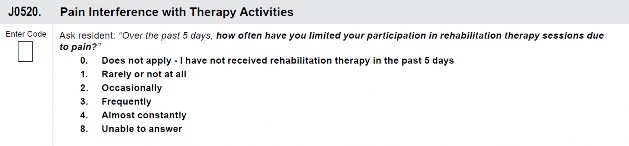
Read the question and response choices as written.
Coding Instructions
Code for pain interference with therapy activities over the last 5 days.


DEFINITION
REHABILITATION THERAPY
Special healthcare services or programs that help a person regain physical, mental, and/or cognitive (thinking and learning) abilities that have been lost or impaired as a result of disease, injury, or treatment. Can include, for example, physical therapy, occupational therapy, speech therapy, and cardiac and pulmonary therapies.
DEFINITION
REHABILITATION THERAPY
Special healthcare services or programs that help a person regain physical, mental, and/or cognitive (thinking and learning) abilities that have been lost or impaired as a result of disease, injury, or treatment. Can include, for example, physical therapy, occupational therapy, speech therapy, and cardiac and pulmonary therapies.
Code 0, Does not apply: if the resident responds that they did not participate in rehabilitation therapy for reasons unrelated to pain (e.g., therapy not needed, unable to schedule) over the past 5 days.
Code 1, Rarely or not at all: if the resident responds that pain has rarely or not at all limited their participation in rehabilitation therapy sessions over the past 5 days.
Code 2, Occasionally: if the resident responds that pain has occasionally limited their participation in rehabilitation therapy sessions over the past 5 days.
Code 3, Frequently: if the resident responds that pain has frequently limited their participation in rehabilitation therapy sessions over the past 5 days.
Code 4, Almost constantly: if the resident responds that pain has almost constantly limited their
participation in rehabilitation therapy sessions over the past 5 days.
Code 8, Unable to answer: if the resident is unable to answer the question, does not respond, or gives a nonsensical response.
Coding Tips
This item should be coded based on the resident’s interpretation of the provided response options for frequency. If the resident is unable to decide between two options, then the assessor should code for the option with the higher frequency.
Rehabilitation therapies may include treatment supervised in person by a therapist or nurse or other staff or the resident carrying out a prescribed therapy program without staff members present.
Rehabilitation therapies do not include restorative nursing programs.
Example
1. When asked, “Over the past 5 days, how often have you limited your participation in rehabilitation therapy sessions due to pain?” the resident responded, “Since the surgery a week ago, the pain has made it hard to even get out of bed. I try to push myself, but the pain frequently limits how much I can do with my therapist.”
Coding: J0520 would be coded 3, Frequently.
Rationale: The resident reports that pain frequently limited participation in therapies over the past 5 days.
J0530: Pain Interference with Day-to-Day Activities 

Steps for Assessment
Read the question and response choices as written.
Coding Instructions
Code for pain interference with day-to-day activities over the last 5 days.
Code 1, Rarely or not at all: if the resident responds that pain has rarely or not at all limited their day-to-day activities (excluding rehabilitation therapy sessions) over the past 5 days.
Code 2, Occasionally: if the resident responds that pain has occasionally limited their day-to-day activities (excluding rehabilitation therapy sessions) over the past 5 days.
Code 3, Frequently: if the resident responds that pain has frequently limited their day-to-day activities (excluding rehabilitation therapy sessions) over the past 5 days.
Code 4, Almost constantly: if the resident responds that pain has almost constantly limited their day-to-day activities (excluding rehabilitation therapy sessions) over the past 5 days.
Coding Tips
Examples
When asked, “Over the past 5 days, how often have you limited your day-to-day activities (excluding rehabilitation therapy sessions) because of pain?” the resident responded, “Although I have some pain in my back, I’m still able to read, eat my meals, and take walks like I usually do.”
Coding: J0530 would be coded 1, Rarely or not at all.
Rationale: The resident reports that pain has not limited their participation in day-to- day activities over the past 5 days.
When asked, “Over the past 5 days, how often have you limited your day-to-day activities (excluding rehabilitation therapy sessions) because of pain?” the resident responded, “The pain has made it hard to do pretty much anything. Even getting out of bed to brush my teeth has been hard. I haven’t been able to talk to my family because the pain is so bad. It’s just constant. I’d say it constantly limits what I do.”
Coding: J0530 would be coded 4, Almost constantly.
Rationale: The resident reports that pain has constantly limited their participation in other activities over the past 5 days.
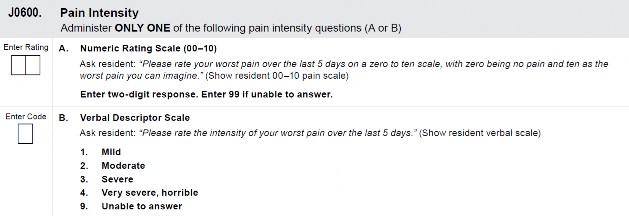
J0600: Pain Intensity 
Steps for Assessment
You may use either the Numeric Rating Scale item (J0600A) or the Verbal Descriptor Scale item (J0600B) to interview the resident about pain intensity.
If the resident is unable to answer using one scale, the other scale should be attempted.
Record either the Numeric Rating Scale item or the Verbal Descriptor Scale item. Leave the response for the unused scale blank.
Read the question and item choices slowly. While reading, you may show the resident the response options (the Numeric Rating Scale or Verbal Descriptor Scale) clearly printed on a piece of paper, such as a cue card. Use large, clear print.
For the Numeric Rating Scale, say, “Please rate your worst pain over the last 5 days with zero being no pain, and ten as the worst pain you can imagine.”
For Verbal Descriptor Scale, say, “Please rate the intensity of your worst pain over the last 5 days.”
The resident may provide a verbal response, point to the written response, or both.
Coding Instructions for J0600A. Numeric Rating Scale (00-10)
Enter the two digit number (00-10) indicated by the resident as corresponding to the intensity of
their worst pain over the last 5 days, where zero is no pain, and 10 is the worst pain imaginable.
Enter 99 if unable to answer.
If the Numeric Rating Scale is not used, leave the response box blank.
Coding Instructions for J0600B. Verbal Descriptor Scale
Code 1, mild: if resident indicates that their pain is “mild.”
Code 2, moderate: if resident indicates that their pain is “moderate.”
Code 3, severe: if resident indicates that their pain is “severe.”
Code 4, very severe, horrible: if resident indicates that their pain is “very severe or horrible.”
J0600: Pain Intensity (cont.) 
Code 9, unable to answer: if resident is unable to answer, chooses not to respond, does not respond or gives a nonsensical response.
If the Verbal Descriptor Scale is not used, leave the response box blank.
Examples for J0600A. Numeric Rating Scale (00-10)
The nurse asks Resident T to rate their pain on a scale of 0 to 10. Resident T states that they are not sure, because they have shoulder pain and knee pain, and sometimes it is really bad, and sometimes it is OK. The nurse reminds Resident T to think about all the pain they had over the last 5 days and select the number that describes their worst pain. They report that their pain is a “6.”
Coding: J0600A would be coded 06.
Rationale: The resident said their pain was 6 on the 0 to 10 scale. Because a 2-digit number is required, it is entered as 06.
The nurse asks Resident S to rate their pain, reviews use of the scale, and provides the 0 to 10 visual aid. Resident S says, “My pain doesn’t have any numbers.” The nurse explains that the numbers help the staff understand how severe their pain is and repeats that the “0” end is no pain and the “10” end is the worst pain imaginable. Resident S replies, “I don’t know where it would fall.”
Coding: Item J0600A would be coded 99, unable to answer. The interviewer would go on to ask about pain intensity using the Verbal Descriptor Scale item (J0600B).
Rationale: The resident was unable to select a number or point to a location on the 0-10 scale that represented their level of pain intensity.
Examples for J0600B. Verbal Descriptor Scale
The nurse asks Resident R to rate their pain using the verbal descriptor scale. They look at the response options presented using a cue card and say their pain is “severe” sometimes, but most of the time it is “mild.”
Coding: J0600B would be coded 3, severe. Rationale: The resident said their worst pain was “Severe.”
The nurse asks Resident U to rate their pain, reviews use of the verbal descriptor scale, and provides a cue card as a visual aid. Resident U says, “I’m not sure whether it’s mild or moderate.” The nurse reminds Resident U to think about their worst pain over the last 5 days. Resident U says, “At its worst, it was moderate.”
Coding: Item J0600B would be coded 2, moderate.
Rationale: The resident indicated that their worst pain was “Moderate.”
J0700: Should the Staff Assessment for Pain be Conducted?

Item Rationale
Item J0700 closes the pain interview and determines if the resident interview was complete or incomplete and based on this determination, whether a staff assessment should be completed.
DEFINITION
COMPLETED PAIN ASSESSMENT INTERVIEW
The Pain Assessment Interview is successfully completed if the resident reported no pain (J0300 =
No), or if the resident reported pain (J0300 =
Yes) and the follow-up question J0410 is answered.
DEFINITION
COMPLETED PAIN ASSESSMENT INTERVIEW
The Pain Assessment Interview is successfully completed if the resident reported no pain (J0300 =
No), or if the resident reported pain (J0300 =
Yes) and the follow-up question J0410 is answered.
Health-related Quality of Life
Resident interview for pain is preferred because it improves the detection of pain. However, a small percentage of residents are unable or unwilling to complete the pain interview.
Persons unable to complete the pain interview may still have pain.
Planning for Care
Resident self-report is the most reliable means of assessing pain. However, when a resident is unable to provide the information, staff assessment is necessary.
Even though the resident was unable to complete the interview, important insights may be gained from the responses that were obtained, observing behaviors and observing the resident’s affect during the interview.
Steps for Assessment
The Staff Assessment for Pain should only be completed if the Pain Assessment Interview
(J0300–J0600) was not completed.
Coding Instructions for J0700. Should the Staff Assessment for Pain be Conducted?
Code 0, no: if the resident completed the Pain Assessment Interview item (J0410 = 1, 2, 3, or 4). Skip to Shortness of Breath (dyspnea) item (J1100).
Code 1, yes: if the resident was unable to complete the Pain Assessment Interview
(J0410 = 9). Continue to Indicators of Pain or Possible Pain item (J0800).
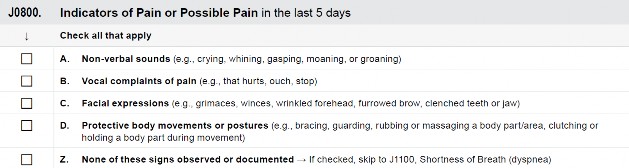
J0800: Indicators of Pain
Item Rationale
Health-related Quality of Life
Residents who cannot verbally communicate about their pain are at particularly high risk for under-detection and undertreatment of pain.
Severe cognitive impairment may affect the ability of residents to verbally communicate, thus limiting the availability of self-reported information about pain. In this population, fewer complaints may not mean less pain.
Individuals who are unable to verbally communicate may be more likely to use alternative methods of expression to communicate their pain.
Even in this population some verbal complaints of pain may be made and should be taken seriously.
Planning for Care
Consistent approach to observation improves the accuracy of pain assessment for residents who are unable to verbally communicate their pain.
Particular attention should be paid to using the indicators of pain during activities when pain is most likely to be demonstrated (e.g., bathing, transferring, dressing, walking and potentially during eating).
Staff must carefully monitor, track, and document any possible signs and symptoms of pain.
Identification of these pain indicators can:
provide a basis for more comprehensive pain assessment,
provide a basis for determining appropriate treatment, and
provide a basis for ongoing monitoring of pain presence and treatment response.
If pain indicators are present, assessment should identify aggravating/alleviating factors related to pain.
J0800: Indicators of Pain (cont.)
DEFINITIONS
NON VERBAL SOUNDS
e.g., crying, whining, gasping, moaning, groaning or other audible indications associated with pain.
VOCAL COMPLAINTS OF PAIN
e.g., “That hurts,” “ouch,” “stop,” etc.
FACIAL EXPRESSIONS THAT MAY BE INDICATORS OF PAIN
e.g., grimaces, winces, wrinkled forehead, furrowed brow, clenched teeth or jaw, etc.
PROTECTIVE BODY MOVEMENTS OR POSTURES
e.g., bracing, guarding, rubbing or massaging a body part/area, clutching or holding a body part during movement, etc.
DEFINITIONS
NON VERBAL SOUNDS
e.g., crying, whining, gasping, moaning, groaning or other audible indications associated with pain.
VOCAL COMPLAINTS OF PAIN
e.g., “That hurts,” “ouch,” “stop,” etc.
FACIAL EXPRESSIONS THAT MAY BE INDICATORS OF PAIN
e.g., grimaces, winces, wrinkled forehead, furrowed brow, clenched teeth or jaw, etc.
PROTECTIVE BODY MOVEMENTS OR POSTURES
e.g., bracing, guarding, rubbing or massaging a body part/area, clutching or holding a body part during movement, etc.
Steps for Assessment
Review the medical record for documentation of each indicator of pain listed in J0800 that occurred in the last 5 days. If the record documents the presence of any of the signs and symptoms listed, confirm your record review with the direct care staff on all shifts who work most closely with the resident during activities of daily living (ADL).
Interview staff because the medical record may fail to note all observable pain behaviors. For any indicators that were not noted as present in medical record review, interview direct care staff on all shifts who work with the resident during ADL. Ask directly about the presence of each indicator that was not noted as being present in the record.
Observe resident during care activities. If you observe additional indicators of pain in the last 5 days code the corresponding items.
Observations for pain indicators may be more sensitive if the resident is observed during ADL, or wound care.
Coding Instructions
Check all that apply in the last 5 days based on staff observation of pain indicators.
Check all that apply in the last 5 days based on staff observation of pain indicators.
If the medical record review and the interview with direct care providers and observation on all shifts
provide no evidence of pain indicators, Check J0800Z, None of these signs observed or documented, and proceed to the Shortness of Breath item (J1100).
Check J0800A, nonverbal sounds: included but not limited to if crying, whining, gasping, moaning, or groaning were observed or reported in the last 5 days.
Check J0800B, vocal complaints of pain: included but not limited to if the resident was observed to or reported to have made vocal complaints of pain (e.g. “that hurts,” “ouch,” or “stop”) in the last 5 days.
Check J0800C, facial expressions: included but not limited to if grimaces, winces, wrinkled forehead, furrowed brow, clenched teeth or jaw were observed or reported in the last 5 days.
Check J0800D, protective body movements or postures: included but not limited to if bracing, guarding, rubbing or massaging a body part/area, or clutching or holding a body part during movement were observed or reported in the last 5 days.
J0800: Indicators of Pain (cont.)
Check J0800Z, none of these signs observed or documented: if none of these signs were observed or reported in the last 5 days.
Coding Tips
Behavior change, depressed mood, rejection of care and decreased activity participation may be related to pain. These behaviors and symptoms are identified in other sections and not reported here as pain screening items. However, the contribution of pain should be considered when following up on those symptoms and behaviors.
Examples
Resident P has advanced dementia and is unable to verbally communicate. A note in their medical record documents that they have been awake during the last night crying and rubbing their elbow. When you go to their room to interview the certified nurse aide (CNA) caring for them, you observe Resident P grimacing and clenching their teeth. The CNA reports that they have been moaning and said “ouch” when the CNA tried to move their arm.
Coding: Nonverbal Sounds item (J0800A); Vocal Complaints of Pain item (J0800B); Facial Expressions item (J0800C); and Protective Body Movements or Postures item (J0800D), would be checked.
Rationale: Resident P has demonstrated vocal complaints of pain (ouch), nonverbal sounds (crying and moaning), facial expression of pain (grimacing and clenched teeth), and protective body movements (rubbing their elbow).
Resident M has end-stage Parkinson’s disease and is unable to verbally communicate. There is no documentation of pain in their medical record in the last 5 days. The CNAs caring for them report that on some mornings they moan and wince when their arms and legs are moved during morning care. During direct observation, you note that Resident M cries and attempts to pull their hand away when the CNA tries to open the contracted hand to wash it.
Coding: Nonverbal Sounds items (J0800A); Facial Expressions item (J0800C); and
Protective Body Movements or Postures item (J0800D), would be checked. Rationale: Resident M has demonstrated nonverbal sounds (crying, moaning); facial expression of pain (wince), and protective body movements (attempt to withdraw).
Resident E has been unable to verbally communicate following a massive cerebrovascular accident (CVA) several months ago and has a Stage 3 pressure ulcer. There is no documentation of pain in their medical record. The CNA who cares for them reports that they do not seem to have any pain. You observe the resident during their pressure ulcer dressing change. During the treatment, you observe groaning, facial grimaces, and a wrinkled forehead.
Coding: Nonverbal Sounds item (J0800A), and Facial Expressions item (J0800C), would be checked.
Rationale: The resident has demonstrated nonverbal sounds (groaning) and facial expression of pain (wrinkled forehead and grimacing).
J0800: Indicators of Pain (cont.)
Resident S is in a persistent vegetative state following a traumatic brain injury. They are unable to verbally communicate. There is no documentation of pain in their medical record in the last 5 days. The CNA reports that they appear comfortable whenever the CNA cares for them. You observe the CNA providing morning care and transferring them from bed to chair. No pain indicators are observed at any time.
Coding: None of These Signs Observed or Documented item (J0800Z), would be
checked.
Rationale: All steps for the assessment have been followed and no pain indicators have been documented, reported or directly observed.
J0850: Frequency of Indicator of Pain or Possible Pain

Item Rationale
Health-related Quality of Life
Unrelieved pain adversely affects function and mobility contributing to dependence, skin breakdown, contractures, and weight loss.
Pain significantly adversely affects a person’s quality of life and is tightly linked to depression, diminished self-confidence and self-esteem, as well as to an increase in behavior problems, particularly for cognitively impaired residents.
Planning for Care
Assessment of pain frequency provides:
Steps for Assessment
Review medical record and interview staff and direct caregivers to determine the number of days the resident either complained of pain or showed evidence of pain as described in J0800 in the last 5 days.
J0850: Frequency of Indicator of Pain or Possible Pain (cont.)
Coding Instructions
Code for pain frequency in the last 5 days.
Code 1: if based on staff observation, the resident complained or showed evidence of pain 1 to 2 days.
Code 2: if based on staff observation, the resident complained or showed evidence of pain 3 to 4 days.
Code 3: if based on staff observation, the resident complained or showed evidence of pain on a daily basis.
Examples
Resident M is an 80-year-old individual with advanced dementia. During the last 5 days, Resident M was noted to be grimacing and verbalizing “ouch” over the past 2 days when their right shoulder was moved.
Coding: Item J0850 would be coded 1, indicators of pain observed 1 to 2 days.
Rationale: They have demonstrated vocal complaints of pain (“ouch”), facial expression of pain (grimacing) on 2 of the last 5 days.
Resident C is a 78-year-old individual with a history of CVA with expressive aphasia and dementia. In the last 5 days, the resident was noted on a daily basis to be rubbing their right knee and grimacing.
Coding: Item J0850 would be coded 3, indicators of pain observed daily. Rationale: The resident was observed with a facial expression of pain (grimacing) and protective body movements (rubbing their knee) every day in the last 5 days.
J1100: Shortness of Breath (dyspnea)
Item Rationale
Health-related Quality of Life
Shortness of breath can be an extremely distressing symptom to residents and lead to decreased interaction and quality of life.
Some residents compensate for shortness of breath by limiting activity. They sometimes compensate for shortness of breath when lying flat by elevating the head of the bed and do not alert caregivers to the problem.
Planning for Care
Shortness of breath can be an indication of a change in condition requiring further assessment and should be explored.
The care plan should address underlying illnesses that may exacerbate symptoms of shortness of breath as well as symptomatic treatment for shortness of breath when it is not quickly reversible.
Steps for Assessment
Interview the resident about shortness of breath. Many residents, including those with mild to moderate dementia, may be able to provide feedback about their own symptoms.
If the resident is not experiencing shortness of breath or trouble breathing during the interview, ask the resident if shortness of breath occurs when they engage in certain activities.
Review the medical record for staff documentation of the presence of shortness of breath or trouble breathing. Interview staff on all shifts, and family/significant other regarding resident history of shortness of breath, allergies or other environmental triggers of shortness of breath.
Observe the resident for shortness of breath or trouble breathing. Signs of shortness of breath include: increased respiratory rate, pursed lip breathing, a prolonged expiratory phase, audible respirations and gasping for air at rest, interrupted speech pattern (only able to say a few words before taking a breath) and use of shoulder and other accessory muscles to breathe.
If shortness of breath or trouble breathing is observed, note whether it occurs with certain positions or activities.
J1100: Shortness of Breath (dyspnea) (cont.)
Coding Instructions
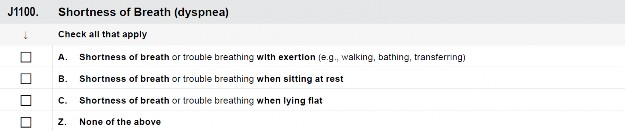
Check all that apply during the 7-day look-back period.
Any evidence of the presence of a symptom of shortness of breath should be captured in this item. A resident may have any combination of these symptoms.
Check all that apply during the 7-day look-back period.
Any evidence of the presence of a symptom of shortness of breath should be captured in this item. A resident may have any combination of these symptoms.
Check J1100A: if shortness of breath or trouble breathing is present when the resident is engaging in activity. Shortness of breath could be present during activity as limited as turning or moving in bed during daily care or with more strenuous activity such as transferring, walking, or bathing. If the resident avoids activity or is unable to engage in activity because of shortness of breath, then code this as present.
Check J1100B: if shortness of breath or trouble breathing is present when the resident is sitting at rest.
Check J1100C: if shortness of breath or trouble breathing is present when the resident attempts to lie flat. Also code this as present if the resident avoids lying flat because of shortness of breath.
Check J1100Z: if the resident reports no shortness of breath or trouble breathing and the medical record and staff interviews indicate that shortness of breath appears to be absent or well controlled with current medication.
Examples
Resident W has diagnoses of chronic obstructive pulmonary disease (COPD) and heart failure. They are on 2 liters of oxygen and daily respiratory treatments. With oxygen they are able to ambulate and participate in most group activities. They report feeling “winded” when going on outings that require walking one or more blocks and have been observed having to stop to rest several times under such circumstances. Recently, they describe feeling “out of breath” when they try to lie down.
Coding: J1100A and J1100C would be checked.
Rationale: Resident W reported being short of breath when lying down as well as during outings that required ambulating longer distances.
Resident T has used an inhaler for years. They are not typically noted to be short of breath. Three days ago, during a respiratory illness, they had mild trouble with their breathing, even when sitting in bed. Their shortness of breath also caused them to limit group activities.
Coding: J1100A and J1100B would be checked.
Rationale: Resident T was short of breath at rest and was noted to avoid activities because of shortness of breath.
J1300: Current Tobacco Use

Item Rationale
Health-related Quality of Life
The negative effects of smoking can shorten life expectancy and create health problems that interfere with daily activities and adversely affect quality of life.
Planning for Care
This item opens the door to negotiation of a plan of care with the resident that includes support for smoking cessation.
If cessation is declined, a care plan that allows safe and environmental accommodation of resident preferences is needed.
DEFINITION
TOBACCO USE
Includes tobacco used in any form.
DEFINITION
TOBACCO USE
Includes tobacco used in any form.
Steps for Assessment
Ask the resident if they used tobacco in any form during the 7-day look-back period.
If the resident states that they used tobacco in some form during the 7-day look-back period, code 1, yes.
If the resident is unable to answer or indicates that they did
not use tobacco of any kind during the look-back period, review the medical record and interview staff for any indication of tobacco use by the resident during the look-back period.
Coding Instructions
Code 0, no: if there are no indications that the resident used any form of tobacco.
Code 1, yes: if the resident or any other source indicates that the resident used tobacco in some form during the look-back period.
J1400: Prognosis

DEFINITION
CONDITION OR CHRONIC DISEASE THAT MAY RESULT IN A LIFE EXPECTANCY OF LESS THAN 6 MONTHS
In the physician’s judgment, the resident has a diagnosis or combination of clinical conditions that have advanced (or will continue to deteriorate) to a point that the average resident with that level of illness would not be expected to survive more than 6 months.
This judgment should be substantiated by a physician note. It can be difficult to pinpoint the exact life expectancy for a single resident. Physician judgment should be based on typical or average life expectancy of residents with similar level of disease burden as this resident.
DEFINITION
CONDITION OR CHRONIC DISEASE THAT MAY RESULT IN A LIFE EXPECTANCY OF LESS THAN 6 MONTHS
In the physician’s judgment, the resident has a diagnosis or combination of clinical conditions that have advanced (or will continue to deteriorate) to a point that the average resident with that level of illness would not be expected to survive more than 6 months.
This judgment should be substantiated by a physician note. It can be difficult to pinpoint the exact life expectancy for a single resident. Physician judgment should be based on typical or average life expectancy of residents with similar level of disease burden as this resident.
Item Rationale
Health-related Quality of Life
Residents with conditions or diseases that may result in a life expectancy of less than 6 months have special needs and may benefit from palliative or hospice services in the nursing home.
Planning for Care
If life expectancy is less than 6 months, interdisciplinary team care planning should be based on the resident’s preferences for goals and interventions of care whenever possible.
Steps for Assessment
Review the medical record for documentation by the physician that the resident’s condition or chronic disease may result in a life expectancy of less than 6 months, or that they have a terminal illness.
If the physician states that the resident’s life expectancy may be less than 6 months, request that they document this in the medical record. Do not code until there is documentation in the medical record.
Review the medical record to determine whether the resident is receiving hospice services.
DEFINITIONS
HOSPICE SERVICES
A program for terminally ill persons where an array of services is provided for the palliation and management of terminal illness and related conditions. The hospice must be licensed by the state as a hospice provider and/or certified under the Medicare program as a hospice provider. Under the hospice program benefit regulations, a physician is required to document in the medical record a life expectancy of less than 6 months, so if a resident is on hospice the expectation is that the documentation is in the medical record.
TERMINALLY ILL
“Terminally ill” means that the individual has a medical prognosis that their life expectancy is 6 months or less if the illness runs its normal course.
DEFINITIONS
HOSPICE SERVICES
A program for terminally ill persons where an array of services is provided for the palliation and management of terminal illness and related conditions. The hospice must be licensed by the state as a hospice provider and/or certified under the Medicare program as a hospice provider. Under the hospice program benefit regulations, a physician is required to document in the medical record a life expectancy of less than 6 months, so if a resident is on hospice the expectation is that the documentation is in the medical record.
TERMINALLY ILL
“Terminally ill” means that the individual has a medical prognosis that their life expectancy is 6 months or less if the illness runs its normal course.
J1400: Prognosis (cont.)
Coding Instructions
Code 0, no: if the medical record does not contain physician documentation that the resident is terminally ill and the resident is not receiving hospice services.
Code 1, yes: if the medical record includes physician documentation: 1) that the resident is terminally ill; or
2) the resident is receiving hospice services.
Examples
Resident T has a diagnosis of heart failure. During the past few months, they have had three hospital admissions for acute heart failure. Their heart has become significantly weaker despite maximum treatment with medications and oxygen. Their physician has discussed their deteriorating condition with them and their family and has documented that their prognosis for survival beyond the next couple of months is poor.
Coding: J1400 would be coded 1, yes. Rationale: The physician documented that their life expectancy is likely to be less than 6 months.
Resident J was diagnosed with non-small cell lung cancer that is metastatic to their bone. They are not a candidate for surgical or curative treatment. With their consent,
Resident J has been referred to hospice by their physician, who documented that their life expectancy was less than 6 months.
Coding: J1400 would be coded 1, yes.
Rationale: The physician referred the resident to hospice and documented that their life expectancy is likely to be less than 6 months.
J1550: Problem Conditions
J1550: Problem Conditions (cont.)
Intent: This item provides an opportunity for screening in the areas of fever, vomiting, fluid deficits, and internal bleeding. Clinical screenings provide indications for further evaluation, diagnosis and clinical care planning.
Item Rationale
Health-related Quality of Life
Steps for Assessment
Review the medical record, interview staff on all shifts and observe the resident for any indication that the resident had vomiting, fever, potential signs of dehydration, or internal bleeding during the 7-day look-back period.
Coding Instructions
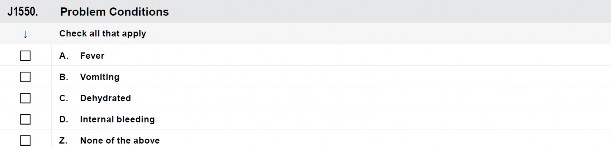
Check all that apply (blue box)
J1550A, fever
J1550B, vomiting
J1550C, dehydrated
J1550D, internal bleeding
J1550Z, none of the above
Coding Tips
Fever: Fever is defined as a temperature 2.4 degrees F higher than baseline. The resident’s baseline temperature should be established prior to the Assessment Reference Date.
Fever assessment prior to establishing base line temperature: A temperature of 100.4 degrees F (38 degrees C) on admission (i.e., prior to the establishment of the baseline temperature) would be considered a fever.
Vomiting: Regurgitation of stomach contents; may be caused by many factors (e.g., drug toxicity, infection, psychogenic).
J1550: Problem Conditions (cont.)
Dehydrated: Check this item if the resident presents with two or more of the following potential indicators for dehydration:
Resident takes in less than the recommended 1,500 ml of fluids daily (water or liquids in beverages and water in foods with high fluid content, such as gelatin and soups). Note: The recommended intake level has been changed from 2,500 ml to 1,500 ml to reflect current practice standards.
Resident has one or more potential clinical signs (indicators) of dehydration, including but not limited to dry mucous membranes, poor skin turgor, cracked lips, thirst, sunken eyes, dark urine, new onset or increased confusion, fever, or abnormal laboratory values (e.g., elevated hemoglobin and hematocrit, potassium chloride, sodium, albumin, blood urea nitrogen, or urine specific gravity).
Resident’s fluid loss exceeds the amount of fluids they take in (e.g., loss from vomiting, fever, diarrhea that exceeds fluid replacement).
Internal Bleeding: Bleeding may be frank (such as bright red blood) or occult (such as guaiac positive stools). Clinical indicators include black, tarry stools, vomiting “coffee grounds,” hematuria (blood in urine), hemoptysis (coughing up blood), and severe epistaxis (nosebleed) that requires packing. However, nose bleeds that are easily controlled, menses, or a urinalysis that shows a small amount of red blood cells should not be coded as internal bleeding.
J1700: Fall History on Admission/Entry or Reentry
Item Rationale
Health-related Quality of Life
Falls are a leading cause of injury, morbidity, and mortality in older adults.
A previous fall, especially a recent fall, recurrent falls, and falls with significant injury are the most important predictors of risk for future falls and injurious falls.
J1700: Fall History on Admission/Entry or Reentry (cont.)
Persons with a history of falling may limit activities because of a fear of falling and should be evaluated for reversible causes of falling.
Planning for Care
DEFINITION
FALL
Unintentional change in position coming to rest on the ground, floor or onto the next lower surface (e.g., onto a bed, chair, or bedside mat) or the result of an overwhelming external force (e.g., a resident pushes another resident).
An intercepted fall occurs when the resident would have fallen if they had not caught themself or had not been intercepted by another person – this is still considered a fall.
DEFINITION
FALL
Unintentional change in position coming to rest on the ground, floor or onto the next lower surface (e.g., onto a bed, chair, or bedside mat) or the result of an overwhelming external force (e.g., a resident pushes another resident).
An intercepted fall occurs when the resident would have fallen if they had not caught themself or had not been intercepted by another person – this is still considered a fall.
Determine the potential need for further assessment and intervention, including evaluation of the resident’s need for rehabilitation or assistive devices.
Evaluate the physical environment as well as staffing needs for residents who are at risk for falls.
Steps for Assessment
The period of review is 180 days (6 months) prior to admission, looking back from the resident’s entry date (A1600).
The period of review is 180 days (6 months) prior to admission, looking back from the resident’s entry date (A1600).
Ask the resident and family or significant other about a history of falls in the month prior to admission and in the 6 months prior to admission. This would include any fall, no matter where it occurred.
Review inter-facility transfer information (if the resident is being admitted from another facility) for evidence of falls.
Review all relevant medical records received from facilities where the resident resided during the previous 6 months; also review any other medical records received for evidence of one or more falls.
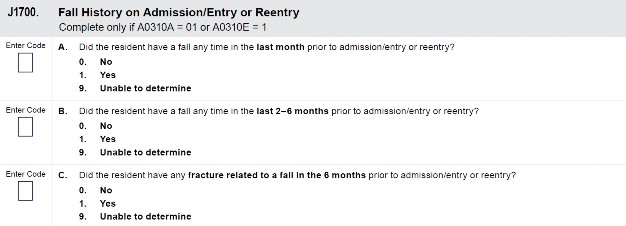
Coding Instructions for J1700A, Did the Resident Have a Fall Any Time in the Last Month Prior to Admission/Entry or Reentry?
Code 0, no: if resident and family report no falls and transfer records and medical records do not document a fall in the month preceding the resident’s entry date item (A1600).
Code 1, yes: if resident or family report or transfer records or medical records document a fall in the month preceding the resident’s entry date item (A1600).
Code 9, unable to determine: if the resident is unable to provide the information or if the resident and family are not available or do not have the information and medical record information is inadequate to determine whether a fall occurred.
J1700: Fall History on Admission/Entry or Reentry (cont.)
Coding Tips
The fall may be witnessed, reported by the resident or an observer or identified when a resident is found on the floor or ground.
Falls include any fall, no matter whether it occurred at home, while out in the community, in an acute hospital or a nursing home.
CMS understands that challenging a resident’s balance and training them to recover from a loss of balance is an intentional therapeutic intervention and does not consider anticipated losses of balance that occur during supervised therapeutic interventions as intercepted falls. However, if there is a loss of balance during supervised therapeutic interventions and the resident comes to rest on the ground, floor or next lower surface despite the clinician’s effort to intercept the loss of balance, it is considered a fall.
Coding Instructions for J1700B, Did the Resident Have a Fall Any Time in the Last 2-6 Months prior to Admission/Entry or Reentry?
Code 0, no: if resident and family report no falls and transfer records and medical records do not document a fall in the 2-6 months prior to the resident’s entry date item (A1600).
Code 1, yes: if resident or family report or transfer records or medical records document a fall in the 2-6 months prior to the resident’s entry date item (A1600).
Code 9, unable to determine: if the resident is unable to provide the information, or if the resident and family are not available or do not have the information, and medical record information is inadequate to determine whether a fall occurred.


DEFINITION
FRACTURE RELATED TO A FALL
Any documented bone fracture (in a problem list from a medical record, an x- ray report, or by history of the resident or caregiver) that occurred as a direct result of a fall or was recognized and later attributed to the fall. Do not include fractures caused by trauma related to car crashes or pedestrian versus car accidents or impact of another person or object against the resident.
DEFINITION
FRACTURE RELATED TO A FALL
Any documented bone fracture (in a problem list from a medical record, an x- ray report, or by history of the resident or caregiver) that occurred as a direct result of a fall or was recognized and later attributed to the fall. Do not include fractures caused by trauma related to car crashes or pedestrian versus car accidents or impact of another person or object against the resident.
Coding Instructions for J1700C. Did the Resident Have Any Fracture Related to a Fall in the 6 Months prior to Admission/Entry or Reentry?
Code 0, no: if resident and family report no fractures related to falls and transfer records and medical records do not document a fracture related to fall in the 6 months (0-180 days) preceding the resident’s entry date item (A1600).
Code 1, yes: if resident or family report or transfer records or medical records document a fracture related to fall in the 6 months (0-180 days) preceding the resident’s entry date item (A1600).
J1700: Fall History on Admission/Entry or Reentry (cont.)
Code 9, unable to determine: if the resident is unable to provide the information, or if the resident and family are not available or do not have the information, and medical record information is inadequate to determine whether a fall occurred.
Examples
On admission interview, Resident J is asked about falls and says they have "not really fallen." However, they go on to say that when they went shopping with their child about 2 weeks ago, their walker got tangled with the shopping cart and they slipped down to the floor.
Coding: J1700A would be coded 1, yes.
Rationale: Falls caused by slipping meet the definition of falls.
On admission interview a resident denies a history of falling. However, their child says that they found their parent on the floor near their toilet twice about 3–4 months ago.
Coding: J1700B would be coded 1, yes.
Rationale: If the individual is found on the floor, a fall is assumed to have occurred.
On admission interview, Resident M and their family deny any history of falling. However, nursing notes in the transferring hospital record document that Resident M repeatedly tried to get out of bed unassisted at night to go to the bathroom and was found on a mat placed at their bedside to prevent injury the week prior to nursing home transfer.
Coding: J1700A would be coded 1, yes.
Rationale: Medical records from an outside facility document that Resident M was found on a mat on the floor. This is defined as a fall.
Medical records note that Resident K had hip surgery 5 months prior to admission to the nursing home. Resident K’s child says the surgery was needed to fix a broken hip due to a fall.
Coding: Both J1700B and J1700C would be coded 1, yes.
Rationale: Resident K had a fall related fracture 1–6 months prior to nursing home entry.
Resident O’s hospital transfer record includes a history of osteoporosis and vertebral compression fractures. The record does not mention falls, and Resident O denies any history of falling.
Coding: J1700C would be coded 0, no. Rationale: The fractures were not related to a fall.
Resident P has a history of a “Colles’ fracture” of their left wrist about 3 weeks before nursing home admission. Their child recalls that the fracture occurred when Resident P tripped on a rug and fell forward on their outstretched hands.
Coding: Both J1700A and J1700C would be coded 1, yes.
Rationale: Resident P had a fall-related fracture less than 1 month prior to entry.
J1800: Any Falls Since Admission/Entry or Reentry or Prior Assessment (OBRA or Scheduled PPS), whichever is more recent

DEFINITION
PRIOR ASSESSMENT
Most recent MDS assessment that reported on falls.
DEFINITION
PRIOR ASSESSMENT
Most recent MDS assessment that reported on falls.
Item Rationale
Health-related Quality of Life
Falls are a leading cause of morbidity and mortality among nursing home residents.
Falls result in serious injury, especially hip fractures.
Fear of falling can limit an individual’s activity and negatively impact quality of life.
Planning for Care
Identification of residents who are at high risk of falling is a top priority for care planning. A previous fall is the most important predictor of risk for future falls.
Falls may be an indicator of functional decline and development of other serious conditions such as delirium, adverse drug reactions, dehydration, and infections.
External risk factors include medication side effects, use of appliances and restraints, and environmental conditions.
A fall should stimulate evaluation of the resident’s need for rehabilitation, ambulation aids, modification of the physical environment, or additional monitoring (e.g., toileting, to avoid incontinence).
Steps for Assessment
If this is the first assessment/entry or reentry (A0310E = 1), review the medical record for the time period from the admission date to the ARD.
If this is not the first assessment/entry or reentry (A0310E = 0), the review period is from the day after the ARD of the last MDS assessment to the ARD of the current assessment.
Review all available sources for any fall since the last assessment, no matter whether it occurred while out in the community, in an acute hospital, or in the nursing home. Include medical records generated in any health care setting since last assessment.
Review nursing home incident reports, fall logs and the medical record (physician, nursing, therapy, and nursing assistant notes).
Ask the resident and family about falls during the look-back period. Resident and family reports of falls should be captured here whether or not these incidents are documented in the medical record.
J1800: Any Falls Since Admission/Entry or Reentry or Prior Assessment (OBRA or Scheduled PPS), whichever is more recent (cont.)
Coding Instructions
Code 0, no: if the resident has not had any fall since the last assessment. Skip to Swallowing Disorder item (K0100) if the assessment being completed is an OBRA assessment. If the assessment being completed is a Scheduled PPS assessment, skip to Prior Surgery item (J2000).
Code 1, yes: if the resident has fallen since the last assessment. Continue to Number of Falls Since Admission/Entry or Reentry or Prior Assessment (OBRA or Scheduled PPS) item (J1900), whichever is more recent.
Example
An incident report describes an event in which Resident S was walking down the hall and appeared to slip on a wet spot on the floor. They lost their balance and bumped into the wall, but were able to grab onto the hand rail and steady themself.
Coding: J1800 would be coded 1, yes. Rationale: An intercepted fall is considered a fall.
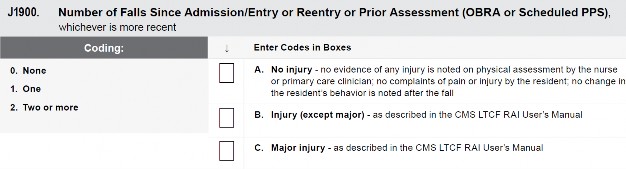
J1900: Number of Falls Since Admission/Entry or Reentry or Prior Assessment (OBRA or Scheduled PPS), whichever is more recent
Item Rationale
DEFINITIONS
INJURY RELATED TO A FALL
Any documented injury that occurred as a result of, or was recognized within a short period of time (e.g., hours to a few days) after the fall and attributed to the fall.
INJURY (EXCEPT MAJOR)
Includes, but is not limited to, skin tears, abrasions, lacerations, superficial bruises, hematomas, and sprains; or any fall-related injury that causes the resident to complain of pain.
MAJOR INJURY
Includes, but is not limited to, traumatic bone fractures, joint dislocations/ subluxations, internal organ injuries, amputations, spinal cord injuries, head injuries, and crush injuries.
DEFINITIONS
INJURY RELATED TO A FALL
Any documented injury that occurred as a result of, or was recognized within a short period of time (e.g., hours to a few days) after the fall and attributed to the fall.
INJURY (EXCEPT MAJOR)
Includes, but is not limited to, skin tears, abrasions, lacerations, superficial bruises, hematomas, and sprains; or any fall-related injury that causes the resident to complain of pain.
MAJOR INJURY
Includes, but is not limited to, traumatic bone fractures, joint dislocations/ subluxations, internal organ injuries, amputations, spinal cord injuries, head injuries, and crush injuries.
Health-related Quality of Life
Falls are a leading cause of morbidity and mortality among nursing home residents.
Falls result in serious injury, especially hip fractures.
Previous falls, especially recurrent falls and falls with injury, are the most important predictor of future falls and injurious falls.
Planning for Care
Identification of residents who are at high risk of falling is a top priority for care planning.
Falls indicate functional decline and other serious conditions such as delirium, adverse drug reactions, dehydration, and infections.
External risk factors include medication side effects, use of appliances and restraints, and environmental conditions.
A fall should stimulate evaluation of the resident’s need for rehabilitation or ambulation aids and of the need for monitoring or modification of the physical environment.
It is important to ensure the accuracy of the level of injury resulting from a fall. Since injuries can present themselves later than the time of the fall, the assessor may need to look beyond the ARD to obtain the accurate information for the complete picture of the fall that occurs in the look back of the MDS.
J1900: Number of Falls Since Admission/Entry or Reentry or Prior Assessment (OBRA or Scheduled PPS), whichever is more recent (cont.)
Steps for Assessment
If this is the first assessment (A0310E = 1), review the medical record for the time period from the admission date to the ARD.
If this is not the first assessment (A0310E = 0), the review period is from the day after the ARD of the last MDS assessment to the ARD of the current assessment.
Review all available sources for any fall since the last assessment, no matter whether it occurred while out in the community, in an acute hospital, or in the nursing home. Include medical records generated in any health care setting since last assessment. All relevant records received from acute and post-acute facilities where the resident was admitted during the look-back period should be reviewed for evidence of one or more falls.
Review nursing home incident reports and medical record (physician, nursing, therapy, and nursing assistant notes) for falls and level of injury.
Ask the resident, staff, and family about falls during the look-back period. Resident and family reports of falls should be captured here, whether or not these incidents are documented in the medical record.
Review any follow-up medical information received pertaining to the fall, even if this information is received after the ARD (e.g., emergency room x-ray, MRI, CT scan results), and ensure that this information is used to code the assessment.
Coding Instructions for J1900
Determine the number of falls that occurred since admission/entry or reentry or prior assessment (OBRA or Scheduled PPS) and code the level of fall-related injury for each. Code each fall only once. If the resident has multiple injuries in a single fall, code the fall for the highest level of injury.
Determine the number of falls that occurred since admission/entry or reentry or prior assessment (OBRA or Scheduled PPS) and code the level of fall-related injury for each. Code each fall only once. If the resident has multiple injuries in a single fall, code the fall for the highest level of injury.
Coding Instructions for J1900A, No Injury
Code 0, none: if the resident had no injurious fall since the admission/entry or reentry or prior assessment (OBRA or Scheduled PPS).
Code 1, one: if the resident had one non-injurious fall since admission/entry or reentry or prior assessment (OBRA or Scheduled PPS).
Code 2, two or more: if the resident had two or more non-injurious falls since admission/entry or reentry or prior assessment (OBRA or Scheduled PPS).
Coding Instructions for J1900B, Injury (Except Major)
Code 0, none: if the resident had no injurious fall (except major) since admission/entry or reentry or prior assessment (OBRA or Scheduled PPS).
Code 1, one: if the resident had one injurious fall (except major) since admission/entry or reentry or prior assessment (OBRA or Scheduled PPS).
J1900: Number of Falls Since Admission/Entry or Reentry or Prior Assessment (OBRA or Scheduled PPS), whichever is more recent (cont.)
Code 2, two or more: if the resident had two or more injurious falls (except major) since admission/entry or reentry or prior assessment (OBRA or Scheduled PPS).
Coding Instructions for J1900C, Major Injury
Code 0, none: if the resident had no major injurious fall since admission/entry or reentry or prior assessment (OBRA or Scheduled PPS).
Code 1, one: if the resident had one major injurious fall since admission/entry or reentry or prior assessment (OBRA or Scheduled PPS).
Code 2, two or more: if the resident had two or more major injurious falls since admission/entry or reentry or prior assessment (OBRA or Scheduled PPS).
Coding Tips
If the level of injury directly related to a fall that occurred during the look-back period is identified after the ARD and is at a different injury level than what was originally coded on an assessment that was submitted to the Internet Quality Improvement and Evaluation System (iQIES), the assessment must be modified to update the level of injury that occurred with that fall.
Fractures confirmed to be pathologic (vs. traumatic) are not considered a major injury resulting from a fall.
Examples
A nursing note states that Resident K slipped out of their wheelchair onto the floor while at the dining room table. Before being assisted back into their chair, a range of motion assessment was completed that indicated no injury. A skin assessment conducted shortly after the fall also revealed no injury.
Coding: J1900A would be coded 1, one.
Rationale: Slipping to the floor is a fall. No injury was noted.
Nurse’s notes describe a situation in which Resident Z went out with their family for dinner. When they returned, their child stated that while at the restaurant, Resident Z fell in the bathroom. No injury was noted when they returned from dinner.
Coding: J1900A would be coded 1, one.
Rationale: Falls during the nursing home stay, even if on outings, are captured here.
J1900: Number of Falls Since Admission/Entry or Reentry or Prior Assessment (OBRA or Scheduled PPS), whichever is more recent (cont.)
A nurse’s note describes a resident who, while being treated for pneumonia, climbed over their bedrails and fell to the floor. They had a cut over their left eye and some swelling on their arm. They were sent to the emergency room, where X-rays revealed no injury and neurological checks revealed no changes in mental status.
Coding: J1900B would be coded 1, one.
Rationale: Lacerations and swelling without fracture are classified as injury (except major).
A resident fell, lacerated their head, and head CT scan indicated a subdural hematoma.
Coding: J1900C would be coded 1, one.
Rationale: Subdural hematoma is a major injury. The injury occurred as a result of a fall.
Resident R fell on their right hip in the facility on the ARD of their Quarterly MDS and complained of mild right hip pain. The initial x-ray of the hip did not show any injury. The nurse completed Resident R’s Quarterly assessment and coded the assessment to reflect this information. The assessment was submitted to iQIES. Three days later, Resident R complained of increasing pain and had difficulty ambulating, so a follow-up x-ray was done. The follow-up x-ray showed a hairline fracture of the right hip. This injury is noted by the physician to be attributed to the recent fall that occurred during the look-back period of the Quarterly assessment.
Original Coding: J1900B, Injury (except major) is coded 1, one and J1900C, Major Injury is coded 0, none.
Rationale: Resident R had a fall-related injury that caused them to complain of pain.
Modification of Quarterly assessment: J1900B, Injury (except major) is
coded 0, none and J1900C, Major Injury, is coded 1, one. Rationale: The extent of the injury did not present itself right after the fall;
however, it was directly related to the fall that occurred during the look-back period of the Quarterly assessment. Since the assessment had been submitted to iQIES and the level of injury documented on the submitted Quarterly was now found to be different based on a repeat x-ray of the resident’s hip, the Quarterly assessment needed to be modified to accurately reflect the injury sustained during that fall.
J1900: Number of Falls Since Admission/Entry or Reentry or Prior Assessment (OBRA or Scheduled PPS), whichever is more recent (cont.)
The therapist had Resident S, who has Parkinson’s disease, stand on one foot during their therapy session to intentionally challenge the resident’s balance. Despite providing contact guard assistance and use of safety mats, Resident S fell and landed on their left side. An X- ray was ordered due to pain and swelling of the left wrist which confirmed a distal radius fracture of the left wrist.
Coding: J1800 would be coded 1, yes and J1900C would be coded 1, one. Rationale: Despite safety precautions in place, Resident S sustained a radius fracture as a result of a fall during a therapeutic intervention with physical therapy. This is a fall, as the clinician’s interventions did not intercept the loss of balance, and the resident landed on the floor and sustained a fracture, which is a major injury.
Differentiating from Traumatic vs. Pathological Fractures
Resident A, who has osteoporosis, falls, resulting in a right hip fracture. The Emergency Department physician confirms that the fracture is a result of the resident’s bone disease and not a result of the fall.
Coding: J1800 would be coded 1, yes and J1900C would be coded 0, none. Rationale: The physician determined that the fracture was a pathological fracture due to osteoporosis. Because the fracture was determined to be pathological, it is not coded as a fall with major injury.
Resident L, who has osteoporosis, falls, resulting in a right hip fracture. The physician in the acute care hospital confirms that the fracture is a result of the resident’s fall and not the resident’s history of osteoporosis.
Coding: J1800 would be coded 1, yes and J1900C would be coded 1, one. Rationale: Because the physician determined that the fracture was a result of the fall, it is a traumatic fracture and, therefore, is a fall with major injury.
J2000: Prior Surgery

Item Rationale
Health-related Quality of Life
A recent history of major surgery during the 100 days prior to admission can affect a resident’s recovery.
J2000: Prior Surgery (cont.)
Planning for Care
DEFINITION
MAJOR SURGERY
Refers to a procedure that meets the following criteria:
The resident was an inpatient in an acute care hospital for at least 1 day in the 100 days prior to admission to the skilled nursing facility (SNF), and
The surgery carried some degree of risk to the resident’s life or the potential for severe disability.
DEFINITION
MAJOR SURGERY
Refers to a procedure that meets the following criteria:
The resident was an inpatient in an acute care hospital for at least 1 day in the 100 days prior to admission to the skilled nursing facility (SNF), and
The surgery carried some degree of risk to the resident’s life or the potential for severe disability.
This item identifies whether the resident has had major surgery during the 100 days prior to the start of the Medicare Part A stay. A recent history of major surgery can affect a resident’s recovery.
Steps for Assessment
Ask the resident and their family or significant other about any surgical procedures in the 100 days prior to admission.
Review the resident’s medical record to determine whether the resident had major surgery during the 100 days prior to admission.
Medical record sources include medical records received from facilities where the resident received health care during the previous 100 days, the most recent history and physical, transfer documents, discharge summaries, progress notes, and other resources as available.
Coding Instructions
Code 0, No: if the resident did not have major surgery during the 100 days prior to admission.
Code 1, Yes: if the resident had major surgery during the 100 days prior to admission.
Code 8, Unknown: if it is unknown or cannot be determined whether the resident had major surgery during the 100 days prior to admission.
J2000: Prior Surgery (cont.)
Examples
Resident T reports that they required surgical removal of a skin tag from their neck a month and a half ago. They had the procedure as an outpatient. Resident T report no other surgeries in the last 100 days.
Coding: J2000 would be coded 0, No.
Rationale: Resident T’s skin tag removal surgery did not require an acute care inpatient stay; therefore, the skin tag removal does not meet the required criteria to be coded as major surgery. Resident T did not have any other surgeries in the last 100 days.
Resident A’s spouse informs their nurse that six months ago Resident A was admitted to the hospital for five days following a bowel resection (partial colectomy) for diverticulitis. Resident A’s spouse reports Resident A has had no other surgeries since the time of their bowel resection.
Coding: J2000 would be coded 0, No.
Rationale: Bowel resection is a major surgery that has some degree of risk for death or severe disability, and Resident A required a five-day hospitalization. However, the bowel resection did not occur in the last 100 days; it happened six months ago, and Resident A has not undergone any surgery since that time.
Resident G was admitted to the facility for wound care related to dehiscence of a surgical wound subsequent to a complicated cholecystectomy. The attending physician also noted diagnoses of anxiety, diabetes, and morbid obesity in their medical record. They were transferred to the facility immediately following a four-day acute care hospital stay.
Coding: J2000 would be coded 1, Yes.
Rationale: In the last 100 days, Resident G underwent a complicated cholecystectomy, which required a four-day hospitalization. They additionally had comorbid diagnoses of diabetes, morbid obesity, and anxiety contributing some additional degree of risk for death or severe disability.
J2100: Recent Surgery Requiring Active SNF Care

Item Rationale
Health-related Quality of Life
A recent history of major surgery during the inpatient stay that preceded the resident’s Part A admission can affect a resident’s recovery.
J2100: Recent Surgery Requiring Active SNF Care (cont.)
Planning for Care
This item identifies whether the resident had major surgery during the inpatient stay that immediately preceded the resident’s Part A admission. A recent history of major surgery can affect a resident’s recovery.
Steps for Assessment
Ask the resident and their family or significant other about any surgical procedures that occurred during the inpatient hospital stay that immediately preceded the resident’s Part A admission.
Review the resident’s medical record to determine whether the resident had major surgery during the inpatient hospital stay that immediately preceded the resident’s Part A admission.
Medical record sources include medical records received from facilities where the resident received health care during the inpatient hospital stay that immediately preceded the resident’s Part A admission, the most recent history and physical, transfer documents, discharge summaries, progress notes, and other resources as available.
Coding Instructions
Code 0, No: if the resident did not have major surgery during the inpatient hospital stay that immediately preceded the resident’s Part A admission.
Code 1, Yes: if the resident had major surgery during the inpatient hospital stay that immediately preceded the resident’s Part A admission.
Code 8, Unknown: if it is unknown or cannot be determined whether the resident had major surgery during the inpatient hospital stay that immediately preceded the resident’s Part A admission.
Coding Tips
Generally, major surgery for item J2100 refers to a procedure that meets the following criteria:
the resident was an inpatient in an acute care hospital for at least one day in the 30 days prior to admission to the skilled nursing facility (SNF), and
the surgery carried some degree of risk to the resident’s life or the potential for severe disability.
J2300–J5000: Recent Surgeries Requiring Active SNF Care
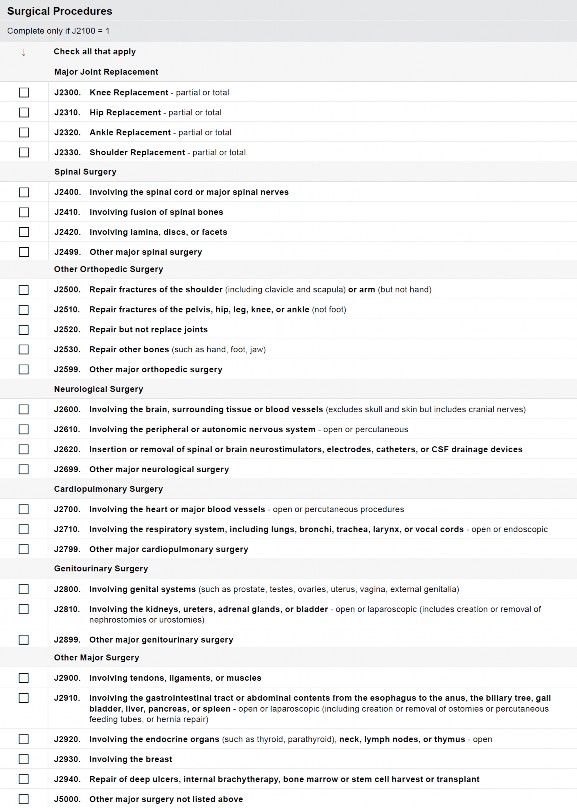
J2300–J5000: Recent Surgeries Requiring Active SNF Care (cont.)
Item Rationale
Health-related Quality of Life
A recent history of major surgery during the inpatient stay that preceded the resident’s Part A admission can affect a resident’s recovery.
Planning for Care
This item identifies whether the resident had major surgery during the inpatient stay that immediately preceded the resident’s Part A admission. A recent history of major surgery can affect a resident’s recovery.
Steps for Assessment
Identify recent surgeries: The surgeries in this section must have been documented by a physician (nurse practitioner, physician assistant, or clinical nurse specialist if allowable under state licensure laws) in the last 30 days and must have occurred during the inpatient stay that immediately preceded the resident’s Part A admission.
Medical record sources for recent surgeries include progress notes, the most recent history and physical, transfer documents, discharge summaries, diagnosis/problem list, and other resources as available.
Although open communication regarding resident information between the physician and other members of the interdisciplinary team is important, it is also essential that resident information communicated verbally be documented in the medical record by the physician to ensure follow-up.
Surgery information, including past history obtained from family members and close contacts, must also be documented in the medical record by the physician to ensure validity and follow-up.
Determine whether the surgeries require active care during the SNF stay: Once a recent surgery is identified, it must be determined if the surgery requires active care during the SNF stay. Surgeries requiring active care during the SNF stay are surgeries that have a direct relationship to the resident’s primary SNF diagnosis, as coded in I0020B.
Do not include conditions that have been resolved, do not affect the resident’s current status, or do not drive the resident’s plan of care during the 7-day look-back period, as these would be considered surgeries that do not require active care during the SNF stay.
Check the following information sources in the medical record for the last 30 days to identify “active” surgeries: transfer documents, physician progress notes, recent history and physical, recent discharge summaries, nursing assessments, nursing care plans, medication sheets, doctor’s orders, consults and official diagnostic reports, and other sources as available.
J2300–J5000: Recent Surgeries Requiring Active SNF Care (cont.)
Coding Instructions
Code surgeries that are documented to have occurred in the last 30 days, and during the inpatient stay that immediately preceded the resident’s Part A admission, that have a direct relationship to the resident’s primary SNF diagnosis, as coded in I0020B.
Code surgeries that are documented to have occurred in the last 30 days, and during the inpatient stay that immediately preceded the resident’s Part A admission, that have a direct relationship to the resident’s primary SNF diagnosis, as coded in I0020B.
Check off each surgery requiring active SNF care as defined above, as follows:
Surgeries are listed by major surgical category: Major Joint Replacement, Spinal Surgery, Orthopedic Surgery, Neurologic Surgery, Cardiopulmonary Surgery, Genitourinary Surgery, Other Major Surgery.
Examples of surgeries are included for each surgical category. For example, J2810, Genitourinary surgery - the kidneys, ureter, adrenals, and bladder—open, laparoscopic, includes open or laparoscopic surgeries on the kidneys, ureter, adrenals, and bladder, but not other components of the genitourinary system.
Check all that apply.
Major Joint Replacement
J2300, Knee Replacement - partial or total
J2310, Hip Replacement - partial or total
J2320, Ankle Replacement - partial or total
J2330, Shoulder Replacement - partial or total
Spinal Surgery
J2400, Spinal surgery - spinal cord or major spinal nerves
J2410, Spinal surgery - fusion of spinal bones
J2420, Spinal surgery - lamina, discs, or facets
J2499, Spinal surgery - other
Orthopedic Surgery
J2500, Ortho surgery - repair fractures of shoulder or arm
J2510, Ortho surgery - repair fractures of pelvis, hip, leg, knee, or ankle
J2520, Ortho surgery - repair but not replace joints
J2530, Ortho surgery - repair other bones
J2599, Ortho surgery - other
J2300–J5000: Recent Surgeries Requiring Active SNF Care (cont.)
Neurologic Surgery
J2600, Neuro surgery - brain, surrounding tissue or blood vessels
J2610, Neuro surgery - peripheral and autonomic nervous system - open and percutaneous
J2620, Neuro surgery - insertion or removal of spinal and brain neurostimulators, electrodes, catheters, and CSF drainage devices
J2699, Neuro surgery - other
Cardiopulmonary Surgery
J2700, Cardiopulmonary surgery - heart or major blood vessels - open and percutaneous procedures
J2710, Cardiopulmonary surgery - respiratory system, including lungs, bronchi, trachea, larynx, or vocal cords - open and endoscopic
J2799, Cardiopulmonary surgery - other
Genitourinary Surgery
J2800, Genitourinary surgery - male or female organs
J2810, Genitourinary surgery - the kidneys, ureter, adrenals, and bladder - open, laparoscopic
J2899, Genitourinary surgery - other
Other Major Surgery
J2900, Major surgery - tendons, ligament, or muscles
J2910, Major surgery - the GI tract and abdominal contents from the esophagus to the anus, the biliary tree, gall bladder, liver, pancreas, spleen - open or laparoscopic
J2920, Major surgery - endocrine organs (such as thyroid, parathyroid), neck, lymph nodes, and thymus - open
J2930, Major surgery - the breast
J2940, Major surgery - repair of deep ulcers, internal brachytherapy, bone marrow, or stem cell harvest or transplant
J5000, Major surgery - not listed above
J2300–J5000: Recent Surgeries Requiring Active SNF Care (cont.)
Coding Tips
The following information may assist assessors in determining whether a surgery should be coded as requiring active care during the SNF stay.
The following information may assist assessors in determining whether a surgery should be coded as requiring active care during the SNF stay.
There may be specific documentation in the medical record by a physician, nurse practitioner, physician assistant, or clinical nurse specialist.
The physician (nurse practitioner, physician assistant, or clinical nurse specialist if allowable under state licensure laws) may specifically indicate that the SNF stay is for treatment related to the surgical intervention. Specific documentation may be found in progress notes, most recent history and physical, transfer notes, hospital discharge summary, etc.
In the rare circumstance of the absence of specific documentation that a surgery requires active SNF care, the following indicators may be used to confirm that the surgery requires active SNF care:
The inherent complexity of the services prescribed for a resident is such that they can be performed safely and/or effectively only by or under the general supervision of skilled nursing. For example:
The management of a surgical wound that requires skilled care (e.g., managing potential infection or drainage).
Daily skilled therapy to restore functional loss after surgical procedures.
Administration of medication and monitoring that requires skilled nursing.
Examples of surgeries requiring active SNF care and related to the primary SNF diagnosis
Resident V was hospitalized for gram-negative pneumonia. Since this was their second episode of pneumonia in the past six months, a diagnostic bronchoscopy was performed while in the hospital. They also have Parkinson’s disease and rheumatoid arthritis. They were discharged to a SNF for continued antibiotic treatment for their pneumonia and require daily skilled care.
Coding: I0020 is coded as 13, Medically Complex Conditions, and the I0020B SNF ICD-10 code is J15.6, Pneumonia due to other aerobic Gram-negative bacteria. There is no documentation that the resident had major surgery; therefore, J2100 is coded 0, No.
Rationale: Resident V did not receive any major surgery during the prior inpatient stay, and they were admitted to the SNF for continued care due to pneumonia.
J2300–J5000: Recent Surgeries Requiring Active SNF Care (cont.)
Resident O, a diabetic, was hospitalized for sepsis from an infection due to Methicillin susceptible Staphylococcus aureus that developed after outpatient bunion surgery. A central line was placed to administer antibiotics. They were discharged to a SNF for continued antibiotic treatment and monitoring.
Coding: I0020 is coded as 13, Medically Complex Conditions. The I0020B SNF ICD- 10 code is A41.01 (Sepsis due to Methicillin susceptible Staphylococcus aureus). There is no documentation that the resident had major surgery; therefore, J2100 is coded 0, No.
Rationale: Neither the placement of a central line nor the outpatient bunion surgery is considered to be a major surgery, but the resident was admitted to the SNF for continued antibiotic treatment and monitoring.
Resident H was hospitalized for severe back pain from a compression fracture of a lumbar vertebral body, which was caused by their age-related osteoporosis. They were treated with a kyphoplasty that relieved their pain. They were transferred to a SNF after discharge because of their mild dementia and need to regulate their anticoagulant treatment for atrial fibrillation.
Coding: I0020 is coded 10, Fractures and Other Multiple Trauma. The I0020B SNF ICD-10 code is M80.08XD (Age-related osteoporosis with current pathological fracture, vertebra(e), subsequent encounter for fracture with routine healing). There was no documentation that the resident had major surgery; therefore, J2100 is coded 0, No.
Rationale: Resident H was treated with a kyphoplasty during the inpatient stay prior to SNF admission. Although kyphoplasty is a minor surgery and does not require SNF care in and of itself, the resident has other conditions requiring skilled care that are unrelated to the kyphoplasty surgery.
Resident J had a craniotomy to drain a subdural hematoma after suffering a fall at home. They have COPD and use oxygen at night. In addition, they have moderate congestive heart failure, are moderately overweight, and have hypothyroidism. After a six-day hospital stay, they were discharged to a SNF for continuing care. The hospital discharge summary indicated that the patient had a loss of consciousness of 45 minutes.
Coding: I0020 is coded 07, Other Neurological Conditions. The I0020B SNF ICD-10 code is S06.5X2D (Traumatic subdural hemorrhage with loss of consciousness of 31 minutes to 59 minutes, subsequent encounter). J2100 would be coded 1, Yes. J2600, Neuro surgery - brain, surrounding tissue or blood vessels, would be checked.
Rationale: The craniotomy surgery during the inpatient stay immediately preceding the SNF stay requires continued skilled care and skilled monitoring for wound care, as well as therapies to address any deficits that led to their fall or any functional deficits resulting from their fall.
J2300–J5000: Recent Surgeries Requiring Active SNF Care (cont.)
Resident D was admitted to an acute care hospital for cytoreductive surgery for metastatic renal cell carcinoma. They were admitted to the SNF for further treatment of the metastatic renal cell carcinoma and post-surgical care.
Coding: I0020 is coded as 13, Medically Complex Conditions. The I0020B SNF ICD- 10 code is C79.01 (Secondary malignant neoplasm of the right kidney and renal pelvis). J2100 would be coded 1, Yes. J2810, Genitourinary surgery – the kidneys, ureter, adrenals, and bladder – open, laparoscopic, would be checked.
Rationale: Resident D was treated with a surgical procedure, genitourinary surgery of the kidney, and admitted to the SNF for further treatment of the metastatic kidney cancer and post-surgical care.
Resident G was admitted to an acute care hospital for severe abdominal pain. They were found to have diverticulitis of the small intestine with perforation and abscess without bleeding. They had surgery to repair the perforation. They were admitted to the SNF for continued antibiotics and post-surgical care.
Coding: I0020 is coded 13, Medically Complex Conditions. The I0020B SNF ICD-10 code is K57.00 (Diverticulitis of small intestine with perforation and abscess without bleeding), and J2100 would be coded 1, Yes. J2910, Major surgery – the GI tract and abdominal contents from the esophagus to the anus, the biliary tree, gall bladder, liver, pancreas, spleen – open or laparoscopic, would be checked.
Rationale: Resident G was treated with a surgical procedure, repair of the small intestine perforation, which is a major surgical procedure. They were admitted to the SNF for continued antibiotics and post-surgical care.
Resident W underwent surgical repair for a left fractured hip (i.e., subtrochanteric fracture) during an inpatient hospitalization. They were admitted to the SNF for post-surgical care.
Coding: I0020 is coded as Code 10, Fractures and Other Multiple Trauma. The I0020B SNF ICD-10 code is S72.22XD (Displaced subtrochanteric fracture of left femur, subsequent encounter for closed fracture with routine healing) and J2100 is coded as 1, Yes. J2510, Ortho surgery – repair fractures of pelvis, hip, leg, knee, or ankle, would be checked.
Rationale: This is major surgery requiring skilled nursing care to provide wound care and to monitor for early signs of infection or blood clots, for which Resident W was admitted to the SNF.