Intent: The items in this section are intended to assess the many conditions that could affect the resident’s ability to maintain adequate nutrition and hydration. This section covers swallowing disorders, height and weight, weight loss, and nutritional approaches. The assessor should collaborate with the dietary staff to ensure that items in this section have been assessed and calculated accurately.
K0100: Swallowing Disorder
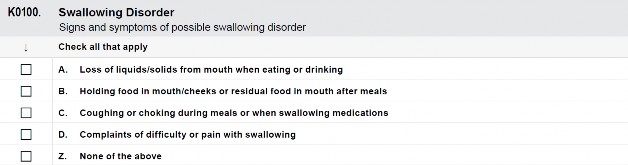
The ability to swallow safely can be affected by many disease processes and functional decline.
Alterations in the ability to swallow can result in choking and aspiration, which can increase the resident’s risk for malnutrition, dehydration, and aspiration pneumonia.
Care planning should include provisions for monitoring the resident during mealtimes and during functions/activities that include the consumption of food and liquids.
When necessary, the resident should be evaluated by the physician, speech language pathologist and/or occupational therapist to assess for any need for swallowing therapy and/or to provide recommendations regarding the consistency of food and liquids.
Assess for signs and symptoms that suggest a swallowing disorder that has not been successfully treated or managed with diet modifications or other interventions (e.g., tube feeding, double swallow, turning head to swallow, etc.) and therefore represents a functional problem for the resident.
Care plan should be developed to assist resident to maintain safe and effective swallow using compensatory techniques, alteration in diet consistency, and positioning during and following meals.
Ask the resident if they have had any difficulty swallowing during the 7-day look-back period. Ask about each of the symptoms in K0100A through K0100D.
Observe the resident during meals or at other times when they are eating, drinking, or swallowing to determine whether any of the listed symptoms of possible swallowing disorder are exhibited.
K0100: Swallowing/Nutritional Status (cont.)
Interview staff members on all shifts who work with the resident and ask if any of the four listed symptoms were evident during the 7-day look-back period.
Review the medical record, including nursing, physician, dietary, and speech language pathologist notes, and any available information on dental history or problems. Dental problems may include poor fitting dentures, dental caries, edentulous, mouth sores, tumors and/or pain with food consumption.
Coding Instructions
Check all that apply.
K0100A, loss of liquids/solids from mouth when eating or drinking. When the resident has food or liquid in their mouth, the food or liquid dribbles down chin or falls out of the mouth.
K0100B, holding food in mouth/cheeks or residual food in mouth after meals. Holding food in mouth or cheeks for prolonged periods of time (sometimes labeled pocketing) or food left in mouth because resident failed to empty mouth completely.
K0100C, coughing or choking during meals or when swallowing medications. The resident may cough or gag, turn red, have more labored breathing, or have difficulty speaking when eating, drinking, or taking medications. The resident may frequently complain of food or medications “going down the wrong way.”
K0100D, complaints of difficulty or pain with swallowing. Resident may refuse food because it is painful or difficult to swallow.
K0100Z, none of the above: if none of the K0100A through K0100D signs or symptoms were present during the look-back period.
Do not code a swallowing problem when interventions have been successful in treating the problem and therefore the signs/symptoms of the problem (K0100A through K0100D) did not occur during the 7-day look-back period.
Code even if the symptom occurred only once in the 7-day look-back period.
K0200: Height and Weight

K0200: Height and Weight (cont.)
Diminished nutritional and hydration status can lead to debility that can adversely affect health and safety as well as quality of life.
Height and weight measurements assist staff with assessing the resident’s nutrition and hydration status by providing a mechanism for monitoring stability of weight over a period of time. The measurement of weight is one guide for determining nutritional status.
Base height on the most recent height since the most recent admission/entry or reentry. Measure and record height in inches.
Measure height consistently over time in accordance with the facility policy and procedure, which should reflect current standards of practice (shoes off, etc.).
For subsequent assessments, check the medical record. If the last height recorded was more than one year ago, measure and record the resident’s height again.
Coding Instructions for K0200A, Height
Record height to the nearest whole inch.
Use mathematical rounding (i.e., if height measurement is X.5 inches or greater, round height upward to the nearest whole inch. If height measurement number is X.1 to X.4 inches, round down to the nearest whole inch). For example, a height of 62.5 inches would be rounded to 63 inches and a height of 62.4 inches would be rounded to 62 inches.
Base weight on the most recent measure in the last 30 days.
Measure weight consistently over time in accordance with facility policy and procedure, which should reflect current standards of practice (shoes off, etc.).
For subsequent assessments, check the medical record and enter the weight taken within 30 days of the ARD of this assessment.
If the last recorded weight was taken more than 30 days prior to the ARD of this assessment or previous weight is not available, weigh the resident again.
If the resident’s weight was taken more than once during the preceding month, record the most recent weight.
Use mathematical rounding (i.e., If weight is X.5 pounds [lbs] or more, round weight upward to the nearest whole pound. If weight is X.1 to X.4 lbs, round down to the nearest whole pound). For example, a weight of 152.5 lbs would be rounded to 153 lbs and a weight of 152.4 lbs would be rounded to 152 lbs.
K0200: Height and Weight (cont.)
If a resident cannot be weighed, for example because of extreme pain, immobility, or risk of pathological fractures, use the standard no-information code (-) and document rationale on the resident’s medical record.
K0300: Weight Loss

DEFINITIONS
5% WEIGHT LOSS IN 30 DAYS
Start with the resident’s weight closest to 30 days ago and multiply it by .95 (or 95%). The resulting figure represents a 5% loss from the weight 30 days ago. If the resident’s current weight is equal to or less than the resulting figure, the resident has lost more than 5% body weight.
10% WEIGHT LOSS IN
180 DAYS
Start with the resident’s weight closest to 180 days ago and multiply it by .90 (or 90%). The resulting figure represents a 10% loss from the weight 180 days ago. If the resident’s current weight is equal to or less than the resulting figure, the resident has lost 10% or more body weight.
DEFINITIONS
5% WEIGHT LOSS IN 30 DAYS
Start with the resident’s weight closest to 30 days ago and multiply it by .95 (or 95%). The resulting figure represents a 5% loss from the weight 30 days ago. If the resident’s current weight is equal to or less than the resulting figure, the resident has lost more than 5% body weight.
10% WEIGHT LOSS IN
180 DAYS
Start with the resident’s weight closest to 180 days ago and multiply it by .90 (or 90%). The resulting figure represents a 10% loss from the weight 180 days ago. If the resident’s current weight is equal to or less than the resulting figure, the resident has lost 10% or more body weight.
Weight loss can result in debility and adversely affect health, safety, and quality of life.
For persons with morbid obesity, controlled and careful weight loss can improve mobility and health status.
For persons with a large volume (fluid) overload, controlled and careful diuresis can improve health status.
Weight loss may be an important indicator of a change in the resident’s health status or environment.
If significant weight loss is noted, the interdisciplinary team should review for possible causes of changed intake, changed caloric need, change in medication (e.g., diuretics), or changed fluid volume status.
Weight should be monitored on a continuing basis; weight loss should be assessed and care planned at the time of detection and not delayed until the next MDS assessment.
K0300: Weight Loss (cont.)
This item compares the resident’s weight in the current observation period with their weight at two snapshots in time:
This item compares the resident’s weight in the current observation period with their weight at two snapshots in time:
At a point closest to 30 days preceding the current weight.
At a point closest to 180 days preceding the current weight.
The resident’s weight captured closest to these two time points are the only two weights considered for this item, but the resident’s weight should be monitored on a continual basis and weight loss assessed and addressed on the care plan as necessary.
The resident’s weight captured closest to these two time points are the only two weights considered for this item, but the resident’s weight should be monitored on a continual basis and weight loss assessed and addressed on the care plan as necessary.
DEFINITIONS
PHYSICIAN- PRESCRIBED WEIGHT- LOSS REGIMEN
A weight reduction plan ordered by the resident’s physician with the care plan goal of weight reduction. May employ a calorie-restricted diet or other weight loss diets and exercise. Also includes planned diuresis. It is important that weight loss is intentional.
BODY MASS INDEX (BMI)
Number calculated from a person’s weight and height. BMI is used as a screening tool to identify possible weight problems for adults. Visit https://www.cdc.gov/bmi/faq/.
DEFINITIONS
PHYSICIAN- PRESCRIBED WEIGHT- LOSS REGIMEN
A weight reduction plan ordered by the resident’s physician with the care plan goal of weight reduction. May employ a calorie-restricted diet or other weight loss diets and exercise. Also includes planned diuresis. It is important that weight loss is intentional.
BODY MASS INDEX (BMI)
Number calculated from a person’s weight and height. BMI is used as a screening tool to identify possible weight problems for adults. Visit https://www.cdc.gov/bmi/faq/.
Ask the resident, family, or significant other about weight loss over the past 30 and 180 days.
Consult the resident’s physician, review transfer documentation, and compare with admission weight.
If the admission weight is less than the previous weight, calculate the percentage of weight loss.
Complete the same process to determine and calculate weight loss comparing the admission weight to the weight 30 and 180 days ago.
For Subsequent Assessments
From the medical record, compare the resident’s weight in the current observation period to their weight in the observation period 30 days ago.
If the current weight is less than the weight in the observation period 30 days ago, calculate the percentage of weight loss.
From the medical record, compare the resident’s weight in the current observation period to their weight in the observation period 180 days ago.
If the current weight is less than the weight in the observation period 180 days ago, calculate the percentage of weight loss.
Weight Comparison Examples

*Weight as determined in item K0200B. Based on an ARD of 10/15/25.
K0300: Weight Loss (cont.)
Mathematically round weights as described in Section K0200B before completing the weight loss calculation.
Mathematically round weights as described in Section K0200B before completing the weight loss calculation.
Code 0, no or unknown: if the resident has not experienced weight loss of 5% or more in the past 30 days or 10% or more in the last 180 days or if information about prior weight is not available.
Code 1, yes on physician-prescribed weight-loss regimen: if the resident has experienced a weight loss of 5% or more in the past 30 days or 10% or more in the last 180 days, and the weight loss was planned and pursuant to a physician’s order. In cases where a resident has a weight loss of 5% or more in 30 days or 10% or more in 180 days as a result of any physician ordered diet plan or expected weight loss due to loss of fluid with physician orders for diuretics, K0300 can be coded as 1.
Code 2, yes, not on physician-prescribed weight-loss regimen: if the resident has experienced a weight loss of 5% or more in the past 30 days or 10% or more in the last 180 days, and the weight loss was not planned and prescribed by a physician.
A resident may experience weight variances in between the snapshot time periods. Although these require follow up at the time, they are not captured on the MDS.
In cases in which multiple weights for the resident may exist during the time period being evaluated, select the weight on the date closest to the appropriate time point.
If the resident is losing a significant amount of weight, the facility should not wait for the 30- or 180-day timeframe to address the problem. Weight changes of 5% in 1 month, 7.5% in 3 months, or 10% in 6 months should prompt a thorough assessment of the resident’s nutritional status.
To code K0300 as 1, yes, the expressed goal of the weight loss diet or the expected weight loss of edema through the use of diuretics must be documented.
On occasion, a resident with normal BMI or even low BMI is placed on a diabetic or otherwise calorie-restricted diet. In this instance, the intent of the diet is not to induce weight loss, and it would not be considered a physician-ordered weight-loss regimen.
K0300: Weight Loss (cont.)
Resident J has been on a physician ordered calorie-restricted diet for the past year. They and their physician agreed to a plan of weight reduction. Their current weight is 169 lbs. Their weight 30 days ago was 172 lbs. Their weight 180 days ago was 192 lbs.
Coding: K0300 would be coded 1, yes, on physician-prescribed weight- loss regimen.
Rationale:
30-day calculation: 172 x 0.95 = 163.4. Since the resident’s current weight of 169 lbs is more than 163.4 lbs, which is the 5% point, they have not lost 5% body weight in the last 30 days.
180-day calculation: 192 x .90 = 172.8. Since the resident’s current weight of 169 lbs is less than 172.8 lbs, which is the 10% point, they have lost 10% or more of body weight in the last 180 days.
Resident S has had increasing need for assistance with eating over the past 6 months. Their current weight is 195 lbs. Their weight 30 days ago was 197 lbs. Their weight 180 days ago was 185 lbs.
Coding: K0300 would be coded 0, No. Rationale:
30-day calculation: 197 x 0.95 = 187.15. Because the resident’s current weight of 195 lbs is more than 187.15 lbs, which is the 5% point, they have not lost 5% body weight in the last 30 days.
180-day calculation: Resident S’s current weight of 195 lbs is greater than their weight 180 days ago, so there is no need to calculate their weight loss. They have gained weight over this time period.
K0300: Weight Loss (cont.)
Resident K underwent a BKA (below the knee amputation). Their preoperative weight 30 days ago was 130 lbs. Their most recent postoperative weight is 102 lbs. The amputated leg weighed 8 lbs. Their weight 180 days ago was 125 lbs.
Was the change in weight significant? Calculation of change in weight must take into account the weight of the amputated limb (which in this case is 6% of 130 lbs = 7.8 lbs).
30-day calculation:
Step 1: Add the weight of the amputated limb to the current weight to obtain the weight if no amputation occurred:
102 lbs (current weight) + 8 lbs (weight of leg) = 110 lbs (current body weight taking the amputated leg into account)
Step 2: Calculate the difference between the most recent weight (including weight of the limb) and the previous weight (at 30 days)
130 lbs (preoperative weight) - 110 lbs (present weight if had two legs) = 20 lbs (weight lost)
Step 3: Calculate the percent weight change relative to the initial weight: 20 lbs (weight change) /130 lbs (preoperative weight) = 15% weight loss Step 4: The percent weight change is significant if >5% at 30 days
Therefore, the most recent postoperative weight of 102 lbs (110 lbs, taking the amputated limb into account) is >5% weight loss (significant at 30 days).
180-day calculation:
Step 1: Add the weight of the amputated limb to the current weight to obtain the weight if no amputation occurred:
102 lbs (current weight) + 8 lbs (weight of leg) = 110 lbs (current body weight taking the amputated leg into account)
Step 2: Calculate the difference between the most recent weight (including weight of the limb) and the previous weight (at 180 days):
125 lbs (preoperative weight 180 days ago) - 110 lbs (present weight if had two legs) = 15 lbs (weight lost)
Step 3: Calculate the percent weight change relative to the initial weight: 15 lbs (weight change) / 130 lbs (preoperative weight) = 12% weight loss Step 4: The percent weight change is significant if >10% at 180 days
The most recent postoperative weight of 110 lbs (110 lbs, taking the amputated limb into account) is >10% weight loss (significant at 180 days).
Present weight of 110 lbs >10% weight loss (significant at 180 days).
Coding: K0300 would be coded 2, yes, weight change is significant; not on physician-prescribed weight-loss regimen.
Rationale: The resident had a significant weight loss of >5% in 30 days and did have a weight loss of >10% in 180 days, the item would be coded as 2, yes weight change is significant; not on physician-prescribed weight–loss regime, with one of the items being triggered. This item is coded for either a 5% 30-day weight loss or a 10% 180-day weight loss. In this example both items, the criteria are met but the coding does not change as long as one of them are met.
K0310: Weight Gain

DEFINITIONS
5% WEIGHT GAIN IN 30 DAYS
Start with the resident’s weight closest to 30 days ago and multiply it by 1.05 (or 105%). The resulting figure represents a 5% gain from the weight 30 days ago. If the resident’s current weight is equal to or more than the resulting figure, the resident has gained more than 5% body weight.
10% WEIGHT GAIN IN
180 DAYS
Start with the resident’s weight closest to 180 days ago and multiply it by 1.10 (or 110%). The resulting figure represents a 10% gain from the weight 180 days ago. If the resident’s current weight is equal to or more than the resulting figure, the resident has gained more than 10% body weight.
DEFINITIONS
5% WEIGHT GAIN IN 30 DAYS
Start with the resident’s weight closest to 30 days ago and multiply it by 1.05 (or 105%). The resulting figure represents a 5% gain from the weight 30 days ago. If the resident’s current weight is equal to or more than the resulting figure, the resident has gained more than 5% body weight.
10% WEIGHT GAIN IN
180 DAYS
Start with the resident’s weight closest to 180 days ago and multiply it by 1.10 (or 110%). The resulting figure represents a 10% gain from the weight 180 days ago. If the resident’s current weight is equal to or more than the resulting figure, the resident has gained more than 10% body weight.
Weight gain can result in debility and adversely affect health, safety, and quality of life.
Weight gain may be an important indicator of a change in the resident’s health status or environment.
If significant weight gain is noted, the interdisciplinary team should review for possible causes of changed intake, changed caloric need, change in medication (e.g., steroidals), or changed fluid volume status.
Weight should be monitored on a continuing basis; weight gain should be assessed and care planned at the time of detection and not delayed until the next MDS assessment.
This item compares the resident’s weight in the current observation period with their weight at two snapshots in time:
This item compares the resident’s weight in the current observation period with their weight at two snapshots in time:
At a point closest to 30 days preceding the current weight.
At a point closest to 180 days preceding the current weight.
The resident’s weight captured closest to these two time points are the only two weights considered for this item, but the resident’s weight should be monitored on a continual basis and weight gain assessed and addressed on the care plan as necessary.
The resident’s weight captured closest to these two time points are the only two weights considered for this item, but the resident’s weight should be monitored on a continual basis and weight gain assessed and addressed on the care plan as necessary.
Ask the resident, family, or significant other about weight gain over the past 30 and 180 days.
Consult the resident’s physician, review transfer documentation, and compare with admission weight.
If the admission weight is more than the previous weight, calculate the percentage of weight gain.
Complete the same process to determine and calculate weight gain comparing the admission weight to the weight 30 and 180 days ago.
K0310: Weight Gain (cont.)
From the medical record, compare the resident’s weight in the current observation period to their weight in the observation period 30 days ago.
If the current weight is more than the weight in the observation period 30 days ago, calculate the percentage of weight gain.
From the medical record, compare the resident’s weight in the current observation period to their weight in the observation period 180 days ago.
If the current weight is more than the weight in the observation period 180 days ago, calculate the percentage of weight gain.
Weight Comparison Examples

*Weight as determined in item K0200B. Based on an ARD of 10/15/25.
Mathematically round weights as described in Section K0200B before completing the weight gain calculation.
Mathematically round weights as described in Section K0200B before completing the weight gain calculation.
Code 0, no or unknown: if the resident has not experienced weight gain of 5% or more in the past 30 days or 10% or more in the last 180 days or if information about prior weight is not available.
Code 1, yes on physician-prescribed weight-gain regimen: if the resident has experienced a weight gain of 5% or more in the past 30 days or 10% or more in the last 180 days, and the weight gain was planned and pursuant to a physician’s order. In cases where a resident has a weight gain of 5% or more in 30 days or 10% or more in 180 days as a result of any physician ordered diet plan, K0310 can be coded as 1.
Code 2, yes, not on physician-prescribed weight-gain regimen: if the resident has experienced a weight gain of 5% or more in the past 30 days or 10% or more in the last 180 days, and the weight gain was not planned and prescribed by a physician.
Coding Tips
A resident may experience weight variances in between the snapshot time periods. Although these require follow up at the time, they are not captured on the MDS.
In cases in which multiple weights for the resident may exist during the time period being evaluated, select the weight on the date closest to the appropriate time point.
If the resident is gaining a significant amount of weight, the facility should not wait for the 30- or 180-day timeframe to address the problem. Weight changes of 5% in 1 month, 7.5% in 3 months, or 10% in 6 months should prompt a thorough assessment of the resident’s nutritional status.
To code K0310 as 1, yes, the expressed goal of the weight gain diet must be documented.
K0520: Nutritional Approaches
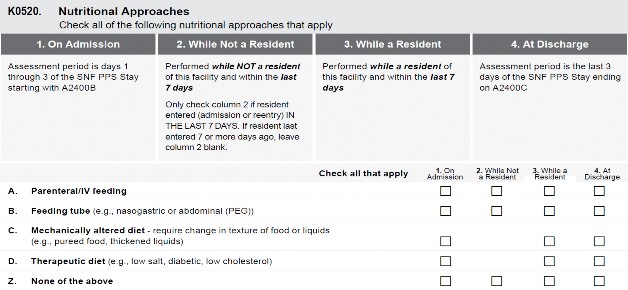
DEFINITIONS
PARENTERAL/IV FEEDING
Introduction of a nutritive substance into the
body by means other than the intestinal tract (e.g., subcutaneous, intravenous).
FEEDING TUBE
Presence of any type of tube that can deliver food/ nutritional substances/ fluids directly into the gastrointestinal system.
Examples include, but are not limited to, nasogastric tubes, gastrostomy tubes, jejunostomy tubes, percutaneous endoscopic gastrostomy (PEG) tubes.
DEFINITIONS
PARENTERAL/IV FEEDING
Introduction of a nutritive substance into the
body by means other than the intestinal tract (e.g., subcutaneous, intravenous).
FEEDING TUBE
Presence of any type of tube that can deliver food/ nutritional substances/ fluids directly into the gastrointestinal system.
Examples include, but are not limited to, nasogastric tubes, gastrostomy tubes, jejunostomy tubes, percutaneous endoscopic gastrostomy (PEG) tubes.
Nutritional approaches that vary from the normal (e.g., mechanically altered food) or that rely on alternative methods (e.g., parenteral/IV or feeding tubes) can diminish an individual’s sense of dignity and self-worth as well as diminish pleasure from eating.
The resident’s clinical condition may potentially benefit from the various nutritional approaches included here. It is important to work with the resident and family members to establish nutritional support goals that balance the resident’s preferences and overall clinical goals.
Alternative nutritional approaches should be monitored to validate effectiveness.
Care planning should include periodic reevaluation of the appropriateness of the approach.
DEFINITIONS
MECHANICALLY ALTERED DIET
A diet specifically prepared to alter the texture or consistency of food to facilitate oral intake.
Examples include soft solids, puréed foods, ground meat, and thickened liquids. A mechanically altered diet should not automatically be considered a therapeutic diet.
THERAPEUTIC DIET
A therapeutic diet is a diet intervention prescribed by a physician or other authorized nonphysician practitioner that provides food or nutrients via oral, enteral, and parenteral routes as part of treatment of disease or clinical condition, to modify, eliminate, decrease, or increase identified micro- and macro- nutrients in the diet (Academy of Nutrition and Dietetics, 2020).
DEFINITIONS
MECHANICALLY ALTERED DIET
A diet specifically prepared to alter the texture or consistency of food to facilitate oral intake.
Examples include soft solids, puréed foods, ground meat, and thickened liquids. A mechanically altered diet should not automatically be considered a therapeutic diet.
THERAPEUTIC DIET
A therapeutic diet is a diet intervention prescribed by a physician or other authorized nonphysician practitioner that provides food or nutrients via oral, enteral, and parenteral routes as part of treatment of disease or clinical condition, to modify, eliminate, decrease, or increase identified micro- and macro- nutrients in the diet (Academy of Nutrition and Dietetics, 2020).
K0520: Nutritional Approaches (cont.)
Review the medical record to determine if any of the listed nutritional approaches were performed during the look-back period.
If none apply, check K0520Z. None of the above.
Check all that apply. If none apply, check K0520Z, None of the above
Check all that apply. If none apply, check K0520Z, None of the above
K0520A, parenteral/IV feeding.
K0520B, feeding tube – nasogastric or abdominal (PEG).
K0520C, mechanically altered diet – require change in texture of food or liquids (e.g., pureed food, thickened liquids).
K0520D, therapeutic diet (e.g., low salt, diabetic, low cholesterol).
K0520Z, none of the above.
Check all nutritional approaches performed prior to
admission/entry or reentry to the facility and within the 7-day look-back period. Leave Column 2 blank if the resident was admitted/entered or reentered the facility more than 7 days ago.
When completing the Interim Payment Assessment (IPA), the completion of items K0520A, K0520B, and K0520Z is required.
Check all nutritional approaches performed after admission/entry or reentry to the facility and within the 7-day look-back period.
Coding Instructions for Column 4
K0520: Nutritional Approaches (cont.)
K0520A includes any and all nutrition and hydration received by the nursing home resident during the observation period either at the nursing home, at the hospital as an outpatient or an inpatient, provided they were administered for nutrition or hydration.
K0520A includes any and all nutrition and hydration received by the nursing home resident during the observation period either at the nursing home, at the hospital as an outpatient or an inpatient, provided they were administered for nutrition or hydration.
Parenteral/IV feeding—The following fluids may be included when there is supporting documentation that reflects the need for additional fluid intake specifically addressing a nutrition or hydration need. This supporting documentation should be noted in the resident’s medical record according to State and Federal Regulations and/or internal facility policy:
IV fluids or hyperalimentation, including total parenteral nutrition (TPN), administered continuously or intermittently
IV fluids running at KVO (Keep Vein Open)
IV fluids contained in IV Piggybacks
Hypodermoclysis and subcutaneous ports in hydration therapy
IV fluids can be coded in K0520A if needed to prevent dehydration if the additional fluid intake is specifically needed for nutrition and/or hydration. Prevention of dehydration should be clinically indicated and supporting documentation should be provided in the medical record.
The following items are NOT to be coded in K0520A:
IV Medications—Code these when appropriate in O0110H, IV Medications.
IV fluids used to reconstitute and/or dilute medications for IV administration.
IV fluids administered as a routine part of an operative or diagnostic procedure or recovery room stay.
IV fluids administered solely as flushes.
Parenteral/IV fluids administered in conjunction with chemotherapy or dialysis.
Enteral feeding formulas:
Should not be coded as a mechanically altered diet.
Should only be coded as K0520D, Therapeutic Diet when the enteral formula is altered to manage problematic health conditions, e.g. enteral formulas specific to residents with diabetes.
Only feeding tubes that are used to deliver nutritive substances and/or hydration during the assessment period are coded in K0520B.
K0520: Nutritional Approaches (cont.)
Assessors should not capture a trial of a mechanically altered diet (e.g., pureed food, thickened liquids) during the observation period in K0520C, mechanically altered diet.
Therapeutic diets are not defined by the content of what is provided or when it is served, but why the diet is required. Therapeutic diets provide the corresponding treatment that addresses a particular disease or clinical condition which is manifesting an altered nutritional status by providing the specific nutritional requirements to remedy the alteration.
A nutritional supplement (house supplement or packaged) given as part of the treatment for a disease or clinical condition manifesting an altered nutrition status, does not constitute a therapeutic diet, but may be part of a therapeutic diet. Therefore, supplements (whether given with, in-between, or instead of meals) are only coded in K0520D, Therapeutic Diet when they are being administered as part of a therapeutic diet to manage problematic health conditions (e.g. supplement for protein-calorie malnutrition).
Food elimination diets related to food allergies (e.g. peanut allergy) can be coded as a therapeutic diet.
Resident H was diagnosed in the acute hospital with a soft tissue infection. A treatment regime was initiated in the acute hospital, including IV antibiotics received every 8 hours within the last 7 days. Because the resident was assessed in the acute hospital with inadequate oral fluid intake demonstrating signs and symptoms of dehydration, the acute care physician ordered that the antibiotic be reconstituted with 250 cc of normal saline rather than 100 cc, which is the minimum amount required for reconstitution. This IV antibiotic and fluid regimen continues for 7 additional days following admission to the SNF due to continued infection and decreased oral intake.
Coding: K0520A1, K0520A2, and K0520A3 would be checked. The IV medication would be coded at IV Medications item (O0110H).
Rationale: The resident’s physician in the acute care hospital ordered additional volume of dilutant for the IV medication reconstitution to address Resident H’s inadequate oral fluid intake. The treatment regime continues upon admission to the SNF to address hydration needs. There is supporting documentation that reflected an identified need for additional fluid intake for hydration.
Resident J is receiving an antibiotic in 100 cc of normal saline via IV. They have a UTI, no fever, and documented adequate fluid intake. They are placed on the nursing home’s hydration plan to ensure adequate hydration.
Coding: K0520A1 would NOT be checked. The IV medication would be coded at
IV Medications item (O0110H).
Rationale: Although the resident received the additional fluid, there is no documentation to support a need for additional fluid intake.
K0520: Nutritional Approaches (cont.)
Resident Q will be discharged today following a 16-day stay in the nursing home. They were receiving rehabilitation services for a stroke. They have longstanding celiac disease and therefore were placed on a gluten-free diet. Because of their recent stroke, they also have documented dysphagia requiring a mechanical soft diet and honey-thick liquids to prevent aspiration and will be discharged on this same diet.
Coding: K0520C3 and K0520C4, as well as K0520D3 and K0520D4, would be checked.
Rationale: Resident Q required both a mechanically altered diet (i.e., mechanical soft diet and honey-thick liquids) and a therapeutic diet (i.e., gluten free) for their celiac disease in the last 7 days as well as at discharge.
Resident B will be discharged today after rehabilitation services for multiple fractures sustained in a car accident. Resident B has been on a regular diet during their entire stay and has not required any parenteral or enteral nutrition. During the acute hospital stay Resident B required a mechanical soft diet following the accident. The resident upgraded to a regular texture diet prior to discharge from the hospital.
Coding: K0520Z3and K0520Z4 would be checked.
Rationale: Resident B had a regular diet their entire stay and did not require any nutritional modifications.
K0710: Percent Intake by Artificial Route
Complete K0710 only if Column 2 and/or Column 3 are checked for K0520A and/or K0520B.
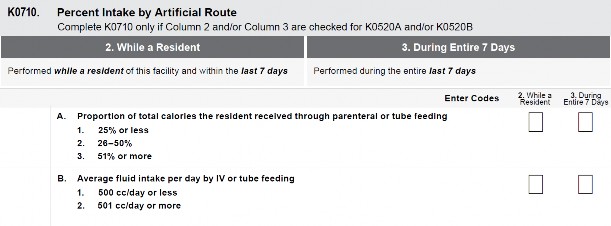
K0710: Percent Intake by Artificial Route (cont.)
Nutritional approaches that vary from the normal, such as parenteral/IV or feeding tubes, can diminish an individual’s sense of dignity and self-worth as well as diminish pleasure from eating.
The proportion of calories received through artificial routes should be monitored with periodic reassessment to ensure adequate nutrition and hydration.
Periodic reassessment is necessary to facilitate transition to increased oral intake as indicated by the resident’s condition.
K0710A, Proportion of Total Calories the Resident Received through Parenteral or Tube Feeding
Review intake records within the last 7 days to determine actual intake through parenteral or tube feeding routes.
Calculate proportion of total calories received through these routes.
If the resident took no food or fluids by mouth or took just sips of fluid, stop here and
code 3, 51% or more.
If the resident had more substantial oral intake than sips of fluid, consult with the
qualified dietitian or other clinically qualified nutrition professional.
Select the best response:
1. 25% or less 2. 26% to 50%
3. 51% or more
K0710: Percent Intake by Artificial Route (cont.)
1. Calculation for Proportion of Total Calories from IV or Tube Feeding
Resident H has had a feeding tube since their surgery two weeks ago. They are currently more alert and feeling much better. They have been taking soft solids by mouth, but only in small to medium amounts. Within the last 7 days, they have been receiving tube feedings for nutritional supplementation. The dietitian has totaled their calories per day as follows:
Oral an
| d Tube Feedin
| g Intake
|
| Oral
| Tube
|
Sun.
| 500
| 2,000
|
Mon.
| 250
| 2,250
|
Tues.
| 250
| 2,250
|
Wed.
| 350
| 2,250
|
Thurs.
| 500
| 2,000
|
Fri.
| 250
| 2,250
|
Sat.
| 350
| 2,000
|
Total
| 2,450
| 15,000
|
Coding: K0710A columns 2 and 3 would be coded 3, 51% or more.
Rationale: Total Oral intake is 2,450 calories
Total Tube intake is 15,000 calories Total calories is 2,450 + 15,000 = 17,450
Calculation of the percentage of total calories by tube feeding: 15,000/17,450 = .859 X 100 = 85.9%
Resident H received 85.9% of their calories by tube feeding, therefore K0710A code 3, 51% or more is correct.
K0710B, Average Fluid Intake per Day by IV or Tube Feeding Steps for Assessment
Review intake records from the last 7 days.
Add up the total amount of fluid received each day by IV and/or tube feedings only.
Divide the week’s total fluid intake by 7 to calculate the average of fluid intake per day.
Divide by 7 even if the resident did not receive IV fluids and/or tube feeding on each of the 7 days.
Code for the average number of cc per day of fluid the resident received via IV or tube feeding. Record what was actually received by the resident, not what was ordered.
Code for the average number of cc per day of fluid the resident received via IV or tube feeding. Record what was actually received by the resident, not what was ordered.
Code 1: 500 cc/day or less
Code 2: 501 cc/day or more
K0710: Percent Intake by Artificial Route (cont.)
Calculation for Average Daily Fluid Intake
Resident A, a long term care resident, has swallowing difficulties secondary to Huntington’s disease. They are able to take oral fluids by mouth with supervision, but not enough to maintain hydration. They received the following daily fluid totals by supplemental tube feedings (including water, prepared nutritional supplements, juices) within the last 7 days.
IV Fluid Intake
|
Sun.
| 1250 cc
|
Mon.
| 775 cc
|
Tues.
| 925 cc
|
Wed.
| 1200 cc
|
Thurs.
| 1200 cc
|
Fri.
| 500 cc
|
Sat.
| 450 cc
|
Total
| 6,300 cc
|
Coding: K0710B columns 2 and 3 would be coded 2, 501cc/day or more.
Rationale: The total fluid intake by supplemental tube feedings = 6,300 cc 6,300 cc divided by 7 days = 900 cc/day
900 cc is greater than 500 cc, therefore code 2, 501 cc/day or more is correct.
K0710: Percent Intake by Artificial Route (cont.)
Resident K has been able to take some fluids orally; however, due to their progressing multiple sclerosis, their dysphagia is not allowing them to remain hydrated enough. Therefore, they received the following fluid amounts within the last 7 days via supplemental tube feedings while in the hospital and after they were admitted to the nursing home.
While in the Nursing
While in the Hospital Home
|
Mon.
| 400 cc Fri. 510 cc
|
Tues.
| 520 cc Sat. 520 cc
|
Wed.
| 500 cc Sun. 490 cc
|
Thurs.
| 480 cc
|
Total
| 1,900 cc Total 1,520 cc
|
Coding: K0710B2 would be coded 2, 501 cc/day or more, and K0710B3 would be coded 1, 500 cc/day or less.
Rationale: The total fluid intake within the last 7 days while Resident K was a resident of the nursing home was 1,520 cc (510 cc + 520 cc + 490 cc = 1,520 cc). Average fluid intake while a resident totaled 507 cc (1,520 cc divided by 3 days). 507 cc is greater than 500 cc, therefore code 2, 501 cc/day or more is correct for K0710B2, While a Resident.
The total fluid intake during the entire 7 days (includes fluid intake while Resident K was in the hospital AND while Resident K was a resident of the nursing home) was 3,420 cc (1,900 cc + 1,520 cc). Average fluid intake during the entire 7 days was 489 cc (3,420 cc divided by 7 days). 489 cc is less than 500 cc, therefore code 1, 500 cc/day or less is correct for K0710B3, During Entire 7 Days.