Intent: This section includes items about functional abilities. It includes items focused on prior function, admission and discharge performance, performance throughout a resident’s stay, mobility device use, and range of motion. Functional status is assessed based on the need for assistance when performing self-care and mobility activities.
GG0100. Prior Functioning: Everyday Activities
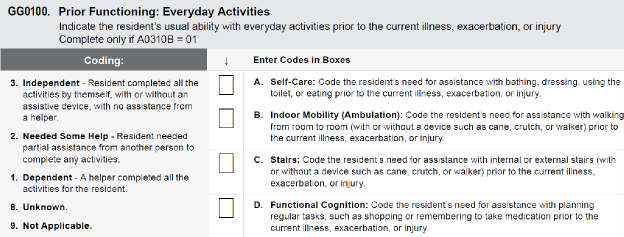
Ask the resident or their family about, or review the resident’s medical records describing, the resident’s prior functioning with everyday activities.
Code 3, Independent: if the resident completed the activities by themself, with or without an assistive device, with no assistance from a helper.
Code 2, Needed Some Help: if the resident needed partial assistance from another person to complete the activities.
Code 1, Dependent: if the helper completed the activities for the resident, or the assistance of two or more helpers was required for the resident to complete the activities.
Code 8, Unknown: if the resident’s usual ability prior to the current illness, exacerbation, or injury is unknown.
Code 9, Not Applicable: if the activities were not applicable to the resident prior to the current illness, exacerbation, or injury.
GG0100: Prior Functioning: Everyday Activities (cont.)
Record the resident’s usual ability to perform self-care, indoor mobility (ambulation), stairs, and functional cognition prior to the current illness, exacerbation, or injury.
If no information about the resident’s ability is available after attempts to interview the resident or their family and after reviewing the resident’s medical record, code as 8, Unknown.
Completing the stair activity for GG0100C indicates that a resident went up and down the stairs, by any safe means, with or without handrails or assistive devices or equipment (such as a cane, crutch, walker, or stair lift) and/or with or without some level of assistance.
For the GG0100C stair activity, “by any safe means” may include a resident scooting up and down stairs on their buttocks.
Going up and down a ramp is not considered going up and down stairs for coding GG0100C.
Self-Care: Resident R was diagnosed with a progressive neurologic condition five years ago. They live in a long-term nursing facility and were recently hospitalized for surgery and have now been admitted to the SNF for skilled services. According to Resident R’s spouse, prior to the surgery, Resident R required complete assistance with self-care activities, including eating, bathing, dressing, and using the toilet.
Coding: GG0100A would be coded 1, Dependent.
Rationale: Resident R’s spouse has reported that Resident R was completely dependent in self-care activities that included eating, bathing, dressing, and using the toilet. Code 1, Dependent, is appropriate based upon this information.
Indoor Mobility (Ambulation): Resident L had a stroke one year ago that resulted in their using a wheelchair to self-mobilize, as they were unable to walk. Resident L subsequently had a second stroke and was transferred from an acute care unit to the SNF for skilled services.
Coding: GG0100B would be coded 9, Not Applicable.
Rationale: The resident did not ambulate immediately prior to the current illness, injury, or exacerbation (the second stroke).
GG0100: Prior Functioning: Everyday Activities (cont.)
Stairs: Resident P has expressive aphasia and difficulty communicating. SNF staff have not received any response to their phone messages to Resident P’s family members requesting a return call. Resident P has not received any visitors since their admission. The medical record from their prior facility does not indicate Resident P’s prior functioning. There is no information to code item GG0100C, but there have been attempts at seeking this information.
Coding: GG0100C would be coded 8, Unknown.
Rationale: Attempts were made to seek information regarding Resident P’s prior functioning; however, no information was available.
Functional Cognition: Resident K has mild dementia and recently sustained a fall resulting in complex multiple fractures requiring multiple surgeries. Resident K has been admitted to the SNF for rehabilitation. Resident K’s caregiver reports that when living at home, Resident K needed reminders to take their medications on time, manage their money, and plan tasks, especially when they were fatigued.
Coding: GG0100D would be coded 2, Needed Some Help.
Rationale: Resident K required some help to recall, perform, and plan regular daily activities as a result of cognitive impairment.
GG0110. Prior Device Use
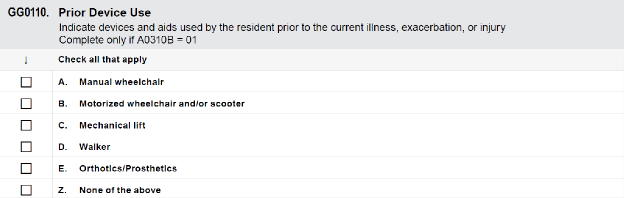
Ask the resident or their family or review the resident’s medical records to determine the resident’s use of prior devices and aids.
Check all devices that apply.
Check Z, None of the above: if the resident did not use any of the listed devices or aids immediately prior to the current illness, exacerbation, or injury.
For GG0110D, Prior Device Use - Walker: “Walker” refers to all types of walkers (for example, pickup walkers, hemi-walkers, rolling walkers, and platform walkers).
GG0110C, Mechanical lift, includes sit-to-stand, stand assist, stair lift, and full-body- style lifts.
Clinical judgment may be used to determine whether other devices meet the definition provided.
Resident M is a bilateral lower extremity amputee and has multiple diagnoses, including diabetes, obesity, and peripheral vascular disease. They are unable to walk and did not walk prior to the current episode of care, which started because of a pressure ulcer and respiratory infection. They use a motorized wheelchair to mobilize.
Coding: GG0110B would be checked.
Rationale: Resident M used a motorized wheelchair prior to the current illness/injury.
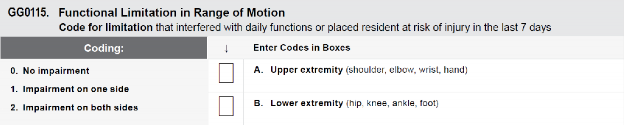
GG0115: Functional Limitation in Range of Motion
DEFINITION
FUNCTIONAL LIMITATION IN RANGE OF MOTION
Limited ability to move a joint that interferes with daily functioning (particularly with activities of daily living) or places the resident at risk of injury.
DEFINITION
FUNCTIONAL LIMITATION IN RANGE OF MOTION
Limited ability to move a joint that interferes with daily functioning (particularly with activities of daily living) or places the resident at risk of injury.
Intent: The intent of GG0115 is to determine whether functional limitation in range of motion (ROM) interferes with the resident’s activities of daily living or places them at risk of injury. When completing this item, staff members should refer to items in GG0130 and GG0170 and view the limitation in ROM, taking into account activities the resident is able to perform.
Functional impairment could place the resident at risk of injury or interfere with performance of activities of daily living.
Individualized care plans should address possible reversible causes such as deconditioning and adverse side effects of medications or other treatments.
Review the medical record for references to functional range-of-motion limitation during the 7-day observation period.
Talk with staff members who work with the resident as well as family/significant others about any impairment in functional ROM.
Coding for functional ROM limitations is a three-step process:
Test the resident’s upper and lower extremity ROM (See item 6 below for examples).
If the resident is noted to have limitation of upper- and/or lower-extremity ROM, review GG0130 and GG0170 and/or directly observe the resident to determine whether the limitation interferes with function or places the resident at risk for injury.
Code GG0115A and GG0115B as appropriate based on the above assessment.
Assess the resident’s ROM bilaterally at the shoulder, elbow, wrist, hand, hip, knee, ankle, foot, and other joints unless contraindicated (e.g., recent fracture, joint replacement or pain).
Staff member observations of various activities, including ADLs, may be used to determine whether any ROM limitations have an impact on the resident’s functional abilities.
GG0115: Functional Limitation in Range of Motion (cont.)
Although this item codes for the presence or absence of functional limitation related to ROM, thorough assessment ought to be comprehensive and follow standards of practice for evaluating ROM impairment. Below are some suggested assessment strategies:
Ask the resident to follow your verbal instructions for each movement.
Demonstrate each movement (e.g., ask the resident to do what you are doing).
Actively assist the resident with the movements by supporting their extremity and guiding it through the joint ROM.
Lower Extremity—includes hip, knee, ankle, and foot
While resident is lying supine in a flat bed, instruct the resident to flex (pull toes up toward head) and extend (push toes down away from head) each foot. Then ask the resident to lift their leg one at a time, bending it at the knee to a right angle (90 degrees). Then ask the resident to slowly lower their leg and extend it flat on the mattress. If assessing lower- extremity ROM by observing the resident, the flexion and extension of the foot mimics the motion on the pedals of a bicycle. Extension might also be needed to don a shoe. If assessing bending at the knee, the motion would be similar to lifting of the leg when donning lower- body clothing.
Upper Extremity—includes shoulder, elbow, wrist, and fingers
For each hand, instruct the resident to make a fist and then open the hand. With resident seated in a chair, instruct them to reach with both hands and touch palms to back of head. Then ask resident to touch each shoulder with the opposite hand. Alternatively, observe the resident donning or removing a shirt over the head. If assessing upper-extremity ROM by observing the resident, making a fist mimics useful actions for grasping and letting go of utensils. When an individual reaches both hands to the back of the head, this mimics the action needed to comb hair.
Do not look at limited ROM in isolation. You must determine whether the limited ROM has an impact on functional ability or places the resident at risk for injury. For example, if the resident has an amputation, it does not automatically mean that they are limited in function. A resident with an amputation may not have a particular joint in which a certain range of motion can be tested, however, that does not mean that the resident necessarily has a limitation in completing activities of daily living, nor does it mean that the resident is automatically at risk of injury. There are many amputees who function extremely well and can complete all activities of daily living either with or without the use of prosthetics. If a resident with an amputation does indeed have difficulty completing ADLs and is at risk for injury, the facility should code this item as appropriate. This item is coded in terms of function and risk of injury, not by diagnosis or lack of a limb or digit.
GG0115: Functional Limitation in Range of Motion (cont.)
Coding Instructions for GG0115A, Upper Extremity (Shoulder, Elbow, Wrist, Hand); GG0115B, Lower Extremity (Hip, Knee, Ankle, Foot)
Code 0, no impairment: if resident has full functional range of motion on the right and left side of upper/lower extremities.
Code 1, impairment on one side: if resident has an upper- and/or lower-extremity impairment on one side that interferes with daily functioning or places the resident at risk of injury.
Code 2, impairment on both sides: if resident has an upper- and/or lower- extremity impairment on both sides that interferes with daily functioning or places the resident at risk of injury.
Examples for GG0115A, Upper Extremity (Shoulder, Elbow, Wrist, Hand); GG0115B, Lower Extremity (Hip, Knee, Ankle, Foot)
The resident can perform all arm, hand, and leg motions on the right side, with smooth coordinated movements. They are able to perform grooming activities (e.g., brush their teeth, comb their hair) with their right upper extremity and are also able to pivot to their wheelchair with the assistance of one person. They are, however, unable to voluntarily move their left side (limited arm, hand, and leg motion), as they have a flaccid left hemiparesis from a prior stroke.
Coding: GG0115A would be coded 1, upper-extremity impairment on one side. GG0115B would be coded 1, lower-extremity impairment on one side.
Rationale: Impairment due to left hemiparesis affects both upper and lower extremities on one side. Even though this resident has limited ROM that impairs function on the left side, as indicated above, the resident can perform ROM fully on the right side. Even though there is impairment on one side, the facility should always attempt to provide the resident with assistive devices or physical assistance that allows the resident to be as independent as possible.
The resident had shoulder surgery and can’t brush their hair with their right arm or raise their right arm above their head. The resident can brush their hair with their left arm and has no impairment on the lower extremities.
Coding: GG0115A would be coded 1, upper-extremity impairment on one side. GG0115B would be coded 0, no impairment.
Rationale: Impairment due to shoulder surgery affects only one side of their upper extremities.
GG0115: Functional Limitation in Range of Motion (cont.)
The resident has a diagnosis of Parkinson’s and ambulates with a shuffling gait. The resident has had three falls in the past quarter and often forgets their walker, which they need to ambulate. They have tremors of both upper extremities that make it very difficult for them to feed themself, brush their teeth, or write.
Coding: GG0115A would be coded 2, upper-extremity impairment on both sides. GG0115B would be coded 2, lower-extremity impairment on both sides.
Rationale: Impairment due to Parkinson’s disease affects the resident’s upper and lower extremities on both sides.
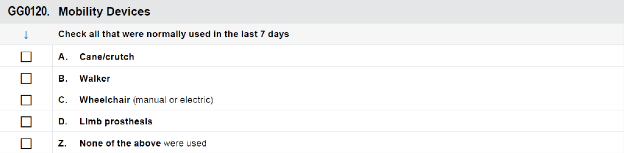
GG0120: Mobility Devices
Maintaining independence is important to an individual’s feelings of autonomy and self- worth. The use of devices may assist the resident in maintaining that independence.
A resident’s ability to move about their room, unit or nursing home may be directly related to the use of devices. It is critical that staff members assure that the resident’s independence is optimized by making mobility devices available on a daily basis, if needed.
Review the medical record for references to locomotion during the 7-day observation period.
Talk with staff members who work with the resident as well as family/significant others about devices the resident used for mobility during the observation period.
Observe the resident during locomotion.
GG0120: Mobility Devices (cont.)
Record the type(s) of mobility devices the resident normally uses for locomotion (in room and in facility). Check all that apply:
Record the type(s) of mobility devices the resident normally uses for locomotion (in room and in facility). Check all that apply:
Check GG0120A, Cane/crutch: if the resident used a cane or crutch, including single-prong, tripod, quad cane, etc.
Check GG0120B, Walker: if the resident used a walker or hemi-walker, including an enclosed frame-wheeled walker with or without a posterior seat and lap cushion. Also check this item if the resident walks while pushing a wheelchair for support.
Check GG0120C, Wheelchair (manual or electric): if the resident normally sits in a wheelchair when moving about. Include wheelchairs that are hand propelled, motorized, or pushed by another person. Do not include geri-chairs, reclining chairs with wheels, positioning chairs, scooters, and other types of specialty chairs.
Check GG0120D, Limb prosthesis: if the resident used an artificial limb to replace a missing extremity.
Check GG0120Z, None of the above: if the resident used none of the mobility devices listed in GG0120 or locomotion did not occur during the observation period.
The resident uses a quad cane daily to walk in the room and on the unit. The resident uses a standard push wheelchair that they self-propel when leaving the unit because of their issues with endurance.
Coding: GG0120A, Cane/crutch, and GG0120C, Wheelchair, would be checked. Rationale: The resident uses a quad cane in their room and on the unit and a wheelchair off the unit.
The resident has an artificial leg that is applied each morning and removed each evening. Once the prosthesis is applied, the resident is able to ambulate independently.
Coding: GG0120D, Limb prosthesis, would be checked.
Rationale: The resident uses a leg prosthesis for ambulating.
GG0130: Self-Care and GG0170: Mobility
Health-related Quality of Life
DEFINITION
ADL
Tasks related to personal care, such as any of the tasks listed in GG0130 and GG0170.
DEFINITION
ADL
Tasks related to personal care, such as any of the tasks listed in GG0130 and GG0170.
Residents may have self-care and mobility limitations on admission. In addition, residents may be at risk of further functional decline during their stay in the facility.
Most nursing home residents need some physical assistance and are at risk of further physical decline. The amount of assistance needed and the risk of decline vary from resident to resident.
A wide range of physical, neurological, and psychological conditions and cognitive factors can adversely affect physical function.
Dependence on others for ADL assistance can lead to feelings of helplessness, isolation, diminished self-worth, and loss of control over one’s destiny.
As inactivity increases, complications such as pressure ulcers, falls, contractures, depression, and muscle wasting may occur.
Individualized care plans should address strengths and weaknesses, possible reversible causes such as deconditioning, and adverse side effects of medications or other treatments. These may contribute to loss of self-sufficiency. In addition, some neurologic injuries such as stroke may continue to improve for months after an acute event.
For some residents, cognitive deficits can limit ability or willingness to initiate or participate in self-care or restrict understanding of the tasks required to complete ADLs.
Individualized care plans should be based on an accurate assessment of the resident’s self-performance and the amount and type of support being provided to the resident.
Many residents may require lower levels of assistance if they are provided with appropriate devices and aids, assisted with segmenting tasks, or given adequate time to complete a task while being provided with graduated prompting and assistance. This type of supervision requires skill, time, and patience.
Most residents are candidates for nursing-based rehabilitative care that focuses on maintaining and expanding self-involvement in ADLs.
Graduated prompting/task segmentation (helping the resident break tasks down into smaller components) and allowing the resident time to complete an activity can often increase functional independence.
GG0130: Self-Care and GG0170: Mobility (cont.)
DEFINITIONS
PRIOR TO THE BENEFIT
OF SERVICES means prior to provision of any care by facility staff that would result in more independent coding.
QUALIFIED CLINICIANS
Healthcare professionals practicing within their scope of practice and consistent with Federal, State, and local law and regulations.
USUAL PERFORMANCE
A resident’s functional status can be impacted by the environment or situations encountered at the facility.
Observing the resident’s interactions with others in different locations and circumstances is important for a comprehensive understanding of the resident’s functional status. If the resident’s functional status varies, record the resident’s usual ability to perform each activity. Do not record the resident’s best performance and do not record the resident’s worst performance, but rather record the resident’s usual performance.
DEFINITIONS
PRIOR TO THE BENEFIT
OF SERVICES means prior to provision of any care by facility staff that would result in more independent coding.
QUALIFIED CLINICIANS
Healthcare professionals practicing within their scope of practice and consistent with Federal, State, and local law and regulations.
USUAL PERFORMANCE
A resident’s functional status can be impacted by the environment or situations encountered at the facility.
Observing the resident’s interactions with others in different locations and circumstances is important for a comprehensive understanding of the resident’s functional status. If the resident’s functional status varies, record the resident’s usual ability to perform each activity. Do not record the resident’s best performance and do not record the resident’s worst performance, but rather record the resident’s usual performance.
Assess the resident’s self-care and mobility performance based on direct observation, incorporating the resident’s self-report and reports from qualified clinicians, care staff, or family documented in the resident’s medical record during the assessment period. CMS anticipates that an interdisciplinary team of clinicians is involved in assessing the resident during the assessment period.
For residents in a Medicare Part A stay, the admission assessment period is the first 3 days of the Part A stay starting with the date in A2400B, the Start of Most Recent Medicare Stay. The admission assessment period for residents who are not in a Medicare Part A stay is the first 3 days of their stay starting with the date in A1600, Entry Date.


o Note: If A0310B = 01 and A0310A = 01 – 06
indicating a 5-day PPS assessment combined with
an OBRA assessment, the assessment period is the first 3 days of the stay beginning on A2400B. In these scenarios, do not complete Column 5.
OBRA/Interim Performance.
For residents in a Medicare Part A stay, the assessment period for the Interim Payment Assessment
(A0310B = 08) is the last 3 days (i.e., the ARD plus 2 previous calendar days).
For residents in a Medicare Part A stay, the discharge assessment period is the End Date of Most Recent Medicare Stay (A2400C) plus 2 previous calendar days. For all other Discharge assessments, the assessment period is A2000, Discharge Date plus 2 previous calendar days.
When completing an OBRA-required assessment other than an Admission assessment (i.e., A0310A = 02 – 06), the assessment period is the ARD plus 2 previous calendar days.
GG0130: Self-Care and GG0170: Mobility (cont.)
For the purposes of completing items GG0130 and GG0170, a “helper” is defined as facility staff who are direct employees and facility-contracted employees (e.g., rehabilitation staff, nursing agency staff). Thus, “helper” does not include individuals hired, compensated or not, by individuals outside of the facility’s management and administration such as hospice staff, nursing/certified nursing assistant students, etc. Therefore, when helper assistance is required because a resident’s performance is unsafe or of poor quality, consider only facility staff when scoring according to the amount of assistance provided.
Allow the resident to complete each activity as independently as possible, as long as they are safe, regardless of how the resident performed the activity prior to the current illness, exacerbation, or injury. Activities may be completed with or without an assistive device. This includes the use of any new or previously utilized assistive device(s) or equipment. Use of a device or equipment may result in the resident needing less assistance from a helper.
If helper assistance is required because the resident’s performance is unsafe or of poor quality, score according to the type and amount of assistance provided.
Refer to facility, Federal, and State policies and procedures to determine which staff members may complete an assessment. Resident assessments are to be done in compliance with facility, Federal, and State requirements.
For residents in a Medicare Part A stay, the admission functional assessment, when possible, should be conducted prior to the resident benefiting from treatment interventions in order to reflect the resident’s true admission baseline functional status. If treatment has started, for example, on the day of admission, a baseline functional status assessment can still be conducted. Treatment should not be withheld in order to conduct the functional assessment.
Assessment of the GG self-care and mobility items is based on the resident’s ability to complete the activity with or without assistance and/or a device. This is true regardless of whether or not the activity is being/will be routinely performed (e.g., walking might be assessed for a resident who did/does/will use a wheelchair as their primary mode of mobility, stair activities might be assessed for a resident not routinely accessing stairs).
GG0130: Self-Care and GG0170: Mobility (cont.)
Admission: The 5-Day PPS assessment (A0310B = 01) is the first Medicare-required assessment to be completed when the resident is admitted for a SNF Part A stay. Additionally, an OBRA Admission assessment (A0310A = 1) is required for a new resident and, under some circumstances, a returning resident and must be completed by the end of day 14. Please refer to Section 2.6 of this Manual for additional information about the OBRA Admission assessment.
For the 5-Day PPS assessment, code the resident’s functional status based on a clinical assessment of the resident’s performance that occurs soon after the resident’s admission. This functional assessment must be completed within the first three days (3 calendar days) of the Medicare Part A stay, starting with the date in A2400B, Start of Most Recent Medicare Stay, and the following two days, ending at 11:59 PM on day 3. The admission function scores are to reflect the resident’s admission baseline status and are to be based on an assessment. The scores should reflect the resident’s status prior to any benefit from interventions. The assessment should occur prior to the resident benefitting from treatment interventions in order to determine the resident’s true admission baseline status. Even if treatment started on the day of admission, a baseline functional status assessment can still be conducted. Treatment should not be withheld in order to conduct the functional assessment.
For an OBRA Admission assessment, code the resident’s usual performance during first 3 days of their stay starting with the date in A1600, Entry Date.
OBRA/Interim: The Interim Payment Assessment (IPA) (A0310B = 08) is an optional assessment that may be completed by providers in order to report a change in the resident’s PDPM classification. OBRA assessments (A0310A = 01 – 06) are required for residents in Medicare-certified, Medicaid-certified, or dually certified nursing homes and are outlined in Chapter 2 of this Manual.
For Section GG on the IPA or an OBRA assessment, providers will use the same 6- point scale and activity not attempted codes to assess the resident’s usual functional performance during the 3-day assessment period.
The ARD for the IPA is determined by the provider, and the assessment period is the last 3 days (i.e., the ARD plus 2 previous calendar days). It is important to note that the IPA changes payment beginning on the ARD and continues until the end of the Medicare Part A stay or until another IPA is completed. The IPA does not affect the variable per diem schedule.
For Section GG on OBRA assessments other than the Admission assessment (i.e., A0310A = 02 – 06), the assessment period is the last 3 days (i.e., the ARD plus 2 previous calendar days).
GG0130: Self-Care and GG0170: Mobility (cont.)
Discharge: The Part A PPS Discharge assessment is required to be completed as a standalone assessment when the resident’s Medicare Part A Stay ends (as documented in A2400C, End of Most Recent Medicare Stay) and the resident remains in the facility. The Part A PPS Discharge assessment must be combined with an OBRA Discharge if the Medicare Part A stay ends on the day of, or one day before, the resident’s Discharge Date (A2000). An OBRA Discharge assessment is required when the resident is discharged from the facility. Please see Chapter 2 and Section A of the RAI Manual for additional details regarding Discharge assessments.
For the PPS Discharge assessment (i.e., standalone Part A PPS or combined OBRA/Part A PPS), code the resident’s discharge functional status, based on a clinical assessment of the resident’s performance that occurs as close to the time of the resident’s discharge from Medicare Part A as possible. This functional assessment must be completed within the last 3 calendar days of the resident’s Medicare Part A stay, which includes the day of discharge from Medicare Part A plus 2 previous calendar days prior to the day of discharge from Medicare Part A.
On standalone OBRA Discharge assessments (i.e., A0310F = 10 or 11 AND A0310H = 0), code the resident’s usual performance during last 3 days of their stay (i.e., A2000, Discharge Date plus 2 previous calendar days).
When coding the resident’s usual performance, use the six-point scale, or use one of the four “activity was not attempted” codes to specify the reason why an activity was not attempted.
Code 06, Independent: if the resident completes the activity by themself with no assistance from a helper.
Code 05, Setup or clean-up assistance: if the helper sets up or cleans up; resident completes activity. Helper assists only prior to or following the activity, but not during the activity. For example, the resident requires assistance cutting up food or opening container, or requires setup of hygiene item(s) or assistive device(s).
Code 04, Supervision or touching assistance: if the helper provides verbal cues or touching/steadying/contact guard assistance as resident completes activity. Assistance may be provided throughout the activity or intermittently. For example, the resident requires verbal cueing, coaxing, or general supervision for safety to complete activity; or resident may require only incidental help such as contact guard or steadying assist during the activity.
Code 04, Supervision or touching assistance: if the resident requires only verbal cueing to complete the activity safely.
GG0130: Self-Care and GG0170: Mobility (cont.)
Code 03, Partial/moderate assistance: if the helper does LESS THAN HALF the effort. Helper lifts, holds, or supports trunk or limbs, but provides less than half the effort.
Code 02, Substantial/maximal assistance: if the helper does MORE THAN HALF the effort. Helper lifts or holds trunk or limbs and provides more than half the effort.
Code 01, Dependent: if the helper does ALL of the effort. Resident does none of the effort to complete the activity; or the assistance of two or more helpers is required for the resident to complete the activity.
Code 01, Dependent: if two helpers are required for the safe completion of an activity, even if the second helper provides supervision/stand-by assist only and does not end up needing to provide hands-on assistance.
Code 01, Dependent: if a resident requires the assistance of two helpers to complete an activity (one to provide support to the resident and a second to manage the necessary equipment to allow the activity to be completed).
Code 07, Resident refused: if the resident refused to complete the activity.
Code 09, Not applicable: if the activity was not attempted and the resident did not perform this activity prior to the current illness, exacerbation, or injury.
Code 10, Not attempted due to environmental limitations: if the resident did not attempt this activity due to environmental limitations. Examples include lack of equipment and weather constraints.
Code 88, Not attempted due to medical condition or safety concerns: if the activity was not attempted due to medical condition or safety concerns.
GG0130: Self-Care and GG0170: Mobility (cont.)
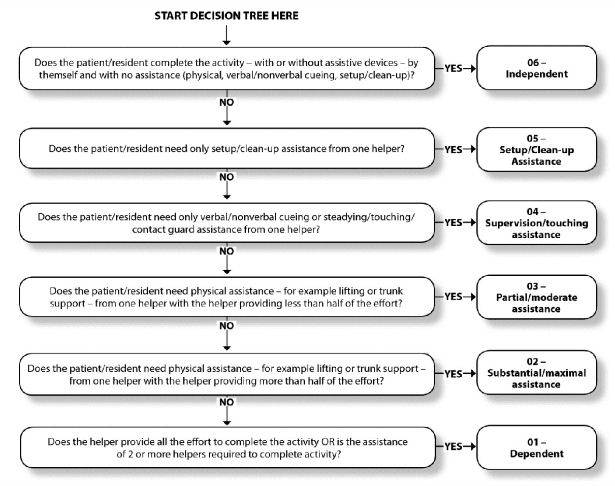
Decision Tree
Use this decision tree to code the resident’s performance on the assessment instrument. If helper assistance is required because the resident’s performance is unsafe or of poor quality, score according to the amount of assistance provided. Only use the “activity not attempted codes” if the activity did not occur; that is, the resident did not perform the activity and a helper did not perform that activity for the resident.
GG0130: Self-Care and GG0170: Mobility (cont.)
General coding tips
The assessment timeframe is up to 3 calendar days based on the target date. During the assessment timeframe, some activities may be performed by the resident multiple times, whereas other activities may only occur once.
A dash (–) indicates “No information.” CMS expects dash use to be a rare occurrence.
CMS does not provide an exhaustive list of assistive devices that may be used when coding self-care and mobility performance. Clinical assessments may include any device or equipment that the resident can use to allow them to safely complete the activity as independently as possible.
Do not code self-care and mobility activities with use of a device that is restricted to resident use during therapy sessions (e.g., parallel bars, exoskeleton, or overhead track and harness systems).
Coding tips for coding the resident’s usual performance
If two or more helpers are required to assist the resident in completing the activity, code as 01, Dependent.
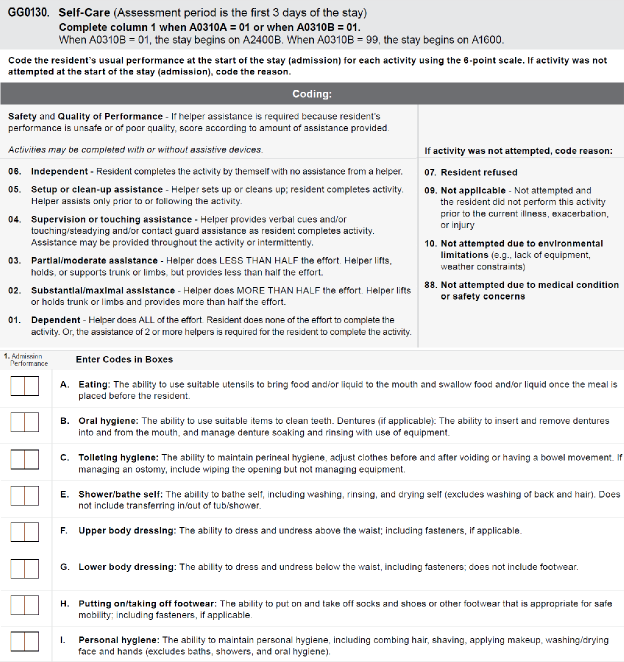
GG0130: Self-Care (3-day assessment period) Admission
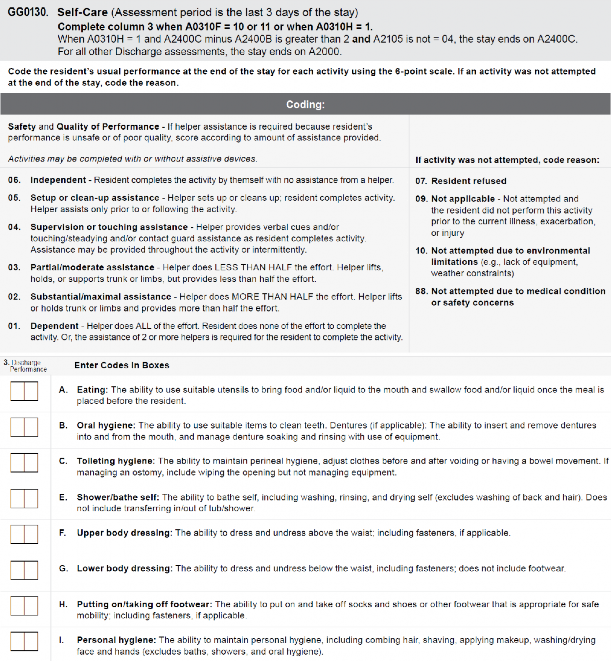
GG0130: Self-Care (3-day assessment period) Discharge
GG0130: Self-Care (OBRA/Interim)
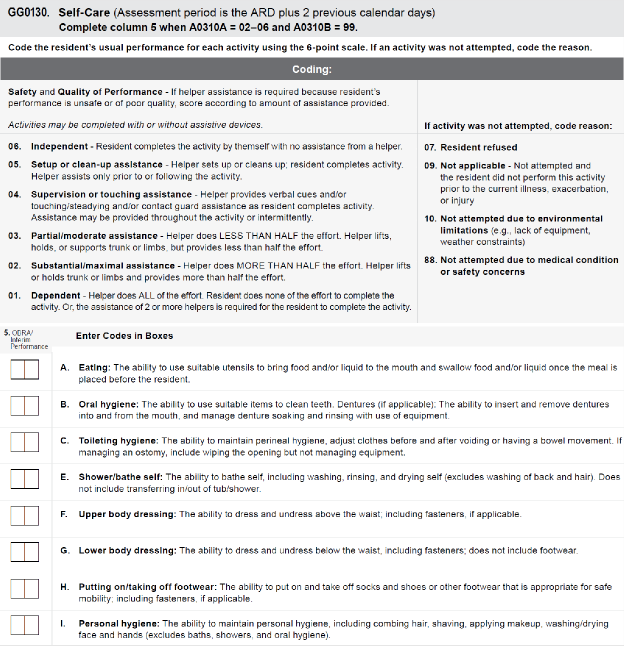
GG0130: Self-Care (cont.)
Note: The following are coding examples and coding tips for self-care items. Some examples describe a single observation of the resident completing the activity; other examples describe a summary of several observations of the resident completing an activity across different times of the day and different days.
The intent of GG0130A, Eating is to assess the resident’s ability to use suitable utensils to bring food and/or liquid to the mouth and swallow food and/or liquid once the meal is placed before the resident.
The adequacy of the resident’s nutrition or hydration is not considered for GG0130A, Eating.
The administration of tube feedings and parenteral nutrition is not considered when coding this activity.
The following is guidance for some situations in which a resident receives tube feedings or parenteral nutrition:
If the resident does not eat or drink by mouth and relies solely on nutrition and liquids through tube feedings or total parenteral nutrition (TPN) because of a new (recent- onset) medical condition, code GG0130A as 88, Not attempted due to medical condition or safety concerns.
If the resident does not eat or drink by mouth at the time of the assessment, and the resident did not eat or drink by mouth prior to the current illness, injury, or exacerbation, code GG0130A as 09, Not applicable - Not attempted and the resident did not perform this activity prior to the current illness, exacerbation, or injury.
If the resident eats and drinks by mouth, and relies partially on obtaining nutrition and liquids via tube feedings or parenteral nutrition, code Eating based on the amount of assistance the resident requires to eat and drink by mouth.
Assistance with tube feedings or parenteral nutrition is not considered when coding the item Eating.
If a resident requires assistance (e.g., supervision or cueing) to swallow safely, code based on the type and amount of assistance required for feeding and safe swallowing.
If a resident swallows safely without assistance, exclude swallowing from consideration when coding GG0130A, Eating.
If the resident eats finger foods using their hands, then code Eating based upon the amount of assistance provided. If the resident eats finger foods with their hands independently, for example, the resident would be coded as 06, Independent.
For a resident taking only fluids by mouth, the item may be coded based on ability to bring liquid to the mouth and swallow liquid, once the drink is placed in front of the resident.
GG0130: Self-Care (cont.)
Eating: Resident S has multiple sclerosis, affecting their endurance and strength. Resident S prefers to feed themself as much as they are capable. During all meals, after eating three- fourths of the meal by themself, Resident S usually becomes extremely fatigued and requests assistance from the certified nursing assistant to feed them the remainder of the meal.
Coding: GG0130A would be coded 03, Partial/moderate assistance.
Rationale: The certified nursing assistant provides less than half the effort for the resident to complete the activity of eating for all meals.
Eating: Resident M has upper extremity weakness and fine motor impairments. The occupational therapist places an adaptive device onto Resident M’s hand that supports the eating utensil within their hand. At the start of each meal Resident M can bring food and liquids to their mouth. Resident M then tires and the certified nursing assistant feeds them more than half of each meal.
Coding: GG0130A would be coded 02, Substantial/maximal assistance. Rationale: The helper provides more than half the effort for the resident to complete the activity of eating at each meal.
Eating: The dietary aide opens all of Resident S’s cartons and containers on their food tray before leaving the room. There are no safety concerns regarding Resident S’s ability to eat. Resident S eats the food themself, bringing the food to their mouth using appropriate utensils and swallowing the food safely.
Coding: GG0130A would be coded 05, Setup or clean-up assistance.
Rationale: The helper provided setup assistance prior to the eating activity.
Eating: Resident H does not have any food consistency restrictions, but often needs to swallow 2 or 3 times so that the food clears their throat due to difficulty with pharyngeal peristalsis. They require verbal cues from the certified nursing assistant to use the compensatory strategy of extra swallows to clear the food.
Coding: GG0130A would be coded 04, Supervision or touching assistance. Rationale: Resident H swallows all types of food consistencies and requires verbal cueing (supervision) from the helper.
Eating: Resident R is unable to eat by mouth since they had a stroke one week ago. They receive nutrition through a gastrostomy tube (G-tube), which is administered by nurses.
Coding: GG0130A would be coded 88, Not attempted due to medical condition or safety concerns.
Rationale: The resident does not eat or drink by mouth at this time due to their recent- onset stroke. This item includes eating and drinking by mouth only. Since eating and drinking did not occur due to their recent-onset medical condition, the activity is coded as 88, Not attempted due to medical condition and safety concerns. Assistance with G-tube feedings is not considered when coding this item.
GG0130: Self-Care (cont.)
If a resident does not perform oral hygiene during therapy, determine the resident’s abilities based on performance on the nursing care unit.
For a resident who is edentulous, code Oral hygiene based on the type and amount of assistance required from a helper to clean the resident’s gums.
Oral hygiene: Before bedtime, the nurse provides steadying assistance to Resident S as they walk to the bathroom. The nurse applies toothpaste onto Resident S’s toothbrush. Resident S then brushes their teeth at the sink in the bathroom without physical assistance or supervision. Once Resident S is done brushing their teeth and washing their hands and face, the nurse returns and provides steadying assistance as the resident walks back to their bed.
Coding: GG0130B would be coded 05, Setup or clean-up assistance.
Rationale: The helper provides setup assistance (putting toothpaste on the toothbrush) every evening before Resident S brushes their teeth. Do not consider assistance provided to get to or from the bathroom to score Oral hygiene.
Oral hygiene: At night, the certified nursing assistant provides Resident K water and toothpaste to clean their dentures. Resident K cleans their upper denture plate. Resident K then cleans half of their lower denture plate, but states they are tired and unable to finish cleaning their lower denture plate. The certified nursing assistant finishes cleaning the lower denture plate and Resident K replaces the dentures in their mouth.
Coding: GG0130B would be coded 03, Partial/moderate assistance.
Rationale: The helper provided less than half the effort to complete oral hygiene.
Oral hygiene: Resident W is edentulous (without teeth) and their dentures no longer fit their gums. In the morning and evening, Resident W begins to brush their upper gums after the helper applies toothpaste onto their toothbrush. Resident W brushes their upper gums, but cannot finish due to fatigue. The certified nursing assistant completes the activity of oral hygiene by brushing their back upper gums and their lower gums.
Coding: GG0130B would be coded 02, Substantial/maximal assistance. Rationale: The resident begins the activity. The helper completes the activity by performing more than half the effort.
Oral hygiene: Resident D has experienced a stroke. They can brush their teeth while sitting on the side of the bed, but when the certified nursing assistant hands them the toothbrush and toothpaste, they look up at them puzzled what to do next. The certified nursing assistant cues Resident D to put the toothpaste on the toothbrush and instructs them to brush their teeth. Resident D then completes the task of brushing their teeth.
Coding: GG0130B would be coded 04, Supervision or touching assistance. Rationale: The helper provides verbal cues to assist the resident in completing the activity of brushing their teeth.
GG0130: Self-Care (cont.)
Toileting hygiene (managing clothing and perineal cleansing) takes place before and after use of the toilet, commode, bedpan, or urinal. If the resident completes a bowel toileting program in bed, code the item Toileting hygiene based on the resident’s need for assistance managing clothing and perineal cleansing.
Includes:
Performing perineal hygiene.
Managing clothing (including undergarments and incontinence products, such as incontinence briefs or pads) before and after voiding or having a bowel movement.
Adjusting clothing relevant to the individual resident.
If the resident has an indwelling urinary catheter and has bowel movements, code the Toilet hygiene item based on the amount of assistance needed by the resident before and after moving their bowels.
When the resident requires different levels of assistance to perform toileting hygiene after voiding versus after a bowel movement, code based on the type and amount of assistance required to complete the ENTIRE activity.
If a resident manages an ostomy, toileting hygiene includes wiping the opening of the ostomy or colostomy bag, but not management of the equipment.
If a resident has an indwelling catheter, toileting hygiene includes perineal hygiene to the indwelling catheter site, but not management of the equipment.
For example, if the resident has an indwelling urinary catheter and has bowel movements, code Toileting hygiene based on the type and amount of assistance needed by the resident before and after moving their bowels. This may include the need to perform perineal hygiene to the indwelling urinary catheter site after the bowel movement.
Toileting hygiene: Resident J uses a bedside commode. The certified nursing assistant provides steadying (touching) assistance as Resident J pulls down their pants and underwear before sitting down on the commode. When Resident J is finished voiding or having a bowel movement, the certified nursing assistant provides steadying assistance as Resident J wipes their perineal area and pulls up their pants and underwear without assistance.
Coding: GG0130C would be coded 04, Supervision or touching assistance. Rationale: The helper provides steadying (touching) assistance to the resident to complete toileting hygiene.
GG0130: Self-Care (cont.)
Toileting hygiene: Resident J is morbidly obese and has a diagnosis of debility. They request the use of a bedpan when voiding or having bowel movements and require two certified nursing assistants to pull down their pants and underwear and mobilize them onto and off the bedpan. Resident J is unable to complete any of their perineal/perianal hygiene. Both certified nursing assistants help Resident J pull up their underwear and pants.
Coding: GG0130C would be coded 01, Dependent.
Rationale: The assistance of two helpers was needed to complete the activity of toileting hygiene.
Toileting hygiene: Resident C has Parkinson’s disease and significant tremors that cause intermittent difficulty for them to perform perineal hygiene after having a bowel movement in the toilet. They walk to the bathroom with close supervision and lower their pants, but ask the certified nursing assistant to help them with perineal hygiene after moving their bowels. They then pull up their pants without assistance.
Coding: GG0130C would be coded 03, Partial/moderate assistance.
Rationale: The helper provides less than half the effort. The resident performs two of the three toileting hygiene tasks by themself. Walking to the bathroom is not considered when scoring toileting hygiene.
Toileting hygiene: Resident Q has a progressive neurological disease that affects their fine and gross motor coordination, balance, and activity tolerance. They wear a hospital gown and underwear during the day. Resident Q uses a bedside commode as they steady themself in standing with one hand and initiates pulling down their underwear with the other hand but need assistance to complete this activity due to their coordination impairment. After voiding, Resident Q wipes their perineal area without assistance while sitting on the commode. When Resident Q has a bowel movement, a certified nursing assistant performs perineal hygiene as Resident Q needs to steady themself with both hands to stand for this activity. Resident Q is usually too fatigued at this point and requires full assistance to pull up their underwear.
Coding: GG0130C would be coded 02, Substantial/maximal assistance. Rationale: The helper provided more than half the effort needed for the resident to complete the activity of toileting hygiene.
Shower/bathe self includes the ability to wash, rinse, and dry the face, upper and lower body, perineal area, and feet. Do not include washing, rinsing, and drying the resident’s back or hair. Shower/bathe self does not include transferring in/out of a tub/shower.
Assessment of Shower/bathe self can take place in any location including a shower or bath or at a sink or in bed (i.e., full body sponge bath). Bathing can be assessed with the resident seated on a tub bench.
Code 05, Setup or clean-up assistance, if the resident can complete bathing tasks only after a helper retrieves or sets up supplies necessary to perform the included tasks.
GG0130: Self-Care (cont.)
Code 05, Setup or clean-up assistance, if the only help the resident requires is assistance before the bathing activity to cover wounds or devices for water protection during bathing.
If the resident cannot bathe their entire body because of a medical condition (e.g., a cast or a nonremovable dressing), then code Shower/bathe self based on the amount of assistance needed to complete the activity.
Shower/bathe self: Resident J sits on a tub bench as they wash, rinse, and dry themself. A certified nursing assistant stays with them to ensure their safety, as Resident J has had instances of losing their sitting balance. The certified nursing assistant also provides lifting assistance as Resident J gets onto and off of the tub bench.
Coding: GG0130E would be coded 04, Supervision or touching assistance. Rationale: The helper provides supervision as Resident J washes, rinses, and dries themself. The transfer onto or off of the tub bench is not considered when coding the Shower/bathe self activity.
Shower/bathe self: Resident E has a severe and progressive neurological condition that has affected their endurance as well as their fine and gross motor skills. They are transferred to the shower bench with partial/moderate assistance. Resident E showers while sitting on a shower bench and washes their arms and chest using a wash mitt. A certified nursing assistant then must help wash the remaining parts of their body, as a result of Resident E’s fatigue, to complete the activity. Resident E uses a hand-held showerhead to rinse themself but tires halfway through the task. The certified nursing assistant dries Resident E’s entire body.
Coding: GG0130E would be coded 02, Substantial/maximal assistance.
Rationale: The helper assists Resident E with more than half of the task of showering, which includes bathing, rinsing, and drying their body. The transfer onto the shower bench is not considered in coding this activity.
Shower/bathe self: Resident Y has limited mobility resulting from their multiple and complex medical conditions. They prefer to wash their body while sitting in front of the sink in their bathroom. A helper assists with washing, rinsing, and drying Resident Y’s arms/hands, upper legs, lower legs, buttocks, and back.
Coding: GG0130E would be coded 02, Substantial/maximal assistance. Rationale: The helper completed more than half the activity. Bathing may occur at the sink. When coding this activity, do not include assistance provided with washing, rinsing, or drying the resident’s back.
GG0130: Self-Care (cont.)
Coding Tips for GG0130F, Upper body dressing; GG0130G, Lower body dressing; and GG0130H, Putting on/taking off footwear
For upper body dressing, lower body dressing, and putting on/taking off footwear, if the resident dresses themself and a helper retrieves or puts away the resident’s clothing, then code 05, Setup or clean-up assistance.
If donning and doffing an elastic bandage, elastic stockings, or an orthosis or prosthesis occurs while the resident is dressing/undressing, then count the elastic bandage/elastic stocking/orthotic/prosthesis as a piece of clothing when determining the amount of assistance the resident needs when coding the dressing item.
The following items are considered a piece of clothing when coding the dressing items:
Upper body dressing examples: thoracic-lumbar-sacrum orthosis (TLSO), abdominal binder, back brace, stump sock/shrinker, upper body support device, neck support, hand or arm prosthetic/orthotic.
Lower body dressing examples: knee brace, elastic bandage, stump sock/shrinker, lower-limb prosthesis.
Footwear examples: ankle-foot orthosis (AFO), elastic bandages, foot orthotics, orthopedic walking boots, compression stockings (considered footwear because of dressing don/doff over foot).
Upper body dressing items used for coding include bra, undershirt, T-shirt, button-down shirt, pullover shirt, dresses, sweatshirt, sweater, nightgown (not hospital gown), and pajama top. Upper body dressing cannot be assessed based solely on donning/doffing a hospital gown.
If a resident requires assistance with dressing, including assistance with buttons, fasteners and/or fastening a bra, code based on the type and amount of assistance required to complete the entire dressing activity.
Lower body dressing items used for coding include underwear, incontinence brief, slacks, shorts, capri pants, pajama bottoms, and skirts.
Footwear dressing items used for coding include socks, shoes, boots, and running shoes.
GG0130: Self-Care (cont.)
For residents with bilateral lower extremity amputations with or without use of prostheses, the activity of putting on/taking off footwear may not occur. For example, the socks and shoes may be attached to the prosthesis associated with the upper or lower leg.
If the resident performed the activity of putting on/taking off footwear immediately prior to the current illness, exacerbation, or injury, code as 88, Not attempted due to medical condition or safety concerns.
If the resident did not perform the activity of putting on/taking off footwear immediately prior to the current illness, exacerbation, or injury because the resident had bilateral lower-extremity amputations and the activity of putting on/taking off footwear was not performed during the assessment period, code as 09, Not applicable
- Not attempted and the resident did not perform this activity prior to the current illness, exacerbation, or injury.
For residents with a single lower extremity amputation with or without use of a prosthesis, the activity of putting on/taking off footwear could apply to the intact limb or both the limb with the prosthesis and the intact limb.
If the resident performed the activity of putting on/taking off footwear for the intact limb only, then code based upon the amount of assistance needed to complete the activity.
If the resident performed the activity of putting on/taking off footwear for both the intact limb and the prosthetic limb, then code based upon the amount of assistance needed to complete the activity.
Consider an item that covers all or part of the foot as footwear, even if it extends up the leg, and do not also consider it as a lower-body dressing item.
If the resident wears just shoes or just socks (e.g., grip socks) that are safe for mobility, then GG0130H, Putting on/taking off footwear, may be coded.
Upper body dressing: Resident Y has right-side upper extremity weakness as a result of a stroke and has worked in therapy to relearn how to dress their upper body. During the day, they require a certified nursing assistant only to place their clothing next to their bedside. Resident Y can now use compensatory strategies to put on their bra and top without any assistance. At night they remove their top and bra independently and put the clothes on the nightstand, and the certified nursing assistant puts them away in their dresser.
Coding: GG0130F would be coded 05, Setup or clean-up assistance.
Rationale: Resident Y dresses and undresses their upper body and requires a helper only to retrieve and put away their clothing, that is, setting up the clothing for their use. The description refers to Resident Y as “independent” (when removing clothes), but they need setup assistance, so they are not independent with regard to the entire activity of upper body dressing.
GG0130: Self-Care (cont.)
Upper body dressing: Resident Z wears a bra and a sweatshirt most days while in the SNF. They require assistance from a certified nursing assistant to initiate the threading of their arms into their bra. Resident Z completes the placement of the bra over their chest. The helper hooks the bra clasps. Resident Z pulls the sweatshirt over their arms, head, and trunk. When undressing, Resident Z removes the sweatshirt, with the helper assisting them with one sleeve. Resident Z slides the bra off, once it has been unclasped by the helper.
Coding: GG0130F would be coded 03, Partial/moderate assistance.
Rationale: The helper provides assistance with threading Resident Z’s arms into their bra and hooking and unhooking their bra clasps and assistance with removing one sleeve of the sweatshirt. Resident Z performs more than half of the effort.
Upper body dressing: Resident K sustained a spinal cord injury that has affected both movement and strength in both upper extremities. They place their left hand into one-third of their left sleeve of their shirt with much time and effort and are unable to continue with the activity. A certified nursing assistant then completes the remaining upper body dressing for Resident K.
Coding: GG0130F would be coded 02, Substantial/maximal assistance. Rationale: Resident K can perform a small portion of the activity of upper body dressing but requires assistance by a helper for more than half of the effort of upper body dressing.
Lower body dressing: Resident D is required to follow hip precautions as a result of recent hip surgery. The occupational therapist in the acute care hospital instructed them in the use of adaptive equipment to facilitate lower body dressing. They require a helper to retrieve their clothing from the closet. Resident D uses their adaptive equipment to assist in threading their legs into their pants. Because of balance issues, Resident D needs the helper to steady them when standing to manage pulling on or pulling down their pants/undergarments. Resident D also needs some assistance to put on and take off their socks and shoes.
Coding: GG0130G would be coded 04, Supervision or touching assistance. Rationale: A helper steadies Resident D when they are standing and performing the activity of lower body dressing, which is supervision or touching assistance. Putting on and taking off socks and shoes is not considered when coding lower body dressing.
GG0130: Self-Care (cont.)
Lower body dressing: Resident M has severe rheumatoid arthritis and multiple fractures and sprains due to a fall. They have been issued a knee brace, to be worn during the day. Resident M threads their legs into their garments and pulls up and down their clothing to and from just below their hips. Only a little assistance from a helper is needed to pull up their garments over their hips. Resident M requires the helper to fasten their knee brace because of grasp and fine motor weakness.
Coding: GG0130G would be coded 03, Partial/moderate assistance.
Rationale: A helper provides only a little assistance when Resident M is putting on their lower extremity garments and fastening the knee brace. The helper provides less than half of the effort. Assistance putting on and removing the knee brace they wear is considered when determining the help needed when coding lower body dressing.
Lower body dressing: Resident R has peripheral neuropathy in their upper and lower extremities. Each morning, Resident R needs assistance from a helper to place their lower limb into, or to take it out of (don/doff), their lower limb prosthesis. They need no assistance to put on and remove their underwear or slacks.
Coding: GG0130G would be coded 03, Partial/moderate assistance.
Rationale: A helper performs less than half the effort of lower body dressing (with a prosthesis considered a piece of clothing). The helper lifts, holds, or supports
Resident R’s trunk or limbs, but provides less than half the effort for the task of lower body dressing.
Putting on/taking off footwear: Resident M is undergoing rehabilitation for right-side upper and lower body weakness following a stroke. They have made significant progress toward their independence and will be discharged to home tomorrow. Resident M wears an ankle- foot orthosis that they put on their foot and ankle after they put on their socks but before they put on their shoes. They always place their AFO, socks, and shoes within easy reach of their bed. While sitting on the bed, they need to bend over to put on and take off their AFO, socks, and shoes, and they occasionally lose their sitting balance, requiring staff to place their hands on them to maintain their balance while performing this task.
Coding: GG0130H would be coded 04, Supervision or touching assistance. Rationale: Resident M puts on and takes off their AFO, socks, and shoes by themself; however, because of occasional loss of balance, they need a helper to provide touching assistance when they are bending over.
GG0130: Self-Care (cont.)
Putting on/taking off footwear: Resident F was admitted to the SNF for a neurologic condition and experiences visual impairment and fine motor coordination and endurance issues. They require setup for retrieving their socks and shoes, which they prefer to keep in the closet. Resident F often drops their shoes and socks as they attempt to put them onto their feet or as they take them off. Often a certified nursing assistant must first thread their socks or shoes over their toes, and then Resident F can complete the task. Resident F needs the certified nursing assistant to initiate taking off their socks and unstrapping the fasteners on their shoes.
Coding: GG0130H would be coded 02, Substantial/maximal assistance.
Rationale: A helper provides Resident F with assistance in initiating putting on and taking off their footwear because of their limitations regarding fine motor coordination when putting on/taking off footwear. The helper completes more than half of the effort with this activity.
Coding Tips for GG0130I, Personal hygiene
• Complete GG0130I when A0310A = 01 – 06 or A0310F = 10 or 11.
Personal hygiene involves the ability to maintain personal hygiene, including combing hair, shaving, applying makeup, and washing and drying face and hands (excludes baths, showers, and oral hygiene).
A certified nursing assistant takes Resident L’s comb, razor, and shaving cream from the drawer and places them at the bathroom sink. Resident L combs their hair and shaves daily. During the observation period, they required cueing to complete their shaving tasks.
Coding: GG0130I would be coded 04, Supervision or touching assistance. Rationale: A certified nursing assistant placed grooming devices at sink for the resident’s use and provided cueing during the observation period.
Resident J completed all hygiene tasks independently two out of six times during the observation period. The other four times they were unable to complete brushing and styling their hair and washing and drying their face because of elbow pain after initiating the tasks, so a staff member completed these tasks.
Coding: GG0130I would be coded 02, Substantial/maximal assistance.
Rationale: Although Resident J was able to complete their personal hygiene tasks independently on two of the six occasions the activity occurred, a staff member had to complete their personal hygiene tasks after the resident initiated them on four of the six occasions. Because the staff had to complete Resident J’s personal hygiene tasks on four of the six occasions the activity occurred during the observation period, the staff provided more than half the effort to complete the personal hygiene tasks.
GG0130: Self-Care (cont.)
Eating: Example of a probing conversation between a nurse and a certified nursing assistant regarding the resident’s eating abilities:
Nurse: “Please describe to me how Resident S eats their meals. Once the food and liquid are presented to them, do they use utensils to bring food to their mouth and swallow?”
Certified nursing assistant: “No, I have to feed them.”
Nurse: “Do you always have to physically feed them or can they sometimes do some aspect of the eating activity with encouragement or cues to feed themself?”
Certified nursing assistant: “No, they can’t do anything by themself. I scoop up each portion of the food and bring the fork or spoon to their mouth. I try to encourage them to feed themself or to help guide the spoon to their mouth but they can’t hold the fork. I even tried encouraging them to eat food they could pick up with their fingers, but they will not eat unless they are completely assisted for food and liquid.”
In this example, the nurse inquired specifically how Resident S requires assistance to eat their meals. The nurse asked about instructions and physical assistance. If this nurse had not asked probing questions, they may not have received enough information to make an accurate assessment of the assistance Resident S received. Accurate coding is important for reporting on the type and amount of care provided. Be sure to consider each activity definition fully.
Coding: GG0130A would be coded 01, Dependent.
Rationale: The resident requires complete assistance from the certified nursing assistant to eat their meals.
Oral hygiene: Example of a probing conversation between a nurse determining a resident’s oral hygiene score and a certified nursing assistant regarding the resident’s oral hygiene routine:
Nurse: “Does Resident K help with brushing their teeth?” Certified nursing assistant: “They can help clean their teeth.” Nurse: “How much help do they need to brush their teeth?”
Certified nursing assistant: “They usually get tired after starting to brush their upper teeth. I have to brush most of their teeth.”
In this example, the nurse inquired specifically how Resident K manages their oral hygiene. The nurse asked about physical assistance and how the resident performed the activity. If this nurse had not asked probing questions, they would not have received enough information to make an accurate assessment of the actual assistance Resident K received.
Coding: GG0130B would be coded 02, Substantial/maximal assistance.
Rationale: The certified nursing assistant provides more than half the effort to complete Resident K’s oral hygiene.
GG0170: Mobility (3-day assessment period) Admission
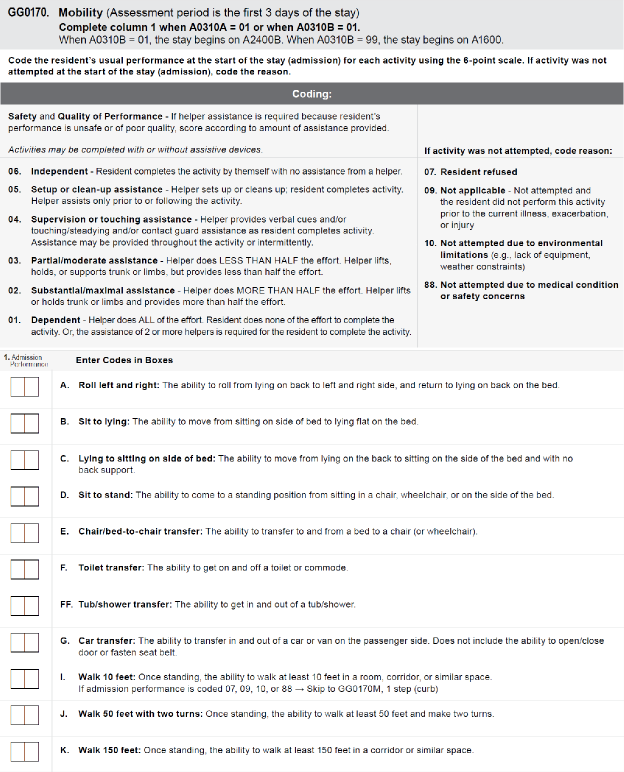
GG0170: Mobility (3-day assessment period) Admission (cont.)
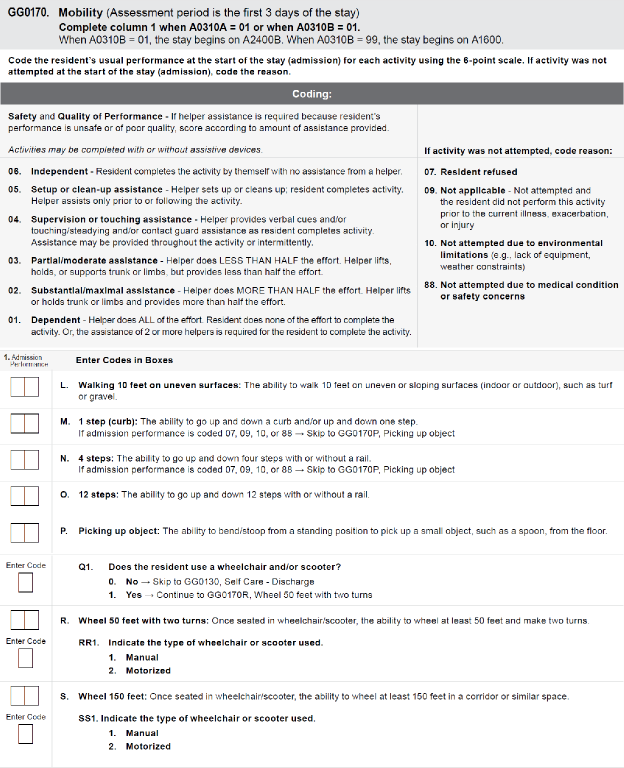
GG0170: Mobility (3-day assessment period) Discharge
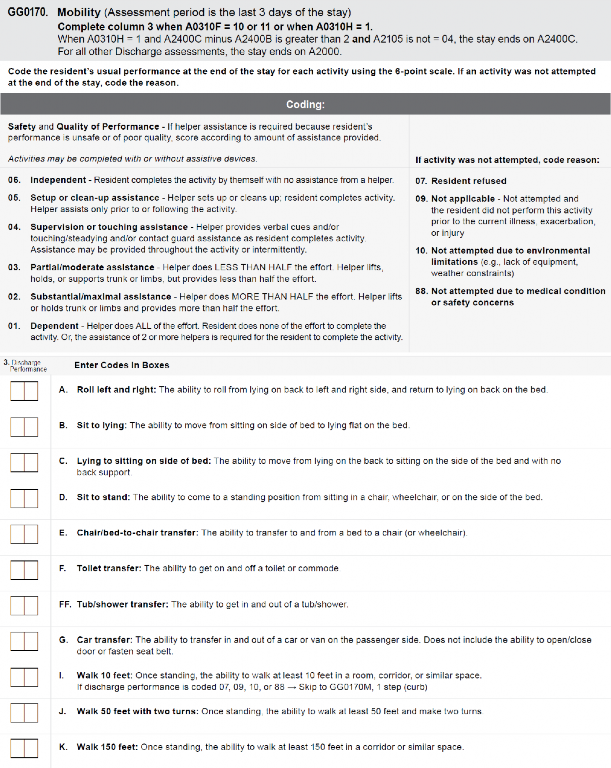
GG0170: Mobility (3-day assessment period) Discharge (cont.)
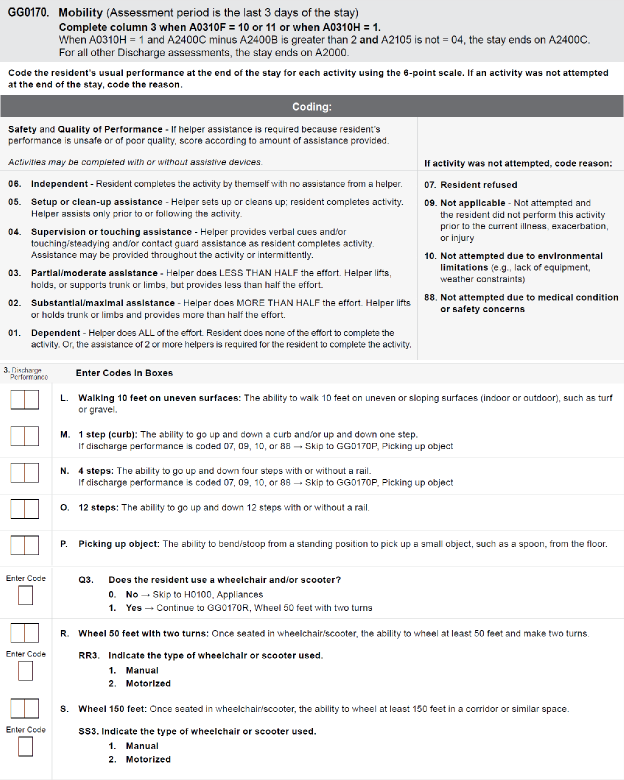
GG0170: Mobility (OBRA/Interim)
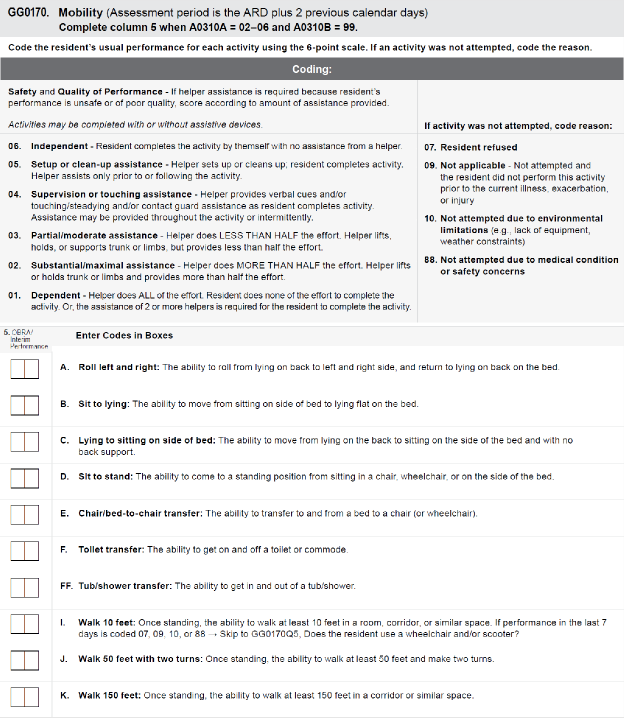
GG0170: Mobility (OBRA/Interim) (cont.)
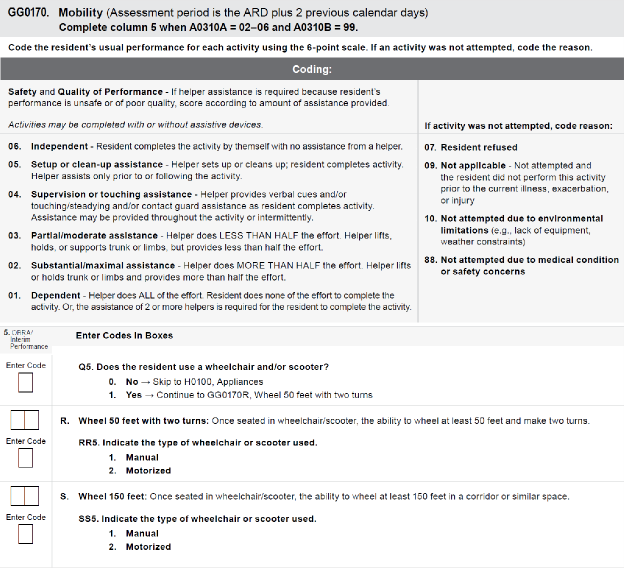
GG0170: Mobility (cont.)
Note: The following are coding examples and coding tips for mobility items. Some examples describe a single observation of the person completing the activity; other examples describe a summary of several observations of the resident completing an activity across different times of the day and different days.
For GG0170A, Roll left and right; GG0170B, Sit to lying; and GG0170C, Lying to sitting on side of bed, clinical judgment should be used to determine what is considered a “lying” position for the resident. For example, a clinician could determine that a resident’s preferred slightly elevated resting position is “lying” for a resident.
If the resident does not sleep in a bed, clinicians should assess bed mobility activities using the alternative furniture on which the resident sleeps (for example, a recliner).
Roll left and right: Resident R has a history of skin breakdown. A nurse instructs them to turn onto their right side, providing step-by-step instructions to use the bedrail, bend their left leg, and then roll onto their right side. Resident R attempts to roll with the use of the bedrail, but indicates they cannot perform the task. The nurse then rolls them onto their right side. Next, Resident R is instructed to return to lying on their back, which they successfully complete. Resident R then requires physical assistance from the nurse to roll onto their left side and to return to lying on their back to complete the activity.
Coding: GG0170A would be coded 02, Substantial/maximal assistance.
Rationale: The nurse provides more than half of the effort needed for the resident to complete the activity of rolling left and right. This is because the nurse provides physical assistance to move Resident R’s body weight to turn onto their right side. The nurse provides the same assistance when Resident R turns to their left side and when they return to their back. Resident R is able to return to lying on their back from their right side by themself.
GG0170: Mobility (cont.)
Roll left and right: A physical therapist helps Resident K turn onto their right side by instructing them to bend their left leg and roll onto their right side. The physical therapist then instructs them on how to position their limbs to return to lying on their back and then to repeat a similar process for rolling onto their left side and then return to lying on their back. Resident K completes the activity without physical assistance from the physical therapist.
Coding: GG0170A would be coded 04, Supervision or touching assistance. Rationale: The physical therapist provides verbal cues (i.e., instructions) to Resident K as they roll from their back to their right side and return to lying on their back, and then again as they perform the same activities with respect to their left side. The physical therapist does not provide any physical assistance.
Roll left and right: Resident Z had a stroke that resulted in paralysis on their right side and is recovering from cardiac surgery. They require the assistance of two certified nursing assistants when rolling onto their right side and returning to lying on their back and also when rolling onto their left side and returning to lying on their back.
Coding: GG0170A would be coded 01, Dependent.
Rationale: Two certified nursing assistants are needed to help Resident Z roll onto their left and right side and back while in bed.
Roll left and right: Resident M fell and sustained left shoulder contusions and a fractured left hip and underwent an open reduction internal fixation of the left hip. A physician’s order allows them to roll onto their left hip as tolerated. A certified nursing assistant assists Resident M in rolling onto their right side by instructing them to bend their left leg while rolling to their right side. Resident M needs physical assistance from the certified nursing assistant to initiate their rolling right because of their left arm weakness when grasping the right bedrail to assist in rolling. Resident M returns to lying on their back without assistance and uses their right arm to grasp the left bedrail to slowly roll onto their left hip and then return to lying on their back.
Coding: GG0170A would be coded 03, Partial/moderate assistance.
Rationale: The helper provides less than half the effort needed for the resident to complete the activity of rolling left and right.
GG0170: Mobility (cont.)
Sit to lying: Resident H requires assistance from a nurse to transfer from sitting at the edge of the bed to lying flat on the bed because of paralysis on their right side. The helper lifts and positions Resident H’s right leg. Resident H uses their arms to position their upper body and lowers themself to a lying position flat on their back.
Coding: GG0170B would be coded 03, Partial/moderate assistance.
Rationale: A helper lifts Resident H’s right leg and helps them position it as they move from a seated to a lying position; the helper performs less than half of the effort.
Sit to lying: Resident F requires assistance from a certified nursing assistant to get from a sitting position to lying flat on the bed because of postsurgical open reduction internal fixation healing fractures of their right hip and left and right wrists. The certified nursing assistant cradles and supports their trunk and right leg to transition Resident F from sitting at the side of the bed to lying flat on the bed. Resident F assists themself a small amount by bending their elbows and left leg while pushing their elbows and left foot into the mattress only to straighten their trunk while transitioning into a lying position.
Coding: GG0170B would be coded 02, Substantial/maximal assistance.
Rationale: The helper provided more than half the effort for the resident to complete the activity of sit to lying.
Sit to lying: Resident H requires assistance from two certified nursing assistants to transfer from sitting at the edge of the bed to lying flat on the bed due to paralysis on their right side, obesity, and cognitive limitations. One of the certified nursing assistants explains to Resident H each step of the sitting to lying activity. Resident H is then fully assisted to get from sitting to a lying position on the bed. Resident H makes no attempt to assist when asked to perform the incremental steps of the activity.
Coding: GG0170B would be coded 01, Dependent.
Rationale: The assistance of two certified nursing assistants was needed to complete the activity of sit to lying. If two or more helpers are required to assist the resident to complete an activity, code as 01, Dependent.
Sit to lying: Resident F had a stroke about 2 weeks ago and is unable to sequence the necessary movements to complete an activity (apraxia). They can maneuver themself when transitioning from sitting on the side of the bed to lying flat on the bed if the certified nursing assistant provides verbal instructions as to the steps needed to complete this task.
Coding: GG0170B would be coded 04, Supervision or touching assistance. Rationale: A helper provides verbal cues in order for the resident to complete the activity of sit to lying flat on the bed.
GG0170: Mobility (cont.)
Sit to lying: Resident A suffered multiple vertebral fractures due to a fall off a ladder. They require assistance from a therapist to get from a sitting position to lying flat on the bed because of significant pain in their lower back. The therapist supports their trunk and lifts both legs to assist Resident A from sitting at the side of the bed to lying flat on the bed. Resident A assists themself a small amount by raising one leg onto the bed and then bending both knees while transitioning into a lying position.
Coding: GG0170B would be coded 02, Substantial/maximal assistance.
Rationale: The helper provided more than half the effort for the resident to complete the activity of sit to lying.
The activity includes resident transitions from lying on their back to sitting on the side of the bed without back support. The resident’s ability to perform each of the tasks within this activity and how much support the residents require to complete the tasks within this activity is assessed.
Back support refers to an object or person providing support for the resident’s back.
Lying to sitting on side of bed: Resident B pushes up from the bed to get themself from a lying to a seated position. The certified nursing assistant provides steadying (touching) assistance as Resident B scoots themself to the edge of the bed and lowers their feet onto the floor.
Coding: GG0170C would be coded 04, Supervision or touching assistance. Rationale: The helper provides touching assistance as the resident moves from a lying to sitting position.
Lying to sitting on side of bed: Resident B pushes up on the bed to attempt to get themself from a lying to a seated position as the occupational therapist provides much of the lifting assistance necessary for them to sit upright. The occupational therapist provides additional lifting assistance as Resident B scoots themself to the edge of the bed and lowers their feet to the floor.
Coding: GG0170C would be coded 02, Substantial/maximal assistance. Rationale: The helper provides lifting assistance (more than half the effort) as the resident moves from a lying to sitting position.
GG0170: Mobility (cont.)
Lying to sitting on side of bed: Resident P is being treated for sepsis and has multiple infected wounds on their lower extremities. Full assistance from the certified nursing assistant is needed to move Resident P from a lying position to sitting on the side of their bed because they usually have pain in their lower extremities upon movement.
Coding: GG0170C would be coded 01, Dependent.
Rationale: The helper fully completed the activity of lying to sitting on the side of bed for the resident.
Lying to sitting on side of bed: Resident P is recovering from Guillain-Barre Syndrome with residual lower body weakness. The certified nursing assistant steadies Resident P’s trunk as they get to a fully upright sitting position on the bed and lifts each leg toward the edge of the bed. Resident P then scoots toward the edge of the bed and places both feet flat on the floor. Resident P completes most of the effort to get from lying to sitting on the side of the bed.
Coding: GG0170C would be coded 03, Partial/moderate assistance.
Rationale: The helper provided lifting assistance and less than half the effort for the resident to complete the activity of lying to sitting on side of bed.
The activity includes the resident coming to a standing position from any sitting surface.
If a sit-to-stand (stand assist) lift is used and two helpers are needed to assist with the sit- to-stand lift, then code as 01, Dependent.
If a full-body mechanical lift is used to assist in transferring a resident for a chair/bed-to- chair transfer, code GG0170D, Sit to stand with the appropriate “activity not attempted” code.
Code as 05, Setup or clean-up assistance, if the only help a resident requires to complete the sit-to-stand activity is for a helper to retrieve an assistive device or adaptive equipment, such as a walker or ankle-foot orthosis.
Sit to stand: Resident M has osteoarthritis and is recovering from sepsis. Resident M transitions from a sitting to a standing position with the steadying (touching) assistance of the nurse’s hand on Resident M’s trunk.
Coding: GG0170D would be coded 04, Supervision or touching assistance.
Rationale: The helper provides touching assistance only.
Sit to stand: Resident L has multiple healing fractures and multiple sclerosis, requiring two certified nursing assistants to assist them to stand up from sitting in a chair.
Coding: GG0170D would be coded 01, Dependent.
Rationale: Resident L requires the assistance of two helpers to complete the activity.
GG0170: Mobility (cont.)
Sit to stand: Resident B has complete tetraplegia and is currently unable to stand when getting out of bed. They transfer from their bed into a wheelchair with assistance. The activity of sit to stand is not attempted due to their medical condition.
Coding: GG0170D would be coded 88, Not attempted due to medical condition or safety concerns.
Rationale: The activity is not attempted due to the resident’s diagnosis of complete tetraplegia.
Sit to stand: Resident Z has amyotrophic lateral sclerosis with moderate weakness in their lower and upper extremities. Resident Z has prominent foot drop in their left foot, requiring the use of an ankle foot orthosis (AFO) for standing and walking. The certified nursing assistant applies Resident Z’s AFO and places the platform walker in front of them; Resident Z uses the walker to steady themself once standing. The certified nursing assistant provides lifting assistance to get Resident Z to a standing position and must also provide assistance to steady Resident Z’s balance to complete the activity.
Coding: GG0170D would be coded 02, Substantial/maximal assistance. Rationale: The helper provided lifting assistance and more than half of the effort for the resident to complete the activity of sit to stand.
Sit to stand: Resident R has severe rheumatoid arthritis and uses forearm crutches to ambulate. The certified nursing assistant brings Resident R their crutches and helps them to stand at the side of the bed. The certified nursing assistant provides some lifting assistance to get Resident R to a standing position but provides less than half the effort to complete the activity.
Coding: GG0170D would be coded 03, Partial/moderate assistance.
Rationale: The helper provided lifting assistance and less than half the effort for the resident to complete the activity of sit to stand.
GG0170: Mobility (cont.)
Depending on the resident’s abilities, the transfer may be a stand-pivot, squat-pivot, or a slide board transfer.
For item GG0170E, Chair/bed-to-chair transfer:
If the resident uses a recliner as their “bed” (preferred or necessary sleeping surface), assess the resident’s need for assistance using that sleeping surface when coding GG0170E, Chair/bed-to-chair transfer.
When assessing the resident moving from the chair/bed to the chair, the assessment begins with the resident sitting at the edge of the bed (or alternative sleeping surface) and ends with the resident sitting in a chair or wheelchair.
When assessing the resident moving from the chair to the bed, the assessment begins with the resident sitting in a chair or wheelchair and ends with the resident returning to sitting at the edge of the bed (or alternative sleeping surface).
The activities of GG0170B, Sit to lying, and GG0170C, Lying to sitting on side of bed, are two separate activities that are not assessed as part of GG0170E.
If a mechanical lift is used to assist in transferring a resident for a chair/bed-to-chair transfer and two helpers are needed to assist with the mechanical lift transfer, then code as 01, Dependent, even if the resident assists with any part of the chair/bed-to-chair transfer.
When possible, the transfer should be assessed in an environmental situation in which taking more than a few steps would not be necessary to complete the transfer.
Chair/bed-to-chair transfer: Resident L had a stroke and currently is not able to walk. They use a wheelchair for mobility. When Resident L gets out of bed, the certified nursing assistant moves the wheelchair into the correct position and locks the brakes so that
Resident L can transfer into the wheelchair safely. Resident L had been observed several other times to determine any safety concerns, and it was documented that they transfer safely without the need for supervision. Resident L transfers into the wheelchair by themself (no helper) after the certified nursing assistant leaves the room.
Coding: GG0170E would be coded 05, Setup or clean-up assistance. Rationale: Resident L is not able to walk, so they transfer from their bed to a wheelchair when getting out of bed. The helper provides setup assistance only.
Resident L transfers safely and does not need supervision or physical assistance during the transfer.
GG0170: Mobility (cont.)
Chair/bed-to-chair transfer: Resident C is sitting on the side of the bed. They stand and pivot into the chair as the nurse provides contact guard (touching) assistance. The nurse reports that one time Resident C only required verbal cues for safety, but usually Resident C requires touching assistance.
Coding: GG0170E would be coded 04, Supervision or touching assistance.
Rationale: The helper provides touching assistance during the transfers.
Chair/bed-to-chair transfer: Resident F’s medical conditions include morbid obesity, diabetes mellitus, and sepsis, and they recently underwent bilateral above-the-knee amputations. Resident F requires full assistance with transfers from the bed to the wheelchair using a lift device. Two certified nursing assistants are required for safety when using the device to transfer Resident F from the bed to a wheelchair. Resident F is unable to assist in the transfer from their bed to the wheelchair.
Coding: GG0170E would be coded 01, Dependent.
Rationale: The two helpers completed all the effort for the activity of chair/bed-to-chair transfer. If two or more helpers are required to assist the resident to complete an activity, code as 01, Dependent.
Chair/bed-to-chair transfer: Resident P has metastatic bone cancer, severely affecting their ability to use their lower and upper extremities during daily activities. Resident P is motivated to assist with their transfers from the side of their bed to the wheelchair.
Resident P pushes themself up from the bed to begin the transfer while the therapist provides limited trunk support with weight-bearing assistance. Once standing, Resident P shuffles their feet, turns, and slowly sits down into the wheelchair with the therapist providing trunk support with weight-bearing assistance.
Coding: GG0170E would be coded 03, Partial/moderate assistance.
Rationale: The helper provided less than half of the effort for the resident to complete the activity of chair/bed-to-chair transfer.
Chair/bed-to-chair transfer: Resident U had their left lower leg amputated due to gangrene associated with their diabetes mellitus and they have reduced sensation and strength in their right leg. They have not yet received their below-the-knee prosthesis. Resident U uses a transfer board for chair/bed-to-chair transfers. The therapist places the transfer board under their buttock. Resident U then attempts to scoot from the bed onto the transfer board. Resident U has reduced sensation in their hands and limited upper body strength, but assists with the transfer. The physical therapist assists them in side scooting by lifting their buttocks/trunk in a rocking motion across the transfer board and into the wheelchair.
Coding: GG0170E would be coded 02, Substantial/maximal assistance.
Rationale: The helper provided more than half of the effort for the resident to complete the activity of chair/bed-to-chair transfer.
GG0170: Mobility (cont.)
Toilet transfer includes the resident’s ability to get on and off a toilet (with or without a raised toilet seat) or bedside commode.
Toileting hygiene, clothing management, and transferring on and off a bedpan are not considered part of the Toilet transfer activity.
Code as 05, Setup or clean-up assistance, if the resident requires a helper to position/set up the bedside commode before and/or after the resident’s bed-to-commode transfers (place at an accessible angle/location next to the bed) and the resident does not require helper assistance during Toilet transfers.
Toilet transfer: The certified nursing assistant moves the wheelchair footrests up so that Resident T can transfer from the wheelchair onto the toilet by themself safely. The certified nursing assistant is not present during the transfer, because supervision is not required. Once Resident T completes the transfer from the toilet back to the wheelchair, they flip the footrests back down themself.
Coding: GG0170F would be coded 05, Setup or clean-up assistance.
Rationale: The helper provides setup assistance (moving the footrest out of the way) before Resident T can transfer safely onto the toilet.
Toilet transfer: The certified nursing assistant provides steadying (touching) assistance as Resident Z lowers their underwear and then transfers onto the toilet. After voiding,
Resident Z cleanses themself. They then stand up as the helper steadies them and Resident Z pulls up their underwear as the helper steadies them to ensure Resident Z does not lose their balance.
Coding: GG0170F would be coded 04, Supervision or touching assistance. Rationale: The helper provides steadying assistance as the resident transfers onto and off the toilet. Assistance with managing clothing and cleansing is coded under item GG0130C, Toileting hygiene and is not considered when rating the Toilet transfer item.
Toilet transfer: The therapist supports Resident M’s trunk with a gait belt by providing weight-bearing as Resident M pivots and lowers themself onto the toilet.
Coding: GG0170F would be coded 03, Partial/moderate assistance.
Rationale: The helper provides less than half the effort to complete the activity. The helper provided weight-bearing assistance as the resident transferred on and off the toilet.
GG0170: Mobility (cont.)
Toilet transfer: Resident W has peripheral vascular disease and sepsis, resulting in lower extremity pain and severe weakness. Resident W uses a bedside commode when having a bowel movement. The certified nursing assistant raises the bed to a height that facilitates the transfer activity. Resident W initiates lifting their buttocks from the bed and in addition requires some of their weight to be lifted by the certified nursing assistant to stand upright. Resident W then reaches and grabs onto the armrest of the bedside commode to steady themself. The certified nursing assistant provides weight-bearing assistance as they slowly rotate and lower Resident W onto the bedside commode.
Coding: GG0170F would be coded 02, Substantial/maximal assistance.
Rationale: The helper provided more than half of the effort for the resident to complete the activity of toilet transfer.
Toilet transfer: Resident H has paraplegia incomplete, pneumonia, and a chronic respiratory condition. Resident H prefers to use the bedside commode when moving their bowels. Due to their severe weakness, history of falls, and dependent transfer status, two certified nursing assistants assist during the toilet transfer.
Coding: GG0170F would be coded 01, Dependent.
Rationale: The activity required the assistance of two or more helpers for the resident to complete the activity.
Toilet transfer: Resident S is on bedrest due to a medical complication. They use a bedpan for bladder and bowel management.
Coding: GG0170F would be coded 88, Not attempted due to medical condition or safety concerns.
Rationale: The resident does not transfer onto or off a toilet due to being on bedrest because of a medical condition.
Complete GG0170FF when A0310A = 01 – 06 or A0310F = 10 or 11.
Tub/shower transfers involve the ability to get into and out of the tub or shower. Do not include washing, rinsing, drying, or any other bathing activities in this item.
GG0170: Mobility (cont.)
During the observation period, Resident M took one shower. They received physical help from two staff members to get into and out of the shower.
Coding: GG0170FF would be coded 01. Dependent.
Rationale: Resident M required two staff members to assist with shower transfers during the observation period. This represents their usual performance of this activity during the observation period.
On Monday, Resident Q required trunk support from one certified nursing assistant to get into and out of the tub. On Wednesday, day 3 of the assessment period, Resident Q required trunk support from one certified nursing assistant to get into the tub and needed assistance lifting their legs during the transfer out of the tub. No other tub or shower transfers occurred during the observation period.
Coding: GG0170FF would be coded 03. Partial/moderate assistance.
Rationale: Resident Q participated in four tub transfers (two transfers into the tub and two transfers out of the tub) during the observation period. They required trunk support for three transfers and required the helper to lift their legs for one transfer. Because the helper performed less than half the effort for three of the four transfers, Resident Q’s usual performance is 03. Partial/moderate assistance.
Any vehicle model appropriate and available may be used for the assessment of GG0170G, Car transfer.
For item GG0170G, Car transfer, use of an indoor car can be used to simulate outdoor car transfers.
The Car transfer does not include getting to or from the vehicle, opening/closing the car door, or fastening/unfastening the seat belt.
If the resident remains in a wheelchair and does not transfer in and out of a car or van seat, then the activity is not considered completed, and the appropriate “activity not attempted” code would be used.
The setup and/or clean-up of an assistive device that is used for walking to and from the car, but not used for the transfer in and out of the car seat, would not be considered when coding the Car transfer activity.
GG0170: Mobility (cont.)
In the event of inclement weather or if an indoor car simulator or outdoor car is not available during the entire assessment period, then use code 10, Not attempted due to environmental limitations.
Clinicians may use clinical judgment to determine if observing a resident performing a portion of the car transfer activity (e.g., getting into the car) allows the clinician to adequately assess the resident’s ability to complete the entire GG0170G, Car transfer, activity (transferring in and out of a car). If the clinician determines that this observation is adequate, code based on the type and amount of assistance required to complete the activity.
Car transfer: Resident W uses a wheelchair and ambulates for only short distances. They require lifting assistance from a physical therapist to get from a seated position in the wheelchair to a standing position. The therapist provides trunk support when Resident W takes several steps during the transfer turn. Resident W lowers themself into the car seat with steadying assistance from the therapist. They lift their legs into the car with support from the therapist.
Coding: GG0170G would be coded 02, Substantial/maximal assistance.
Rationale: Although Resident W also contributes effort to complete the activity, the helper contributed more than half the effort needed to transfer Resident W into the car by providing lifting assistance and trunk support.
Car transfer: During their rehabilitation stay Resident N works with an occupational therapist on transfers in and out of the passenger side of a car. On the day before discharge, when performing car transfers, Resident N requires verbal reminders for safety and light touching assistance. The therapist instructs them on strategic hand placement while Resident N transitions to sitting in the car’s passenger seat. The therapist opens and closes the door.
Coding: GG0170G would be coded 04, Supervision or touching assistance. Rationale: The helper provides touching assistance as the resident transfers into the passenger seat of the car. Assistance with opening and closing the car door is not included in the definition of this item and is not considered when coding this item.
GG0170: Mobility (cont.)
Assessment of the walking activities starts with the resident in a standing position.
A walking activity cannot be completed without some level of resident participation that allows resident ambulation to occur for the entire stated distance. A helper cannot complete a walking activity for a resident.
During a walking activity, a resident may take a brief standing rest break. If the resident needs to sit to rest during a Section GG walking activity, consider the resident unable to complete the walking activity and use the appropriate activity not attempted code.
Clinicians can use clinical judgment to determine how the actual resident assessment of walking is conducted. If a clinician chooses to combine the assessment of multiple walking activities, the clinician should use clinical judgment to determine the type and amount of assistance needed for each individual activity.
Use clinical judgment when assessing activities that overlap or occur sequentially to determine the type and amount of assistance needed for each individual activity.
Walking activities do not need to occur during one session. Allowing a resident to rest between activities or completing activities at different times during the day or on different days may facilitate completion of the activities.
Do not code walking activities with the use of a device that is restricted to resident use during therapy sessions (e.g., parallel bars, exoskeleton, or overhead track and harness systems).
If the resident who participates in walking requires the assistance of two helpers to complete the activity, code 01, Dependent.
If the only help a resident requires to complete the walking activity is for a helper to retrieve and place the walker and/or put it away after resident use, then enter code 05, Setup or clean-up assistance.
The turns included in item GG0170J, Walk 50 feet with two turns, are 90-degree turns. The turns may be in the same direction (two 90-degree turns to the right or two 90-degree turns to the left) or may be in different directions (one 90-degree turn to the left and one 90-degree turn to the right). The 90-degree turn should occur at the person’s ability level and can include use of an assistive device (for example, cane).
When coding GG0170K, Walk 150 feet, if the resident’s environment does not accommodate a walk of 150 feet without turns, but the resident demonstrates the ability to walk, with or without assistance, 150 feet with turns without jeopardizing the resident’s safety, code using the 6-point scale.
When coding GG0170L, Walking 10 feet on uneven surfaces, the activity can be assessed inside or outside. Examples of uneven surfaces include uneven or sloping surfaces, turf, and gravel. Use clinical judgment to determine whether a surface is uneven.
GG0170: Mobility (cont.)
Walk 10 feet: Resident C has resolving sepsis and has not walked in three weeks because of their medical condition. A physical therapist determines that it is unsafe for Resident C to use a walker, and the resident only walks using the parallel bars. On day 3 of the Admission assessment period, Resident C walks 10 feet using the parallel bars while the therapist provides substantial weight-bearing support throughout the activity.
Coding: GG0170I would be coded 88, Not attempted due to medical condition or safety concerns.
Rationale: When assessing a resident for GG0170 walking items, do not consider walking in parallel bars, as parallel bars are not a portable assistive device. If the resident is unable to walk without the use of parallel bars because of their medical condition or safety concerns, use code 88, Activity not attempted due to medical condition or safety concerns.
Walk 10 feet: Resident L had bilateral amputations three years ago, and prior to the current admission they used a wheelchair and did not walk. Currently Resident L does not use prosthetic devices and uses only a wheelchair for mobility. Resident L’s care plan includes fitting and use of bilateral lower extremity prostheses.
Coding: GG0170I would be coded 09, Not applicable, not attempted and the resident did not perform this activity prior to the current illness, exacerbation, or injury.
Rationale: When assessing a resident for GG0170I, Walk 10 feet, consider the resident’s status prior to the current episode of care and current assessment status. Use code 09, Not applicable, because Resident L did not walk prior to the current episode of care and did not walk during the assessment period.
Walk 10 feet: Resident C has Parkinson’s disease and walks with a walker. A physical therapist must advance the walker for Resident C with each step. The physical therapist assists Resident C by physically initiating the stepping movement forward, advancing Resident C’s foot, during the activity of walking 10 feet.
Coding: GG0170I would be coded 02, Substantial/maximal assistance.
Rationale: A helper provides more than half the effort as the resident completes the activity.
GG0170: Mobility (cont.)
Walk 10 feet: Resident O has bilateral upper extremity tremors, lower extremity weakness, and Parkinson’s disease. A physical therapist assistant guides and steadies the shaking, rolling walker forward while cueing Resident O to take larger steps. Resident O requires steadying at the beginning of the walk and progressively requires some of their weight to be supported for the last two feet of the 10-foot walk.
Coding: GG0170I would be coded 03, Partial/moderate assistance.
Rationale: The helper provides less than half the effort required for the resident to complete the activity, Walk 10 feet. While the helper guided and steadied the walker during the walk, Resident O supported their own body weight with their arms and legs and propelled their legs forward for 8 of the 10 feet. The helper supported part of Resident O’s weight only for 2 of the 10 feet; thus Resident O contributed more than half the effort.
Walk 10 feet: Resident U has an above-the-knee amputation and severe rheumatoid arthritis. Once a nurse has donned their stump sock and prosthesis, Resident U is assisted to stand and uses their rolling walker while walking. The nurse places their hand on Resident U’s back to steady them toward the last half of their 10-foot walk.
Coding: GG0170I would be coded 04, Supervision or touching assistance. Rationale: A helper provides touching assistance in order for the resident to complete the activity of Walk 10 feet. Assistance in donning the stump stock, prosthesis, and getting from a sitting to standing position is not coded as part of the Walk 10 feet item.
Walk 50 feet with two turns: A therapist provides steadying assistance as Resident W gets up from a sitting position to a standing position. After the therapist places Resident W’s walker within reach, Resident W walks 60 feet down the hall with two turns without any assistance from the therapist. No supervision is required while they walk.
Coding: GG0170J would be coded 05, Setup or clean-up assistance.
Rationale: Resident W walks more than 50 feet and makes two turns once the helper places the walker within reach. Assistance with getting from a sitting to a standing position is coded separately under the item GG0170D, Sit to stand (04, Supervision or touching assistance).
Walk 50 feet with two turns: Resident P walks 70 feet with a quad cane, completing two turns during the walk. The therapist provides steadying assistance only when Resident P turns.
Coding: GG0170J would be coded 04, Supervision or touching assistance. Rationale: The helper provides touching assistance as the resident walks more than 50 feet and makes two turns. The resident may use an assistive device.
GG0170: Mobility (cont.)
Walk 50 feet with two turns: Resident L is unable to bear their full weight on their left leg. As they walk 60 feet down the hall with their crutches and make two turns, the certified nursing assistant supports their trunk providing weight-bearing assistance.
Coding: GG0170J would be coded 03, Partial/moderate assistance.
Rationale: The helper provides trunk support as the resident walks more than 50 feet and makes two turns.
Walk 50 feet with two turns: Resident T walks 50 feet with the therapist providing trunk support. They also require a second helper, the rehabilitation aide, who provides supervision and follows closely behind with a wheelchair for safety. Resident T walks the 50 feet with two turns with the assistance of two helpers.
Coding: GG0170J would be coded 01, Dependent.
Rationale: Resident T requires two helpers to complete the activity.
Walk 50 feet with two turns: Resident U has an above-the-knee amputation, severe rheumatoid arthritis, and uses a prosthesis. Resident U is assisted to stand and, after walking 10 feet, requires progressively more help as they near the 50-foot mark. Resident U is unsteady and typically loses their balance when turning, requiring significant support to remain upright. The therapist provides significant trunk support for about 30 to 35 feet.
Coding: GG0170J would be coded 02, Substantial/maximal assistance.
Rationale: The helper provided more than half of the effort for the resident to complete the activity of walk 50 feet with two turns.
Walk 150 feet: Resident D walks down the hall using their walker and the certified nursing assistant usually needs to provide touching assistance to Resident D, who intermittently loses their balance while they use the walker.
Coding: GG0170K would be coded 04, Supervision or touching assistance. Rationale: The helper provides touching assistance intermittently throughout the activity.
Walk 150 feet: Resident R has endurance limitations due to heart failure and has only walked about 30 feet during the assessment period. They have not walked 150 feet or more during the assessment period, including with the physical therapist who has been working with Resident R.
Coding: GG0170K would be coded 88, Not attempted due to medical condition or safety concerns, and the resident’s ability to walk a shorter distance would be coded in item GG0170I.
Rationale: The activity was not attempted. The resident did not complete the activity, and a helper cannot complete the activity for the resident. A resident who walks less than 50 feet would be coded in item GG0170I, Walk 10 feet.
GG0170: Mobility (cont.)
Walk 150 feet: Resident T has an unsteady gait due to balance impairment. Resident T walks the length of the hallway using their quad cane in their right hand. The physical therapist supports their trunk, helping them to maintain their balance while ambulating. The therapist provides less than half of the effort to walk the 160-foot distance.
Coding: GG0170K would be coded 03, Partial/moderate assistance.
Rationale: The helper provides less than half of the effort for the resident to complete the activity of walking at least 150 feet.
Walk 150 feet: Resident W, who has Parkinson’s disease, walks the length of the hallway using their rolling walker. The physical therapist provides trunk support and advances Resident W’s right leg in longer strides with each step. The therapist occasionally prevents Resident W from falling as they lose their balance during the activity.
Coding: GG0170K would be coded 02, Substantial/maximal assistance. Rationale: The helper provides more than half the effort for the resident to complete the activity of walk 150 feet.
Example for GG0170L, Walking 10 feet on uneven surfaces
Walking 10 feet on uneven surfaces: Resident N has severe joint degenerative disease and is recovering from sepsis. Upon discharge Resident N will need to be able to walk on the uneven and sloping surfaces of their driveway. During their SNF stay, a physical therapist takes Resident N outside to walk on uneven surfaces. Resident N requires the therapist’s weight-bearing assistance less than half the time during walking in order to prevent Resident N from falling as they navigate walking 10 feet over uneven surfaces.
Coding: GG0170L would be coded 03, Partial/moderate assistance.
Rationale: Resident N requires a helper to provide weight-bearing assistance several times to prevent them from falling as they walk 10 feet on uneven surfaces. The helper contributes less than half the effort required for Resident N to walk 10 feet on uneven surfaces.
Coding Tips for GG0170M, 1 step (curb); GG0170N, 4 steps; and GG0170O, 12 steps
Completing the stair activities indicates that a resident goes up and down the stairs, by any safe means, with or without any assistive devices (for example, railing or stair lift) and with or without some level of assistance. Getting to and from the stairs is not included when coding the curb or step activities.
Ascending and descending stairs does not have to occur sequentially or during one session. If the assessment of going up the stairs and then down the stairs occurs sequentially, the resident may take a standing or seated rest break between ascending and descending the 4 steps or 12 steps.
GG0170: Mobility (cont.)
If a resident requires a helper to provide total assist (for example, the resident requires total assist from a helper to move up and down over a curb in their wheelchair), code as 01, Dependent.
A resident who uses a wheelchair may be assessed going up and down stairs (including one step or curb) in a wheelchair. Code based on the type and amount of assistance required from the helper.
If, at the time of the assessment, a resident is unable to complete the activity because of a physician-prescribed restriction of no stair climbing, they may be able to complete the stair activities safely by some other means (e.g., stair lift, bumping/scooting on their buttocks). If so, code based on the type and amount of assistance required to complete the activity.
If, at the time of assessment, a resident is unable to complete the stair activities because of a physician-prescribed bedrest, code the stair activity using the appropriate “activity not attempted” code.
Assess the resident going up and down one step or up and down over a curb. If both are assessed, and the resident’s performance going up and down over a curb is different from their performance going up and down one step (e.g., because the step has a railing), code GG0170M, 1 step (curb) based on the activity with which the resident requires the most assistance.
If a resident’s environment does not have 12 steps, the combination of going up and down 4 stairs three times consecutively in a safe manner is an acceptable alternative to comply with the intention and meet the requirements of this activity.
While a resident may take a break between ascending or descending the 4 steps or 12 steps, once they start the activity, they must be able to ascend (or descend) all the steps, by any safe means, without taking more than a brief rest break to consider the stair activity completed.
Getting to/from the stairs is not included when coding the curb/step activities.
Do not consider the sit-to-stand or stand-to-sit transfer when coding any of the step activities.
1. 1 step (curb): Resident Z has had a stroke; they must be able to step up and down one step to enter and exit their home. A physical therapist provides standby assistance as they use their quad cane to support their balance in stepping up one step. The physical therapist provides steadying assistance as Resident Z uses their cane for balance and steps down one step.
Coding: GG0170M would be coded 04, Supervision or touching assistance. Rationale: A helper provides touching assistance as Resident Z completes the activity of stepping up and down one step.
GG0170: Mobility (cont.)
1. 4 steps: Resident J has lower body weakness, and a physical therapist provides steadying assistance when they ascend 4 steps. While descending 4 steps, the physical therapist provides trunk support (more than touching assistance) as Resident J holds the stair railing.
Coding: GG0170N would be coded 03, Partial/moderate assistance.
Rationale: A helper provides touching assistance as Resident J ascends 4 steps. The helper provides trunk support (more than touching assistance) when they descend the 4 steps.
12 steps: Resident Y is recovering from a stroke resulting in motor issues and poor endurance. Resident Y’s home has 12 stairs, with a railing, and they need to use these stairs to enter and exit their home. Their physical therapist uses a gait belt around their trunk and supports less than half of the effort as Resident Y ascends and then descends 12 stairs.
Coding: GG0170O would be coded 03, Partial/moderate assistance.
Rationale: The helper provides less than half the required effort in providing the necessary support for Resident Y as they ascend and descend 12 stairs.
The activity includes the resident bending or stooping from a standing position to pick up a small object, such as a spoon, from the floor.
Picking up the object must be assessed while the resident is in a standing position. If the resident is not able to stand, the activity did not occur, and the appropriate “not attempted” code would be used.
If a standing resident is unable to pick up a small object from the floor, therefore requiring the helper to assist in picking up the object, code as 01, 02, or 03, depending on whether the helper is providing all the effort, more than half of the effort, or less than half of the effort, respectively.
Assistive devices and adaptive equipment may be used, for example, a cane to support standing balance and/or a reacher to pick up the object.
GG0170: Mobility (cont.)
Picking up object: Resident P has a neurologic condition that has resulted in balance problems. They want to be as independent as possible. Resident P lives with their spouse and will soon be discharged from the SNF. They tend to drop objects and have been practicing bending or stooping from a standing position to pick up small objects, such as a spoon, from the floor. An occupational therapist needs to remind Resident P of safety strategies when they bend to pick up objects from the floor, and the occupational therapist needs to steady them to prevent them from falling.
Coding: GG0170P would be coded 04, Supervision or touching assistance. Rationale: A helper is needed to provide verbal cues and touching or steadying assistance when Resident P picks up an object because of their coordination issues.
Picking up object: Resident C has recently undergone a hip replacement. When they drop items they use a long-handled reacher that they have been using at home prior to admission. They are ready for discharge and can now ambulate with a walker without assistance. When they drop objects from their walker basket they require a certified nursing assistant to locate their long-handled reacher and bring it to them in order for them to use it. They do not need assistance to pick up the object after the helper brings them the reacher.
Coding: GG0170P would be coded 05, Setup or clean-up assistance.
Rationale: The helper provides set-up assistance so that Resident C can use their long- handled reacher.
The intent of the wheelchair mobility items is to assess the ability of residents who are learning how to self-mobilize using a wheelchair or who used a wheelchair for self- mobilization prior to admission. Use clinical judgment to determine whether a resident’s use of a wheelchair is for self-mobilization as a result of the resident’s medical condition or safety.
If the resident used a wheelchair for self-mobilization prior to admission to the facility, indicate 1, Yes, to the gateway wheelchair items on the initial assessment in GG0170Q1.
The responses for gateway wheelchair items (GG0170Q1, GG0170Q3, and/or GG0170Q5) do not have to be the same on subsequent assessments. For example, the Admission assessment may indicate that the resident does not use a wheelchair but the subsequent assessment may indicate that the resident uses a wheelchair.
If a wheelchair is used for transport purposes only, then GG0170Q1, GG0170Q3, and/or GG0170Q5, Does the resident use a wheelchair or scooter? is coded as 0, No; then follow the skip pattern to continue coding the assessment.
The turns included in item GG0170R (wheeling 50 feet with two turns) are 90-degree turns. The turns may be in the same direction (two 90-degree turns to the right or two 90- degree turns to the left) or may be in different directions (one 90-degree turn to the left and one 90-degree turn to the right). The 90-degree turn should occur at the person’s ability level.
If a resident’s environment does not accommodate wheelchair or scooter use for 150 feet without turns, but the resident demonstrates the ability to mobilize a wheelchair or scooter with or without assistance for 150 feet with turns without jeopardizing the resident’s safety, code GG0170S, Wheel 150 feet, using the 6-point scale.
For GG0170S, Wheel 150 feet, a helper can assist a resident in completing the required distance in the wheelchair or in making turns if required. When a resident is unable to wheel the entire distance themself, the activity can still be completed, and a performance code can be determined based on the type and amount of assistance required from the helper to complete the entire activity.
Example for GG0170Q1, Does the resident use a wheelchair/scooter?
1. Does the resident use a wheelchair/scooter? On admission, Resident T wheels themself using a manual wheelchair, but with difficulty due to their severe osteoarthritis and COPD.
Coding: GG0170Q1 would be coded 1, Yes. The admission performance codes for wheelchair items GG0170R and GG0170S are coded; in addition, the type of wheelchair Resident T uses for GG0170RR1 is indicated as code 1, Manual.
Rationale: The resident currently uses a wheelchair. Coding the resident’s performance and the type of wheelchair (manual) is indicated.
Examples for GG0170R, Wheel 50 feet with two turns and GG0170RR, Indicate the type of wheelchair/scooter used
Wheel 50 feet with two turns: Resident M is unable to bear any weight on their right leg due to a recent fracture. The certified nursing assistant provides steadying assistance when transferring Resident M from the bed into the wheelchair. Once in their wheelchair, Resident M propels themself about 60 feet down the hall using their left leg and makes two turns without any physical assistance or supervision.
Coding: GG0170R would be coded 06, Independent.
Rationale: The resident wheels themself more than 50 feet. Assistance provided with the transfer is not considered when scoring Wheel 50 feet with two turns. There is a separate item for scoring bed-to-chair transfers.
Indicate the type of wheelchair/scooter used: In the above example Resident M used a manual wheelchair during the assessment period.
Coding: GG0170RR would be coded 1, Manual.
Rationale: Resident M used a manual wheelchair during the assessment period.
GG0170: Mobility (cont.)
Wheel 50 feet with two turns: Resident R is very motivated to use their motorized wheelchair with an adaptive throttle for speed and steering. Resident R has amyotrophic lateral sclerosis, and moving their upper and lower extremities is very difficult. The physical therapist assistant is required to walk next to Resident R for frequent readjustments of their hand position to better control the steering and speed throttle. Resident R often drives too close to corners, becoming stuck near doorways upon turning, preventing them from continuing to mobilize/wheel themself. The physical therapist assistant backs up Resident R’s wheelchair for them so that they may continue mobilizing/wheeling themself.
Coding: GG0170R would be coded 03, Partial/moderate assistance.
Rationale: The helper provided less than half of the effort for the resident to complete the activity, Wheel 50 feet with two turns.
Indicate the type of wheelchair/scooter used: In the above example Resident R used a motorized wheelchair during the assessment period.
Coding: GG0170RR would be coded 2, Motorized.
Rationale: Resident R used a motorized wheelchair during the assessment period.
Wheel 50 feet with two turns: Resident V had a spinal tumor resulting in paralysis of their lower extremities. The physical therapist assistant provides verbal instruction for Resident V to navigate their manual wheelchair in their room and into the hallway while making two turns.
Coding: GG0170R would be coded 04, Supervision or touching assistance. Rationale: The helper provided verbal cues for the resident to complete the activity, Wheel 50 feet with two turns.
Indicate the type of wheelchair/scooter used: In the above example Resident V used a manual wheelchair during the assessment period.
Coding: GG0170RR would be coded 1, Manual.
Rationale: Resident V used a manual wheelchair during the assessment period.
Wheel 50 feet with two turns: Once seated in the manual wheelchair, Resident R wheels about 10 feet in the corridor, then asks the certified nursing assistant to push the wheelchair an additional 40 feet turning into their room and then turning into their bathroom.
Coding: GG0170R would be coded 02, Substantial/maximal assistance. Rationale: The helper provides more than half the effort to assist the resident to complete the activity.
Indicate the type of wheelchair/scooter used: In the above example Resident R used a manual wheelchair during the assessment period.
Coding: GG0170RR would be coded 1, Manual.
Rationale: Resident R used a manual wheelchair during the assessment period.
GG0170: Mobility (cont.)
Examples for GG0170S, Wheel 150 feet and GG0170SS, Indicate the type of wheelchair/scooter used
Wheel 150 feet: Resident N uses a below-the-knee prosthetic limb. Resident N has peripheral neuropathy and limited vision due to complications of diabetes. Resident N’s prior preference was to ambulate within the home and use a manual wheelchair when mobilizing themself within the community. Resident N is assessed for the activity of 150 feet wheelchair mobility. Resident N’s usual performance indicates a helper is needed to provide verbal cues for safety due to vision deficits.
Coding: GG0170S would be coded 04, Supervision or touching assistance. Rationale: Resident N requires the helper to provide verbal cues for their safety when using a wheelchair for 150 feet.
Indicate the type of wheelchair/scooter used: In the above example Resident N used a manual wheelchair during the assessment period.
Coding: GG0170SS would be coded 1, Manual.
Rationale: Resident N used a manual wheelchair during the assessment period.
Wheel 150 feet: Resident L has multiple sclerosis, resulting in extreme muscle weakness and minimal vision impairment. Resident L uses a motorized wheelchair with an adaptive joystick to control both the speed and steering of the motorized wheelchair. They occasionally need reminders to slow down around the turns and require assistance from the nurse for backing up the scooter when barriers are present.
Coding: GG0170S would be coded 03, Partial/moderate assistance.
Rationale: The helper provides less than half of the effort to complete the activity of wheel 150 feet.
Indicate the type of wheelchair/scooter used: Resident L used a motorized wheelchair during the assessment period.
Coding: GG0170SS would be coded 2, Motorized.
Rationale: Resident L used a motorized wheelchair during the assessment period.
Wheel 150 feet: Resident M has had a mild stroke, resulting in muscle weakness in their right upper and lower extremities. Resident M uses a manual wheelchair. They usually can self-propel themself about 60 to 70 feet but need assistance from a helper to complete the distance of 150 feet.
Coding: GG0170S would be coded 02, Substantial/Maximal assistance.
Rationale: The helper provides more than half of the effort to complete the activity of wheel 150 feet.
GG0170: Mobility (cont.)
Indicate the type of wheelchair/scooter used: In the above example, Resident M used a manual wheelchair during the assessment period.
Coding: GG0170SS would be coded 1, Manual.
Rationale: Resident M used a manual wheelchair during the assessment period.
Wheel 150 feet: Resident A has a cardiac condition with medical precautions that do not allow them to propel their own wheelchair. Resident A is completely dependent on a helper to wheel them 150 feet using a manual wheelchair.
Coding: GG0170S would be coded 01, Dependent.
Rationale: The helper provides all the effort and the resident does none of the effort to complete the activity of wheel 150 feet.
Indicate the type of wheelchair/scooter used: In the above example, Resident A is wheeled using a manual wheelchair during the assessment period.
Coding: GG0170SS would be coded 1, Manual.
Rationale: Resident A is assisted using a manual wheelchair during the assessment period.
Sit to lying: Example of a probing conversation between a nurse determining a resident’s score for sit to lying and a certified nursing assistant regarding the resident’s bed mobility:
Nurse: “Please describe how Resident H moves themself from sitting on the side of the bed to lying flat on the bed. When they are sitting on the side of the bed, how do they move to lying on their back?”
Certified nursing assistant: “They can lie down with some help.”
Nurse: “Please describe how much help they need and exactly how you help them.”
Certified nursing assistant: “I have to lift and position their right leg, but once I do that, they can use their arms to position their upper body.”
In this example, the nurse inquired specifically about how Resident H moves from a sitting position to a lying position. The nurse asked about physical assistance.
Coding: GG0170B would be coded 03, Partial/moderate assistance.
Rationale: The certified nursing assistant lifts Resident H’s right leg and helps them position it as they move from a sitting position to a lying position. The helper does less than half the effort.
GG0170: Mobility (cont.)
Lying to sitting on side of bed: Example of a probing conversation between a nurse determining a resident’s score for lying to sitting on side of bed and a certified nursing assistant regarding the resident’s bed mobility:
Nurse: “Please describe how Resident L moves themself in bed. When they are in bed, how do they move from lying on their back to sitting up on the side of the bed?”
Certified nursing assistant: “They can sit up by themself.”
Nurse: “They sit up without any instructions or physical help?”
Certified nursing assistant: “No, I have to remind them to check on the position of their arm that has limited movement and sensation as they move in the bed, but once I remind them to check their arm, they can do it themself.”
In this example, the nurse inquired specifically about how Resident L moves from a lying position to a sitting position. The nurse asked about instructions and physical assistance.
Coding: GG0170C would be coded 04, Supervision or touching assistance. Rationale: The certified nursing assistant provides verbal instructions as the resident moves from a lying to sitting position.
Sit to stand: Example of a probing conversation between a nurse determining a resident’s sit to stand score and a certified nursing assistant regarding the resident’s sit to stand ability:
Nurse: “Please describe how Resident L usually moves from sitting on the side of the bed or chair to a standing position. Once they are sitting, how do they get to a standing position?”
Certified nursing assistant: “They need help to get to sitting up and then standing.”
Nurse: “I’d like to know how much help they need for safely rising up from sitting in a chair or sitting on the bed to get to a standing position.”
Certified nursing assistant: “They need two people to assist them to stand up from sitting on the side of the bed or when they are sitting in a chair.”
In this example, the nurse inquired specifically about how Resident L moves from a sitting position to a standing position and clarified that this did not include any other positioning to be included in the answer. The nurse specifically asked about physical assistance.
Coding: GG0170D would be coded 01, Dependent.
Rationale: Resident L requires the assistance of two helpers to complete the activity.
GG0170: Mobility (cont.)
Chair/bed-to-chair transfer: Example of a probing conversation between a nurse determining a resident’s score for chair/bed-to-chair transfer and a certified nursing assistant regarding the resident’s chair/bed-to-chair transfer ability:
Nurse: “Please describe how Resident C moves into the chair from the bed. When they are sitting at the side of the bed, how much help do they need to move from the bed to the chair?”
Certified nursing assistant: “They need me to help them move from the bed to the chair.”
Nurse: “Do they help with these transfers when you give them any instructions, setup, or physical help?”
Certified nursing assistant: “Yes, they will follow some of my instructions to get ready to transfer, such as moving their feet from being spread out to placing them under their knees. I have to place the chair close to the bed and then I lift them because they are very weak. I then tell them to reach for the armrest of the chair. Resident C follows these directions and that helps a little in transferring them from the bed to the chair. They do help with the transfer.”
In this example, the nurse inquired specifically about how Resident C moves from sitting on the side of the bed to sitting in a chair. The nurse asked about instructions, physical assistance, and cueing instructions. If this nurse had not asked probing questions, they would not have received enough information to make an accurate assessment of the actual assistance Resident C received.
Coding: GG0170E would be coded 02, Substantial/maximal assistance.
Rationale: The helper provides more than half of the effort to complete the activity of Chair/bed-to-chair transfer.
GG0170: Mobility (cont.)
Toilet transfer: Example of a probing conversation between a nurse determining the resident’s score and a certified nursing assistant regarding a resident’s toilet transfer assessment:
Nurse: “I understand that Resident M usually uses a wheelchair to get to their toilet. Please describe how Resident M moves from their wheelchair to the toilet. How do they move from sitting in a wheelchair to sitting on the toilet?”
Certified nursing assistant: “It is hard for them, but they do it with my help.”
Nurse: “Can you describe the amount of help in more detail?”
Certified nursing assistant: “I have to give them a bit of a lift using a gait belt to get them to stand and then remind them to reach for the toilet grab bar while they pivot to the toilet. Sometimes, I have to remind them to take a step while they pivot to or from the toilet, but they do most of the effort themself.”
In this example, the nurse inquired specifically about how Resident M moves from sitting in a wheelchair to sitting on the toilet. The nurse specifically asked about instructions and physical assistance. If this nurse had not asked probing questions, they would not have received enough information to make an accurate assessment of the actual assistance Resident M received.
Coding: GG0170F would be coded 03, Partial/moderate assistance.
Rationale: The certified nursing assistant provides less than half the effort to complete this activity.
Walk 50 feet with two turns: Example of a probing conversation between a nurse determining a resident’s score for walking 50 feet with two turns and a certified nursing assistant regarding the resident’s walking ability:
Nurse: “How much help does Resident T need to walk 50 feet and make two turns once they are standing?”
Certified nursing assistant: “They need help to do that.”
Nurse: “How much help do they need?”
Certified nursing assistant: “They walk about 50 feet with one of us holding onto the gait belt and another person following closely with a wheelchair in case they need to sit down.”
In this example, the nurse inquired specifically about how Resident T walks 50 feet and makes two turns. The nurse asked about physical assistance. If this nurse had not asked probing questions, they would not have received enough information to make an accurate assessment of the actual assistance Resident T received.
Coding: GG0170J would be coded 01, Dependent.
Rationale: Resident T requires two helpers to complete this activity.
GG0170: Mobility (cont.)
Walk 150 feet: Example of a probing conversation between a nurse determining a resident’s score for walking 150 feet and a certified nursing assistant regarding the resident’s walking ability:
Nurse: “Please describe how Resident D walks 150 feet in the corridor once they are standing.”
Certified nursing assistant: “They use a walker and some help.”
Nurse: “They use a walker and how much instructions or physical help do they need?”
Certified nursing assistant: “I have to support them by holding onto the gait belt that is around their waist so that they don’t fall. They do push the walker forward most of the time.”
Nurse: “Do you help with more than or less than half the effort?”
Certified nursing assistant: “I have to hold onto their belt firmly when they walk because they frequently lose their balance when taking steps. Their balance gets worse the further they walk, but they are very motivated to keep walking. I would say I help them with more than half the effort.”
In this example, the nurse inquired specifically about how Resident D walks 150 feet. The nurse asked about instructions and physical assistance. If this nurse had not asked probing questions, they would not have received enough information to make an accurate assessment of the actual assistance Resident D received.
Coding: GG0170K would be coded 02, Substantial/maximal assistance.
Rationale: The certified nursing assistant provides trunk support that is more than half the effort as Resident D walks 150 feet.
GG0170: Mobility (cont.)
Wheel 50 feet with two turns: Example of a probing conversation between a nurse determining a resident’s score for wheel 50 feet with two turns and a certified nursing assistant regarding the resident’s mobility:
Nurse: “I understand that Resident R uses a manual wheelchair. Describe to me how Resident R wheels themself 50 feet and makes two turns once they are seated in the wheelchair.”
Certified nursing assistant: “They wheel themself.”
Nurse: “They wheel themself without any instructions or physical help?”
Certified nursing assistant: “Well yes, they need help to get around turns, so I have to help them and set them on a straight path, but once I do, they wheel themself.”
In this example, the nurse inquired specifically about how Resident R wheels 50 feet with two turns. The nurse asked about instructions and physical assistance. If this nurse had not asked probing questions, they would not have received enough information to make an accurate assessment of the actual assistance Resident R received.
Coding: GG0170R would be coded 03, Partial/Moderate assistance.
Rationale: The certified nursing assistant must physically push the wheelchair at some points of the activity; however, the helper does less than half of the activity for the resident.
Wheel 150 feet: Example of a probing conversation between a nurse determining a resident’s score for wheel 150 feet and a certified nursing assistant regarding the resident’s mobility:
Nurse: “I understand that Resident G usually uses an electric scooter for longer distances. Once they are seated in the scooter, do they need any help to mobilize themself at least 150 feet?”
Certified nursing assistant: “They drive the scooter themself … they are very slow.” Nurse: “They use the scooter themself without any instructions or physical help?” Certified nursing assistant: “That is correct.”
In this example, the nurse inquired specifically about how Resident G uses an electric scooter to mobilize themself 150 feet. If this nurse had not asked probing questions, they would not have received enough information to make an accurate assessment of the actual assistance Resident G received.
Coding: GG0170S would be coded 06, Independent.
Rationale: The resident navigates in the corridor for at least 150 feet without assistance.