Intent: The intent of items in this section is to document whether the resident is comatose, the resident’s ability to hear (with assistive hearing devices, if they are used), understand, and communicate with others, and the resident’s ability to see objects nearby in their environment.
B0100: Comatose

DEFINITION
COMATOSE (coma)
A pathological state in which neither arousal (wakefulness, alertness) nor awareness exists. The person is unresponsive and cannot be aroused; they do not open their eyes, do not speak and do not move their extremities on command or in response to noxious stimuli (e.g., pain).
DEFINITION
COMATOSE (coma)
A pathological state in which neither arousal (wakefulness, alertness) nor awareness exists. The person is unresponsive and cannot be aroused; they do not open their eyes, do not speak and do not move their extremities on command or in response to noxious stimuli (e.g., pain).
Item Rationale
Health-related Quality of Life
Residents who are in a coma or persistent vegetative state are at risk for the complications of immobility, including skin breakdown and joint contractures.
Planning for Care
Care planning should center on eliminating or minimizing complications and providing care consistent with the resident’s health care goals.
Steps for Assessment
Review the medical record to determine if a neurological diagnosis of comatose or persistent vegetative state has been documented by a physician, or nurse practitioner, physician assistant, or clinical nurse specialist if allowable under state licensure laws.
Coding Instructions
Code 0, no: if a diagnosis of coma or persistent vegetative state is not present during the 7-day look-back period. Continue to B0200, Hearing.
Code 1, yes: if the record indicates that a physician, nurse practitioner or clinical nurse specialist has documented a diagnosis of coma or persistent vegetative state that is applicable during the 7-day look-back period. Skip to GG0100, Prior Functioning: Everyday Activities.
DEFINITION
PERSISTENT VEGETATIVE STATE
Sometimes residents who were comatose after an anoxic-ischemic injury (i.e., not enough oxygen to the brain) from a cardiac
arrest, head trauma, or massive stroke, regain wakefulness but do not evidence any purposeful behavior or cognition. Their eyes are open, and they may grunt, yawn, pick with their fingers, and have random body movements.
Neurological exam shows extensive damage to both cerebral hemispheres.
DEFINITION
PERSISTENT VEGETATIVE STATE
Sometimes residents who were comatose after an anoxic-ischemic injury (i.e., not enough oxygen to the brain) from a cardiac
arrest, head trauma, or massive stroke, regain wakefulness but do not evidence any purposeful behavior or cognition. Their eyes are open, and they may grunt, yawn, pick with their fingers, and have random body movements.
Neurological exam shows extensive damage to both cerebral hemispheres.
B0100: Comatose (cont.)
Coding Tips
Only code if a diagnosis of coma or persistent vegetative state has been assigned. For example, some residents in advanced stages of progressive neurologic disorders such as Alzheimer’s disease may have severe cognitive impairment, be non-communicative and sleep a great deal of time; however, they are usually not comatose or in a persistent vegetative state, as defined here.
B0200: Hearing

Item Rationale
Health-related Quality of Life
Problems with hearing can contribute to sensory deprivation, social isolation, and mood and behavior disorders.
Unaddressed communication problems related to hearing impairment can be mistaken for confusion or cognitive impairment.
Planning for Care
Address reversible causes of hearing difficulty (such as cerumen impaction).
Evaluate potential benefit from hearing assistance devices.
Offer assistance to residents with hearing difficulties to avoid social isolation.
B0200: Hearing (cont.)
Consider other communication strategies for persons with hearing loss that is not reversible or is not completely corrected with hearing devices.
Adjust environment by reducing background noise by lowering the sound volume on televisions or radios, because a noisy environment can inhibit opportunities for effective communication.
Steps for Assessment
Ensure that the resident is using their normal hearing appliance if they have one. Hearing devices may not be as conventional as a hearing aid. Some residents by choice may use hearing amplifiers or a microphone and headphones as an alternative to hearing aids. Ensure the hearing appliance is operational.
Interview the resident and ask about hearing function in different situations (e.g. hearing staff members, talking to visitors, using the telephone, watching TV, attending activities).
Observe the resident during your verbal interactions and when they interact with others throughout the day.
Think through how you can best communicate with the resident. For example, you may need to speak more clearly, use a louder tone, speak more slowly or use gestures. The resident may need to see your face to understand what you are saying, or you may need to take the resident to a quieter area for them to hear you. All of these are cues that there is a hearing problem.
Review the medical record.
Consult the resident’s family, caregivers, direct care staff, activities personnel, and speech or hearing specialists.
Coding Instructions
Code 0, adequate: No difficulty in normal conversation, social interaction, or listening to TV. The resident hears all normal conversational speech and telephone or group conversation.
Code 1, minimal difficulty: Difficulty in some environments (e.g., when a person speaks softly or the setting is noisy). The resident hears speech at conversational levels but has difficulty hearing when not in quiet listening conditions or when not in one-on- one situations. The resident’s hearing is adequate after environmental adjustments are made, such as reducing background noise by moving to a quiet room or by lowering the volume on television or radio.
Code 2, moderate difficulty: Speaker has to increase volume and speak distinctly. Although hearing-deficient, the resident compensates when the speaker adjusts tonal quality and speaks distinctly; or the resident can hear only when the speaker’s face is clearly visible.
B0200: Hearing (cont.)
Code 3, highly impaired: Absence of useful hearing. The resident hears only some sounds and frequently fails to respond even when the speaker adjusts tonal quality, speaks distinctly, or is positioned face-to-face. There is no comprehension of conversational speech, even when the speaker makes maximum adjustments.
Coding Tips for Special Populations
Residents who are unable to respond to a standard hearing assessment due to cognitive impairment will require alternate assessment methods. The resident can be observed in their normal environment. Do they respond (e.g., turn their head) when a noise is made at a normal level? Does the resident seem to respond only to specific noise in a quiet environment? Assess whether the resident responds only to loud noise or do they not respond at all.
Examples
“When I’m at home, I usually keep the TV on a low volume and hear it just fine. When I have visitors, I can hear people from across the room.”
Coding: B0200 would be coded 0, Adequate. Rationale: The resident hears normal conversational speech.
“Sitting at the dinner table, I can hear people who are sitting close by me within five feet, but not much if they are sitting down one end of the table speaking at a normal volume, and I’m at the other end of the table about eight feet away.”
Coding: B0200 would be coded 1. Minimal Difficulty.
Rationale: The resident has difficulty in some situations (when someone is sitting farther away) but can hear clearly when someone is sitting close.
The resident failed to respond during an interview with the assessor despite the interviewer increasing the volume of their voice and speaking distinctly. The resident’s family shared that the resident cannot hear the spoken word, even when they are directly facing the resident and speak loudly and distinctly, and they noted that they often use a picture board to point to things to communicate with the resident.
Coding: B0200 would be coded 3, Highly Impaired.
Rationale: The resident has no comprehension of conversational speech, even when the speaker makes maximum adjustments.
B0200: Hearing (cont.)
“I have trouble following normal conversations, especially when a lot of different people are talking at the same time. I can usually make out what someone is saying if they talk a little louder and make sure they speak clearly and I can see their face when they are talking to me.”
Coding: B0200 would be coded 2. Moderate Difficulty.
Rationale: The resident has difficulty hearing people in conversation, but comprehension is improved when the speaker makes adjustments like speaking at high volume, speaking clearly, and sitting close by so that the speaker’s face is visible.
B0300: Hearing Aid

Item Rationale
Health-related Quality of Life
Problems with hearing can contribute to social isolation and mood and behavior disorders.
Many residents with impaired hearing could benefit from hearing aids or other hearing appliances.
Many residents who own hearing aids do not have the hearing aids with them or have nonfunctioning hearing aids upon arrival.
Planning for Care
Knowing if a hearing aid was used when determining hearing ability allows better identification of evaluation and management needs.
For residents with hearing aids, use and maintenance should be included in care planning.
Residents who do not have adequate hearing without a hearing aid should be asked about history of hearing aid use.
Residents who do not have adequate hearing despite wearing a hearing aid might benefit from a re-evaluation of the device or assessment for new causes of hearing impairment.
Steps for Assessment
Prior to beginning the hearing assessment, ask the resident if they own a hearing aid or other hearing appliance and, if so, whether it is at the nursing home.
If the resident cannot respond, write the question down and allow the resident to read it.
B0300: Hearing Aid (cont.)
If the resident is still unable, check with family and care staff about hearing aid or other hearing appliances.
Check the medical record for evidence that the resident had a hearing appliance in place when hearing ability was recorded.
Ask staff and significant others whether the resident was using a hearing appliance when they observed hearing ability (above).
Coding Instructions
Code 0, no: if the resident did not use a hearing aid (or other hearing appliance) for the 7-day hearing assessment coded in B0200, Hearing.
Code 1, yes: if the resident did use a hearing aid (or other hearing appliance) for the hearing assessment coded in B0200, Hearing.
B0600: Speech Clarity

DEFINITION
SPEECH
The verbal expression of articulate words.
DEFINITION
SPEECH
The verbal expression of articulate words.
Item Rationale
Health-related Quality of Life
Unclear speech or absent speech can hinder communication and be very frustrating to an individual.
Unclear speech or absent speech can result in physical and psychosocial needs not being met and can contribute to depression and social isolation.
Planning for Care
If speech is absent or is not clear enough for the resident to make needs known, other methods of communication should be explored.
Lack of speech clarity or ability to speak should not be mistaken for cognitive impairment.
Steps for Assessment
Listen to the resident.
Ask primary assigned caregivers about the resident’s speech pattern.
Review the medical record.
B0600: Speech Clarity (cont.)
Determine the quality of the resident’s speech, not the content or appropriateness—just words spoken.
Coding Instructions
Code 0, clear speech: if the resident usually utters distinct, intelligible words.
Code 1, unclear speech: if the resident usually utters slurred or mumbled words.
Code 2, no speech: if there is an absence of spoken words.
B0700: Makes Self Understood

DEFINITION
MAKES SELF UNDERSTOOD
Able to express or communicate requests, needs, opinions, and to conduct social conversation in their primary language, whether in speech, writing, sign language, gestures, or a combination of these. Deficits in the ability to make one’s self understood (expressive communication deficits) can include reduced voice volume and difficulty in producing sounds, or difficulty in finding the right word, making sentences, writing, and/or gesturing.
DEFINITION
MAKES SELF UNDERSTOOD
Able to express or communicate requests, needs, opinions, and to conduct social conversation in their primary language, whether in speech, writing, sign language, gestures, or a combination of these. Deficits in the ability to make one’s self understood (expressive communication deficits) can include reduced voice volume and difficulty in producing sounds, or difficulty in finding the right word, making sentences, writing, and/or gesturing.
Item Rationale


Health-related Quality of Life
Problems making self understood can be very frustrating for the resident and can contribute to social isolation and mood and behavior disorders.
Unaddressed communication problems can be inappropriately mistaken for confusion or cognitive impairment.
Planning for Care
Ability to make self understood can be optimized by not rushing the resident, breaking longer questions into parts and waiting for reply, and maintaining eye contact (if appropriate).
If a resident has difficulty making self understood:
B0700: Makes Self Understood (cont.)
Steps for Assessment
Assess using the resident’s preferred language or method of communication.
Interact with the resident. Be sure they can hear you or have access to their preferred method for communication. If the resident seems unable to communicate, offer alternatives such as writing, pointing, sign language, or using cue cards.
Observe their interactions with others in different settings and circumstances.
Consult with the primary nurse assistants (over all shifts) and the resident’s family and speech-language pathologist.
Coding Instructions
Coding Tips and Special Populations
This item cannot be coded as Rarely/Never Understood if the resident completed any of the resident interviews, as the interviews are conducted during the look-back period for this item and should be factored in when determining the residents’ ability to make self understood during the entire 7-day look-back period.
While B0700 and the resident interview items are not directly dependent upon one another, inconsistencies in coding among these items should be evaluated.
B0800: Ability to Understand Others

B0800: Ability to Understand Others (cont.)
Item Rationale
Health-related Quality of Life
Inability to understand direct person-to-person communication
Can severely limit association with others.
Can inhibit the individual’s ability to follow instructions that can affect health and safety.
DEFINITION
ABILITY TO UNDERSTAND OTHERS
Comprehension of direct person-to-person communication whether spoken, written, or in sign language or Braille. Includes the resident’s ability to process and understand language. Deficits in one’s ability to understand (receptive communication deficits) can involve declines in hearing, comprehension (spoken or written) or recognition of facial
expressions.
DEFINITION
ABILITY TO UNDERSTAND OTHERS
Comprehension of direct person-to-person communication whether spoken, written, or in sign language or Braille. Includes the resident’s ability to process and understand language. Deficits in one’s ability to understand (receptive communication deficits) can involve declines in hearing, comprehension (spoken or written) or recognition of facial
expressions.
Planning for Care
Thorough assessment to determine underlying cause or causes is critical in order to develop a care plan to address the individual’s specific deficits and needs.
Every effort should be made by the facility to provide information to the resident in a consistent manner that they understand based on an individualized assessment.
Steps for Assessment
Assess in the resident’s preferred language or preferred method of communication.
If the resident uses a hearing aid, hearing device or other communications enhancement device, the resident should use that device during the evaluation of the resident’s understanding of person-to-person communication.
Interact with the resident and observe their understanding of other’s communication.
Consult with direct care staff over all shifts, if possible, the resident’s family, and speech- language pathologist (if involved in care).
Review the medical record for indications of how well the resident understands others.
Coding Instructions
Code 0, understands: if the resident clearly comprehends the message(s) and demonstrates comprehension by words or actions/behaviors.
Code 1, usually understands: if the resident misses some part or intent of the message but comprehends most of it. The resident may have periodic difficulties integrating information but generally demonstrates comprehension by responding in words or actions.
Code 2, sometimes understands: if the resident demonstrates frequent difficulties integrating information, and responds adequately only to simple and direct questions or
B0800: Ability to Understand Others (cont.)
instructions. When staff rephrase or simplify the message(s) and/or use gestures, the resident’s comprehension is enhanced.
Code 3, rarely/never understands: if the resident demonstrates very limited ability to understand communication. Or, if staff have difficulty determining whether or not the resident comprehends messages, based on verbal and nonverbal responses. Or, the resident can hear sounds but does not understand messages.
B1000: Vision

DEFINITION
ADEQUATE LIGHT
Lighting that is sufficient or comfortable for a person with normal vision to see fine detail.
DEFINITION
ADEQUATE LIGHT
Lighting that is sufficient or comfortable for a person with normal vision to see fine detail.
Item Rationale
Health-related Quality of Life
A person’s reading vision often diminishes over time.
If uncorrected, vision impairment can limit the enjoyment of everyday activities such as reading newspapers, books or correspondence, and maintaining
and enjoying hobbies and other activities. It also limits the ability to manage personal business, such as reading and signing consent forms.
Moderate, high or severe impairment can contribute to sensory deprivation, social isolation, and depressed mood.
Planning for Care
Reversible causes of vision impairment should be sought.
Consider whether simple environmental changes such as better lighting or magnifiers would improve ability to see.
Consider large print reading materials for persons with impaired vision.
For residents with moderate, high, or severe impairment, consider alternative ways of providing access to content of desired reading materials or hobbies.
B1000: Vision (cont.)
Steps for Assessment
Ask family, caregivers, and/or direct care staff over all shifts, if possible, about the resident’s usual vision patterns during the 7-day look-back period (e.g., is the resident able to see newsprint, menus, greeting cards?).
Then ask the resident about their visual abilities.
Test the accuracy of your findings:
Ensure that the resident’s customary visual appliance for close vision is in place (e.g., eyeglasses, magnifying glass).
Ensure adequate lighting.
Ask the resident to look at regular-size print in a book or newspaper. Then ask the resident to read aloud, starting with larger headlines and ending with the finest, smallest print. If the resident is unable to read a newspaper, provide material with larger print, such as a flyer or large textbook.
When the resident is unable to read out loud (e.g. due to aphasia, illiteracy), you should test this by another means such as, but not limited to:
— Substituting numbers or pictures for words that are displayed in the appropriate print size (regular-size print in a book or newspaper).
Coding Instructions
Code 0, adequate: if the resident sees fine detail, including regular print in newspapers/books.
Code 1, impaired: if the resident sees large print, but not regular print in newspapers/books.
Code 2, moderately impaired: if the resident has limited vision and is not able to see newspaper headlines but can identify objects nearby in their environment.
Code 3, highly impaired: if the resident’s ability to identify objects nearby in their environment is in question, but the resident’s eye movements appear to be following objects (especially people walking by).
Code 4, severely impaired: if the resident has no vision, sees only light, colors or shapes, or does not appear to follow objects with eyes.
Coding Tips and Special Populations
Some residents have never learned to read or are unable to read English. In such cases, ask the resident to read numbers, such as dates or page numbers, or to name items in small pictures. Be sure to display this information in two sizes (equivalent to regular and large print).
B1000: Vision (cont.)
If the resident is unable to communicate or follow your directions for testing vision, observe the resident’s eye movements to see if their eyes seem to follow movement of objects or people. Though these are gross measures of visual acuity, they may assist you in assessing whether or not the resident has any visual ability. For residents who appear to do this, code 3, highly impaired.
Examples
When asked about whether they can see fine detail, including regular print in newspaper/books, the resident responds, “When I wear my glasses, I can read the paper fine. If I forget to wear glasses, it is harder to see unless I hold the paper a little closer.”
Coding: B1000 would be coded 0, Adequate.
Rationale: The resident can read regular print when wearing glasses.
The assessor asks the resident to read aloud from a newspaper, starting with larger headlines and then the smaller print. The resident is able to read the headlines but not the regular newspaper print.
Coding: B1000 would be coded 1. Impaired.
Rationale: The resident is able to read large, but not regular, print.
“I cannot read the newspaper headlines, even with glasses.” When the assessor presents the resident with newspaper text, while wearing glasses, the resident is not able to correctly read the headlines. The resident is able to identify the objects on the table a few feet away.
Coding: B1000 would be coded 2, Moderately Impaired.
Rationale: The resident is not able to read large print (i.e., newspaper headlines) but is able to identify objects in their environment.
During the assessment, the resident states, “I cannot see much of anything at this point, I can see blurry shapes and I can tell what large objects are, but I cannot read books anymore—even the ones with giant print. I do okay recognizing my caregivers by their voices, but I couldn’t tell you what they look like. Everyone’s just a blob of color, even with my glasses on.” The resident’s eyes appear to follow the assessor when they move about the room. When the assessor presents the resident with newspaper text, while wearing glasses, the resident is able to appropriately reach for and successfully hold the paper but is not able to correctly read the headlines.
Coding: B1000 would be coded 3, Highly Impaired.
Rationale: The resident is able to follow objects and track movement in the environment (e.g., people moving throughout the room) but is unable to see people or objects in detail.
B1200: Corrective Lenses

Item Rationale
Health-related Quality of Life
Decreased ability to see can limit the enjoyment of everyday activities and can contribute to social isolation and mood and behavior disorders.
Many residents who do not have corrective lenses could benefit from them, and others have corrective lenses that are not sufficient.
Many persons who benefit from and own visual aids do not have them on arrival at the nursing home.
Planning for Care
Knowing if corrective lenses were used when determining ability to see allows better identification of evaluation and management needs.
Residents with eyeglasses or other visual appliances should be assisted in accessing them. Use and maintenance should be included in care planning.
Residents who do not have adequate vision without eyeglasses or other visual appliances should be asked about history of corrective lens use.
Residents who do not have adequate vision, despite using a visual appliance, might benefit from a re-evaluation of the appliance or assessment for new causes of vision impairment.
Steps for Assessment
Prior to beginning the assessment, ask the resident whether they use eyeglasses or other vision aids and whether the eyeglasses or vision aids are at the nursing home. Visual aids do not include surgical lens implants.
If the resident cannot respond, check with family and care staff about the resident’s use of vision aids during the 7-day look-back period.
Observe whether the resident used eyeglasses or other vision aids during reading vision test (B1000).
Check the medical record for evidence that the resident used corrective lenses when ability to see was recorded.
Ask staff and significant others whether the resident was using corrective lenses when they observed the resident’s ability to see.
B1200: Corrective Lenses (cont.)
Coding Instructions
Code 0, no: if the resident did not use eyeglasses or other vision aid during the
B1000, Vision assessment.
Code 1, yes: if corrective lenses or other visual aids were used when visual ability was assessed in completing B1000, Vision.
B1300: Health Literacy 
Complete only if A0310B = 01 or A0310G = 1 and A0310H = 1.
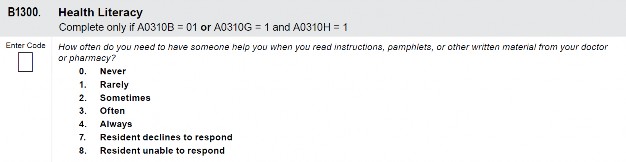
The Single Item Literacy Screener is licensed under a Creative Commons Attribution-NonCommercial 4.0 International License.
Item Rationale
Health-related Quality of Life
DEFINITION
HEALTH LITERACY
Health literacy is the degree to which individuals have the capacity to obtain, process, and understand basic health information and services needed to make appropriate health decisions.
DEFINITION
HEALTH LITERACY
Health literacy is the degree to which individuals have the capacity to obtain, process, and understand basic health information and services needed to make appropriate health decisions.
Similar to language barriers, low health literacy interferes with communication between provider and resident. Health literacy can also affect residents’ ability to understand and follow treatment plans, including medication management.
Poor health literacy is linked to lower levels of knowledge of health, worse outcomes, the receipt of fewer preventive services, and higher medical costs and rates of emergency department use.
Planning for Care
Assessing for health literacy will facilitate better care coordination and discharge planning.
B1300: Health Literacy (cont.) 
Steps for Assessment
This item is intended to be a resident self-report item. No other source should be used to identify the response.
Ask the resident, “How often do you need to have someone help you when you read instructions, pamphlets, or other written material from your doctor or pharmacy?”
Coding Instructions
Code 0, Never: if the resident indicates never needing help reading instructions, pamphlets, or other written materials from doctors or pharmacies.
Code 1, Rarely: if the resident indicates rarely needing help reading instructions, pamphlets, or other written materials from doctors or pharmacies.
Code 2, Sometimes: if the resident indicates sometimes needing help reading instructions, pamphlets, or other written materials from doctors or pharmacies.
Code 3, Often: if the resident indicates often needing help reading instructions, pamphlets, or other written materials from doctors or pharmacies.
Code 4, Always: if the resident indicates always needing help reading instructions, pamphlets, or other written materials from doctors or pharmacies.
Code 7, Resident declines to respond: if the resident declines to respond.
Code 8, Resident unable to respond: if the resident is unable to respond.
Example
1. When asked how often they need help when reading the instructions provided by their doctor, the resident reports that they never need help. The resident’s adult child is present and shares that a family member must always accompany the resident to doctors’ visits and that the resident often needs someone to explain the written materials to them multiple times before they understand, providing examples of needing to frequently explain to the resident why they are on a special diet and why and how to take some of their medications.
Coding: B1300, Health Literacy is coded as Code 0, Never.
Rationale: The resident indicates they never need help reading instructions from their doctor or pharmacist. B1300, Health Literacy is intended to be a resident self-report item and no other sources, including family members/caregivers, should be used to identify the response to this item.