Intent: The items in this section identify behavioral symptoms in the last seven days that may cause distress to the resident, or may be distressing or disruptive to facility residents, staff members or the care environment. These behaviors may place the resident at risk for injury, isolation, and inactivity and may also indicate unrecognized needs, preferences or illness.
Behaviors include those that are potentially harmful to the resident themself. The emphasis is identifying behaviors, which does not necessarily imply a medical diagnosis. Identification of the frequency and the impact of behavioral symptoms on the resident and on others is critical to distinguish behaviors that constitute problems from those that are not problematic. Once the frequency and impact of behavioral symptoms are accurately determined, follow-up evaluation and care plan interventions can be developed to improve the symptoms or reduce their impact.
This section focuses on the resident’s actions, not the intent of their behavior. Because of their interactions with residents, staff may have become used to the behavior and may underreport or minimize the resident’s behavior by presuming intent (e.g., “Resident A doesn’t really mean to hurt anyone. They’re just frightened.”). Resident intent should not be taken into account when coding for items in this section.
E0100: Potential Indicators of Psychosis

DEFINITIONS
HALLUCINATION
The perception of the presence of something that is not actually there. It may be auditory or visual or involve smells, tastes or touch.
DELUSION
A fixed, false belief not shared by others that the resident holds even in the
face of evidence to the
contrary.
DEFINITIONS
HALLUCINATION
The perception of the presence of something that is not actually there. It may be auditory or visual or involve smells, tastes or touch.
DELUSION
A fixed, false belief not shared by others that the resident holds even in the
face of evidence to the
contrary.
Psychotic symptoms may be associated with
Hallucinations and delusions may
be distressing to residents and families,
cause disability,
interfere with delivery of medical, nursing, rehabilitative and personal care, and
lead to dangerous behavior or possible harm.
E0100: Potential Indicators of Psychosis (cont.)
Reversible and treatable causes should be identified and addressed promptly. When the cause is not reversible, the focus of management strategies should be to minimize the amount of disability and distress.
Review the resident’s medical record for the 7-day look-back period.
Interview staff members and others who have had the opportunity to observe the resident in a variety of situations during the 7-day look-back period.
Observe the resident during conversations and the structured interviews in other assessment sections and listen for statements indicating an experience of hallucinations, or the expression of false beliefs (delusions).
Clarify potentially false beliefs:
When a resident expresses a belief that is plausible but alleged by others to be false (e.g., history indicates that the resident’s spouse died 20 years ago, but the resident states their spouse has been visiting them every day), try to verify the facts to determine whether there is reason to believe that it could have happened or whether it is likely that the belief is false.
When a resident expresses a clearly false belief, determine if it can be readily corrected by a simple explanation of verifiable (real) facts (which may only require a simple reminder or reorientation) or demonstration of evidence to the contrary. Do not, however, challenge the resident.
The resident’s response to the offering of a potential alternative explanation is often helpful in determining whether the false belief is held strongly enough to be considered fixed.
Code based on behaviors observed and/or thoughts expressed in the last 7 days rather than the presence of a medical diagnosis. Check all that apply.
Code based on behaviors observed and/or thoughts expressed in the last 7 days rather than the presence of a medical diagnosis. Check all that apply.
Check E0100A, hallucinations: if hallucinations were present in the last 7 days. A hallucination is the perception of the presence of something that is not actually there. It may be auditory or visual or involve smells, tastes or touch.
Check E0100B, delusions: if delusions were present in the last 7 days. A delusion is a fixed, false belief not shared by others that the resident holds true even in the face of evidence to the contrary.
Check E0100Z, none of the above: if no hallucinations or delusions were present in the last 7 days.
E0100: Potential Indicators of Psychosis (cont.)
If a belief cannot be objectively shown to be false, or it is not possible to determine whether it is false, do not code it as a delusion.
If a resident expresses a false belief but easily accepts a reasonable alternative explanation, do not code it as a delusion. If the resident continues to insist that the belief is correct despite an explanation or direct evidence to the contrary, code as a delusion.
A resident carries a doll, which they believe is their baby, and the resident appears upset. When asked about this, they report they are distressed from hearing their baby crying and think that the baby is hungry and they want to get the baby a bottle.
Coding: E0100A would be checked and E0100B would be checked. Rationale: The resident believes the doll is a baby, which is a delusion, and they hear the doll crying, which is an auditory hallucination.
A resident reports that they heard a gunshot. In fact, there was a loud knock on the door. When this is explained to them, they accept the alternative interpretation of the loud noise.
Coding: E0100Z would be checked.
Rationale: They misinterpreted a real sound in the external environment. Because they are able to accept the alternative explanation for the cause of the sound, their report of a gunshot is not a fixed false belief and is therefore not a delusion.
A resident is found speaking aloud in their room. When asked about this, they state that they are answering a question posed to them by an individual in front of them. Staff note that no one is present and that no other voices can be heard in the environment.
Coding: E0100A would be checked.
Rationale: The resident reports auditory and visual sensations that occur in the absence of any external stimulus. Therefore, this is a hallucination.
A resident announces that they must leave to go to work, because they are needed in their office right away. In fact, they have been retired for 15 years. When reminded of this, they continue to insist that they must get to their office.
Coding: E0100B would be checked.
Rationale: The resident adheres to the belief that they still work, even after being reminded about their retirement status. Because the belief is held firmly despite an explanation of the real situation, it is a delusion.
E0100: Potential Indicators of Psychosis (cont.)
A resident believes they must leave the facility immediately because their parents are waiting for them to return home. Staff know that, in reality, their parents are deceased and gently remind them that their parents are no longer living. In response to this reminder, the resident acknowledges, “Oh yes, I remember now. My parents passed away years ago.”
Coding: E0100Z would be checked.
Rationale: The resident’s initial false belief is readily altered with a simple reminder, suggesting that their mistaken belief is due to forgetfulness (i.e., memory loss) rather than psychosis. Because it is not a firmly held false belief, it does not fit the definition of a delusion.
E0200: Behavioral Symptom—Presence & Frequency
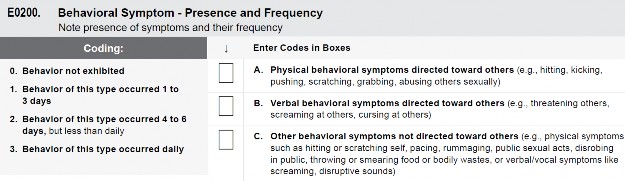
New onset of behavioral symptoms warrants prompt evaluation, assurance of resident safety, relief of distressing symptoms, and compassionate response to the resident.
Reversible and treatable causes should be identified and addressed promptly. When the cause is not reversible, the focus of management strategies should be to minimize the amount of disability and distress.
Identification of the frequency and the impact of behavioral symptoms on the resident and on others is critical to distinguish behaviors that constitute problems—and may therefore require treatment planning and intervention—from those that are not problematic.
These behaviors may indicate unrecognized needs, preferences, or illness.
Once the frequency and impact of behavioral symptoms are accurately determined, follow-up evaluation and interventions can be developed to improve the symptoms or reduce their impact.
E0200: Behavioral Symptom—Presence & Frequency (cont.)
Subsequent assessments and documentation can be compared to baseline to identify changes in the resident’s behavior, including response to interventions.
Review the medical record for the 7-day look-back period.
Interview staff, across all shifts and disciplines, as well as others who had close interactions with the resident during the 7-day look-back period, including family or friends who visit frequently or have frequent contact with the resident.
Observe the resident in a variety of situations during the 7-day look-back period.
Code 0, behavior not exhibited: if the behavioral symptoms were not present in the last 7 days. Use this code if the symptom has never been exhibited or if it previously has been exhibited but has been absent in the last 7 days.
Code 1, behavior of this type occurred 1-3 days: if the behavior was exhibited 1-3 days of the last 7 days, regardless of the number or severity of episodes that occur on any one of those days.
Code 2, behavior of this type occurred 4-6 days, but less than daily: if the behavior was exhibited 4-6 of the last 7 days, regardless of the number or severity of episodes that occur on any of those days.
Code 3, behavior of this type occurred daily: if the behavior was exhibited daily, regardless of the number or severity of episodes that occur on any of those days.
Code based on whether the symptoms occurred and not based on an interpretation of the behavior’s meaning, cause or the assessor’s judgment that the behavior can be explained or should be tolerated.
Code as present, even if staff have become used to the behavior or view it as typical or tolerable.
Behaviors in these categories should be coded as present or not present, whether or not they might represent a rejection of care.
Item E0200C does not include wandering.
E0200: Behavioral Symptom—Presence & Frequency (cont.)
Every morning, a nursing assistant tries to help a resident who is unable to dress themself. On the last 4 out of 6 mornings, the resident has hit or scratched the nursing assistant during attempts to dress them.
Coding: E0200A would be coded 2, behavior of this type occurred 4-6 days, but less than daily.
Rationale: Scratching the nursing assistant was a physical behavior directed toward others.
A resident has previously been found rummaging through the clothes in their roommate’s dresser drawer. This behavior has not been observed by staff or reported by others in the last 7 days.
Coding: E0200C would be coded 0, behavior not exhibited. Rationale: The behavior did not occur during the look-back period.
A resident throws their dinner tray at another resident who repeatedly spit food at them during dinner. This is a single, isolated incident.
Coding: E0200A would be coded 1, behavior of this type occurred 1-3 days of the last 7 days.
Rationale: Throwing a tray was a physical behavior directed toward others. Although a possible explanation exists, the behavior is noted as present because it occurred.
E0300: Overall Presence of Behavioral Symptoms

To determine whether or not additional items E0500, Impact on Resident, and E0600, Impact on Others, are required to be completed.
Review coding for item E0200 and follow these coding instructions:
Code 0, no: if E0200A, E0200B, and E0200C all are coded 0, not present. Skip to
Rejection of Care—Presence & Frequency item (E0800).
Code 1, yes: if any of E0200A, E0200B, or E0200C were coded 1, 2, or 3. Proceed to complete Impact on Resident item (E0500), and Impact on Others item (E0600).
E0500: Impact on Resident
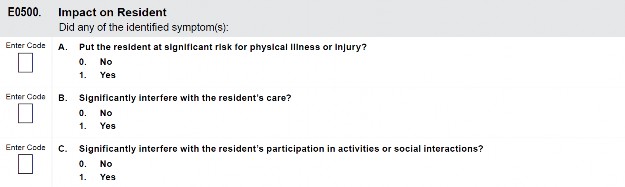
Behaviors identified in item E0200 impact the resident’s risk for significant injury, interfere with care or their participation in activities or social interactions.
Identification of the impact of the behaviors noted in E0200 may require treatment planning and intervention.
Subsequent assessments and documentation can be compared to a baseline to identify changes in the resident’s behavior, including response to interventions.
Consider the previous review of the medical record, staff interviews across all shifts and disciplines, interviews with others who had close interactions with the resident and previous observations of the behaviors identified in E0200 for the 7-day look-back period.
Code E0500A, E0500B, and E0500C based on all of the behavioral symptoms coded in E0200.
Determine whether those behaviors put the resident at significant risk of physical illness or injury, whether the behaviors significantly interfered with the resident’s care, and/or whether the behaviors significantly interfered with the resident’s participation in activities or social interactions.
Coding Instructions for E0500A. Did Any of the Identified Symptom(s) Put the Resident at Significant Risk for Physical Illness or Injury?
Code 0, no: if none of the identified behavioral symptom(s) placed the resident at clinically significant risk for a physical illness or injury.
Code 1, yes: if any of the identified behavioral symptom(s) placed the resident at clinically significant risk for a physical illness or injury, even if no injury occurred.
E0500: Impact on Resident (cont.)
Coding Instructions for E0500B. Did Any of the Identified Symptom(s) Significantly Interfere with the Resident’s Care?
Code 0, no: if none of the identified behavioral symptom(s) significantly interfered with the resident’s care.
Code 1, yes: if any of the identified behavioral symptom(s) impeded the delivery of essential medical, nursing, rehabilitative or personal care, including but not limited to assistance with activities of daily living, such as bathing, dressing, feeding, or toileting.
Coding Instructions for E0500C. Did Any of the Identified Symptom(s) Significantly Interfere with the Resident’s Participation in Activities or Social Interactions?
Code 0, no: if none of the identified symptom(s) significantly interfered with the resident’s participation in activities or social interactions.
Code 1, yes: if any of the identified behavioral symptom(s) significantly interfered with or decreased the resident’s participation or caused staff not to include residents in activities or social interactions.
For E0500A, code based on whether the risk for physical injury or illness is known to occur commonly under similar circumstances (i.e., with residents who exhibit similar behavior in a similar environment). Physical injury is trauma that results in pain or other distressing physical symptoms, impaired organ function, physical disability, or other adverse consequences, regardless of the need for medical, surgical, nursing, or rehabilitative intervention.
For E0500B, code if the impact of the resident’s behavior is impeding the delivery of care to such an extent that necessary or essential care (medical, nursing, rehabilitative or personal that is required to achieve the resident’s goals for health and well-being) cannot be received safely, completely, or in a timely way without more than a minimal accommodation, such as simple change in care routines or environment.
For E0500C, code if the impact of the resident’s behavior is limiting or keeping the resident from engaging in solitary activities or hobbies, joining groups, or attending programmed activities or having positive social encounters with visitors, other residents, or staff.
A resident frequently grabs and scratches staff when they attempt to change their soiled brief, digging their nails into staff members’ skin. This makes it difficult to complete the care task.
Coding: E0500B would be coded 1, yes.
Rationale: This behavior interfered with delivery of essential personal care.
E0500: Impact on Resident (cont.)
During the last 7 days, a resident with vascular dementia and severe hypertension, hits staff during incontinent care making it very difficult to change them. Six out of the last seven days the resident refuses all their medication including their antihypertensive. The resident closes their mouth and shakes their head and will not take it even if re-approached multiple times.
Coding: E0500A and E0500B would both be coded 1, yes.
Rationale: The behavior interfered significantly with delivery of their medical and nursing care and put them at clinically significant risk for physical illness.
A resident paces incessantly. When staff encourage them to sit at the dinner table, they return to pacing after less than a minute, even after cueing and reminders. They are so restless that they cannot sit still long enough to feed themself or receive assistance in obtaining adequate nutrition.
Coding: E0500A and E0500B would both be coded 1, yes.
Rationale: This behavior significantly interfered with personal care (i.e., feeding) and put the resident at risk for malnutrition and physical illness.
A resident repeatedly throws their markers and card on the floor during bingo.
Coding: E0500C would be coded 1, yes.
Rationale: This behavior interfered with their ability to participate in the activity.
A resident with severe dementia has continuous outbursts while awake despite all efforts made by staff to address the issue, including trying to involve the resident in prior activities of choice.
Coding: E0500C would be coded 1, yes.
Rationale: The staff determined the resident’s behavior interfered with the ability to participate in any activities.
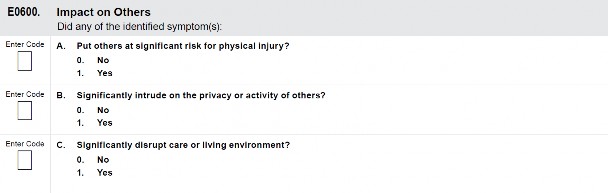
E0600: Impact on Others
E0600: Impact on Others (cont.)
Behaviors identified in item E0200 put others at risk for significant injury, intrude on their privacy or activities and/or disrupt their care or living environments. The impact on others is coded here in item E0600.
Identification of the behaviors noted in E0200 that have an impact on others may require treatment planning and intervention.
Subsequent assessments and documentation can be compared with a baseline to identify changes in the resident’s behavior, including response to interventions.
Consider the previous review of the clinical record, staff interviews across all shifts and disciplines, interviews with others who had close interactions with the resident and previous observations of the behaviors identified in E0200 for the 7-day look-back period.
To code E0600, determine if the behaviors identified put others at significant risk of physical illness or injury, intruded on their privacy or activities, and/or interfered with their care or living environments.
Coding Instructions for E0600A. Did Any of the Identified Symptom(s) Put Others at Significant Risk for Physical Injury?
Code 0, no: if none of the identified behavioral symptom(s) placed staff, visitors, or other residents at significant risk for physical injury.
Code 1, yes: if any of the identified behavioral symptom(s) placed staff, visitors, or other residents at significant risk for physical injury.
Coding Instructions for E0600B. Did Any of the Identified Symptom(s) Significantly Intrude on the Privacy or Activity of Others?
Code 0, no: if none of the identified behavioral symptom(s) significantly intruded on the privacy or activity of others.
Code 1, yes: if any of the identified behavioral symptom(s) kept other residents from enjoying privacy or engaging in informal activities (not organized or run by staff). Includes coming in uninvited, invading, or forcing oneself on others’ private activities.
E0600: Impact on Others (cont.)
Coding Instructions for E0600C. Did Any of the Identified Symptom(s) Significantly Disrupt Care or the Living Environment?
Code 0, no: if none of the identified behavioral symptom(s) significantly disrupted delivery of care or the living environment.
Code 1, yes: if any of the identified behavioral symptom(s) created a climate of excessive noise or interfered with the receipt of care or participation in organized activities by other residents.
For E0600A, code based on whether the behavior placed others at significant risk for physical injury. Physical injury is trauma that results in pain or other distressing physical symptoms, impaired organ function, physical disability or other adverse consequences, regardless of the need for medical, surgical, nursing, or rehabilitative intervention.
For E0600B, code based on whether the behavior violates other residents’ privacy or interrupts other residents’ performance of activities of daily living or limits engagement in or enjoyment of informal social or recreational activities to such an extent that it causes the other residents to experience distress (e.g., displeasure or annoyance) or inconvenience, whether or not the other residents complain.
For E0600C, code based on whether the behavior interferes with staff ability to deliver care or conduct organized activities, interrupts receipt of care or participation in organized activities by other residents, and/or causes other residents to experience distress or adverse consequences.
A resident appears to intentionally stick their cane out when another resident walks by.
Coding: E0600A would be coded 1, yes; E0600B and E0600C would be coded 0, no.
Rationale: The behavior put the other resident at risk for falling and physical injury. You may also need to consider coding B and C depending on the specific situation in the environment or care setting.
A resident, when sitting in the hallway outside the community activity room, continually yells, repeating the same phrase. The yelling can be heard by other residents in hallways and activity/recreational areas but not in their private rooms.
Coding: E0600A would be coded 0, no; E0600B and E0600C would be coded 1, yes.
Rationale: The behavior does not put others at risk for significant injury. The behavior does create a climate of excessive noise, disrupting the living environment and the activity of others.
E0600: Impact on Others (cont.)
A resident repeatedly enters the rooms of other residents and rummages through their personal belongings. The other residents do not express annoyance.
Coding: E0600A and E0600C would be coded 0, no; E0600B would be coded 1, yes.
Rationale: This is an intrusion and violates other residents’ privacy regardless of whether they complain or communicate their distress.
When eating in the dining room, a resident frequently grabs food off the plates of other residents. Although the other resident’s food is replaced, and the behavior does not compromise their nutrition, other residents become anxious in anticipation of this recurring behavior.
Coding: E0600A would be coded 0, no; E0600B and E0600C would be coded 1, yes.
Rationale: This behavior violates other residents’ privacy as it is an intrusion on the personal space and property (food tray). In addition, the behavior is pervasive and disrupts the staff’s ability to deliver nutritious meals in dining room (an organized activity).
A resident tries to seize the telephone out of the hand of another resident who is attempting to complete a private conversation. Despite being asked to stop, the resident persists in grabbing the telephone and insisting that they want to use it.
Coding: E0600A and E0600C would be coded 0, no; E0600B would be coded 1, yes.
Rationale: This behavior is an intrusion on another resident’s private telephone conversation.
A resident begins taunting two residents who are playing an informal card game, yelling that they will “burn in hell” if they don’t stop “gambling.”
Coding: E0600A and E0600C would be coded 0, no; E0600B would be coded 1, yes.
Rationale: The behavior is intruding on the other residents’ game. The game is not an organized facility event and does not involve care. It is an activity in which the two residents wanted to engage.
A resident yells continuously during an exercise group, diverting staff attention so that others cannot participate in and enjoy the activity.
Coding: E0600A and E0600B would be coded 0, no; E0600C would be coded 1, yes.
Rationale: This behavior disrupts the delivery of physical care (exercise) to the group participants and creates an environment of excessive noise.
E0600: Impact on Others (cont.)
A resident becomes verbally threatening in a group discussion activity, frightening other residents. In response to this disruption, staff terminate the discussion group early to avoid eliciting the behavioral symptom.
Coding: E0600A and E0600B would be coded 0, no; E0600C would be coded 1, yes.
Rationale: This behavior does not put other residents at risk for significant injury. However, the behavior restricts full participation in the organized activity, and limits the enjoyment of other residents. It also causes fear, thereby disrupting the living environment.
E0800: Rejection of Care—Presence & Frequency

Goals for health and well-being reflect the resident’s wishes and objectives for health, function, and life satisfaction that define an acceptable quality of life for that individual.
The resident’s care preferences reflect desires, wishes, inclinations, or choices for care. Preferences do not have to appear logical or rational to the clinician. Similarly, preferences are not necessarily informed by facts or scientific knowledge and may not be consistent with “good judgment.”
It is really a matter of resident choice. When rejection/decline of care is first identified, the team then investigates and determines the rejection/decline of care is really a matter of resident’s choice. Education is provided and the resident’s choices become part of the plan of care. On future assessments, this behavior would not be coded in this item.
A resident might reject/decline care because the care conflicts with their preferences and goals. In such cases, care rejection behavior is not considered a problem that warrants treatment to modify or eliminate the behavior.
Care rejection may be manifested by verbally declining, statements of refusal, or through physical behaviors that convey aversion to, result in avoidance of, or interfere with the receipt of care.
E0800: Rejection of Care—Presence & Frequency (cont.)
DEFINITIONS
REJECTION OF CARE
Behavior that interrupts or interferes with the delivery or receipt of care. Care rejection may be manifested by verbally declining or statements of refusal or through physical behaviors that convey aversion to or result in avoidance of or interfere with the receipt of care.
INTERFERENCE WITH CARE
Hindering the delivery or receipt of care by disrupting the usual routines or processes by which care is given, or by exceeding the level or intensity of resources that are usually available for the provision of care.
DEFINITIONS
REJECTION OF CARE
Behavior that interrupts or interferes with the delivery or receipt of care. Care rejection may be manifested by verbally declining or statements of refusal or through physical behaviors that convey aversion to or result in avoidance of or interfere with the receipt of care.
INTERFERENCE WITH CARE
Hindering the delivery or receipt of care by disrupting the usual routines or processes by which care is given, or by exceeding the level or intensity of resources that are usually available for the provision of care.
This type of behavior interrupts or interferes with the delivery or receipt of care by disrupting the usual routines or processes by which care is given, or by exceeding the level or intensity of resources that are usually available for the provision of care.
A resident’s rejection of care might be caused by an underlying neuropsychiatric, medical, or dental problem. This can interfere with needed care that is consistent with the resident’s preferences or established care goals. In such cases, care rejection behavior may be a problem that requires assessment and intervention.
Evaluation of rejection of care assists the nursing home in honoring the resident’s care preferences in order to meet their desired health care goals.
Follow-up assessment should consider:
Determine whether a previous discussion identified an
objection to the type of care or the way in which the care was provided. If so, determine approaches to accommodate the resident’s preferences.
Review the medical record.
Interview staff, across all shifts and disciplines, as well as others who had close interactions with the resident during the 7-day look-back period.
Review the record and consult staff to determine whether the rejected care is needed to achieve the resident’s preferences and goals for health and well-being.
Review the medical record to find out whether the care rejection behavior was previously addressed and documented in discussions or in care planning with the resident, family, or significant other and determined to be an informed choice consistent with the resident’s values, preferences, or goals; or whether that the behavior represents an objection to the way care is provided, but acceptable alternative care and/or approaches to care have been identified and employed.
If the resident exhibits behavior that appears to communicate a rejection of care (and that rejection behavior has not been previously determined to be consistent with the resident’s values or goals), ask them directly whether the behavior is meant to decline or refuse care.
E0800: Rejection of Care—Presence & Frequency (cont.)
If the resident indicates that the intention is to decline or refuse, then ask them about the reasons for rejecting care and about their goals for health care and well-being.
If the resident is unable or unwilling to respond to questions about their rejection of care or goals for health care and well-being, then interview the family or significant other to ascertain the resident’s health care preferences and goals.
Code 0, behavior not exhibited: if rejection of care consistent with goals was not exhibited in the last 7 days.
Code 1, behavior of this type occurred 1-3 days: if the resident rejected care consistent with goals 1-3 days during the 7-day look-back period, regardless of the number of episodes that occurred on any one of those days.
Code 2, behavior of this type occurred 4-6 days, but less than daily: if the resident rejected care consistent with goals 4-6 days during the 7-day look-back period, regardless of the number of episodes that occurred on any one of those days.
Code 3, behavior of this type occurred daily: if the resident rejected care consistent with goals daily in the 7-day look-back period, regardless of the number of episodes that occurred on any one of those days.
The intent of this item is to identify potential behavioral problems, not situations in which care has been rejected based on a choice that is consistent with the resident’s preferences or goals for health and well-being or a choice made on behalf of the resident by a family member or other proxy decision maker.
Do not include behaviors that have already been addressed (e.g., by discussion or care planning with the resident or family) and determined to be consistent with the resident’s values, preferences, or goals. Residents who have made an informed choice about not wanting a particular treatment, procedure, etc., should not be identified as “rejecting care.”
A resident with heart failure who recently returned to the nursing home after surgical repair of a hip fracture is offered physical therapy and declines. They say that they get too short of breath when they try to walk even a short distance, making physical therapy intolerable. They do not expect to walk again and does not want to try. Their physician has discussed this with them and has indicated that their prognosis for regaining ambulatory function is poor.
Coding: E0800 would be coded 0, behavior not exhibited.
Rationale: This resident has communicated that they consider physical therapy to be both intolerable and futile. The resident discussed this with their physician. Their choice to not accept physical therapy treatment is consistent with their values and goals for health care. Therefore, this would not be coded as rejection of care.
E0800: Rejection of Care—Presence & Frequency (cont.)
A resident informs the staff that they would rather receive care at home, and the next day they call for a taxi and exits the nursing facility. When staff try to persuade them to return, they firmly state, “Leave me alone. I always swore I’d never go to a nursing home. I’ll get by with my visiting nurse service at home again.” They are not exhibiting signs of disorientation, confusion, or psychosis and has never been judged incompetent.
Coding: E0800 would be coded 0, behavior not exhibited.
Rationale: Their departure is consistent with their stated preferences and goals for health care. Therefore, this is not coded as care rejection.
A resident goes to bed at night without changing out of the clothes they wore during the day. When a nursing assistant offers to help them get undressed, they decline, stating that they prefer to sleep in their clothes tonight. The clothes are wet with urine. This has happened 2 of the past 7 days. The resident was previously fastidious, recently has expressed embarrassment at being incontinent, and has care goals that include maintaining personal hygiene and skin integrity.
Coding: E0800 would be coded 1, behavior of this type occurred 1-3 days. Rationale: The resident’s care rejection behavior is not consistent with their values and goals for health and well-being. Therefore, this is classified as care rejection that occurred twice.
A resident chooses not to eat supper one day, stating that the food causes them diarrhea. They say they know they need to eat and do not wish to compromise their nutrition, but they are more distressed by the diarrhea than by the prospect of losing weight.
Coding: E0800 would be coded 1, behavior of this type occurred 1-3 days. Rationale: Although choosing not to eat is consistent with the resident’s desire to avoid diarrhea, it is also in conflict with their stated goal to maintain adequate nutrition.
A resident is given their antibiotic medication prescribed for treatment of pneumonia and immediately spits the pills out on the floor. This resident’s assessment indicates that they do not have any swallowing problems. This happened on each of the last 4 days. The resident’s advance directive indicates that they would choose to take antibiotics to treat a potentially life-threatening infection.
Coding: E0800 would be coded 2, behavior of this type occurred 4-6 days, but less than daily.
Rationale: The behavioral rejection of antibiotics prevents the resident from achieving their stated goals for health care listed in their advance directives. Therefore, the behavior is coded as care rejection.
E0800: Rejection of Care—Presence & Frequency (cont.)
A resident who recently returned to the nursing home after surgery for a hip fracture is offered physical therapy and declines. They state that they want to walk again but is afraid of falling. This occurred on 4 days during the look-back period.
Coding: E0800 would be coded 2, behavior of this type occurred 4-6 days. Rationale: Even though the resident’s health care goal is to regain their ambulatory status, their fear of falling results in rejection of physical therapy and interferes with their rehabilitation. This would be coded as rejection of care.
A resident who previously ate well and prided themself on following a healthy diet has been refusing to eat every day for the past 2 weeks. They complain that the food is boring and that they feel full after just a few bites. They say they want to eat to maintain their weight and avoid getting sick, but they cannot push themself to eat anymore.
Coding: E0800 would be coded 3, behavior of this type occurred daily. Rationale: The resident’s choice not to eat is not consistent with their goal of weight maintenance and health. Choosing not to eat may be related to a medical condition such as a disturbance of taste sensation, gastrointestinal illness, endocrine condition, depressive disorder, or medication side effects.
E0900: Wandering—Presence & Frequency

Wandering may be a pursuit of exercise or a pleasurable leisure activity, or it may be related to tension, anxiety, agitation, or searching.
It is important to assess for reason for wandering. Determine the frequency of its occurrence, and any factors that trigger the behavior or that decrease the episodes.
Assess for underlying tension, anxiety, psychosis, drug-induced psychomotor restlessness, agitation, or unmet need (e.g., for food, fluids, toileting, exercise, pain relief, sensory or cognitive stimulation, sense of security, companionship) that may be contributing to wandering.
E0900: Wandering—Presence & Frequency (cont.)
Review the medical record and interview staff to determine whether wandering occurred during the 7-day look-back period.
Wandering is the act of moving (walking or locomotion in a wheelchair) from place to place with or without a specified course or known direction. Wandering may or may not be aimless. The wandering resident may be oblivious to their physical or safety needs. The resident may have a purpose such as searching to find something, but they persist without knowing the exact direction or location of the object, person or place. The behavior may or may not be driven by confused thoughts or delusional ideas (e.g., when a resident believes they must find their parent, who staff know is deceased).
If wandering occurred, determine the frequency of the wandering during the 7-day look-back period.
Code 0, behavior not exhibited: if wandering was not exhibited during the 7-day look-back period. Skip to Change in Behavior or Other Symptoms item (E1100).
Code 1, behavior of this type occurred 1-3 days: if the resident wandered on 1-3 days during the 7-day look-back period, regardless of the number of episodes that occurred on any one of those days. Proceed to answer Wandering—Impact item (E1000).
Code 2, behavior of this type occurred 4-6 days, but less than daily: if the resident wandered on 4-6 days during the 7-day look-back period, regardless of the number of episodes that occurred on any one of those days. Proceed to answer Wandering—Impact item (E1000).
Code 3, behavior of this type occurred daily: if the resident wandered daily during the 7-day look-back period, regardless of the number of episodes that occurred on any one of those days. Proceed to answer Wandering—Impact item (E1000).
Pacing (repetitive walking with a driven/pressured quality) within a constrained space is not included in wandering.
Wandering may occur even if resident is in a locked unit.
Traveling via a planned course to another specific place (such as going to the dining room to eat a meal or to an activity) is not considered wandering.
E1000: Wandering—Impact
Answer this item only if E0900, Wandering—Presence & Frequency, was coded 1 (behavior of this type occurred 1-3 days), 2 (behavior of this type occurred 4-6 days, but less than daily), or 3 (behavior of this type occurred daily).
Answer this item only if E0900, Wandering—Presence & Frequency, was coded 1 (behavior of this type occurred 1-3 days), 2 (behavior of this type occurred 4-6 days, but less than daily), or 3 (behavior of this type occurred daily).
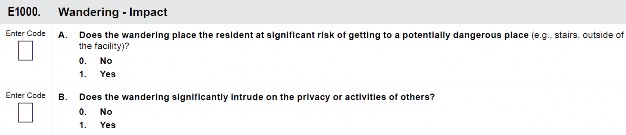
Not all wandering is harmful.
Some residents who wander are at potentially higher risk for entering an unsafe situation.
Some residents who wander can cause significant disruption to other residents.
Care plans should consider the impact of wandering on resident safety and disruption to others.
Care planning should be focused on minimizing these issues.
Determine the need for environmental modifications (door alarms, door barriers, etc.) that enhance resident safety if wandering places the resident at risk.
Determine when wandering requires interventions to reduce unwanted intrusions on other residents or disruption of the living environment.
Consider the previous review of the resident’s wandering behaviors identified in E0900 for the 7-day look-back period.
Determine whether those behaviors put the resident at significant risk of getting into potentially dangerous places and/or whether wandering significantly intrudes on the privacy or activities of others based on clinical judgment for the individual resident.
Coding Instructions for E1000A. Does the Wandering Place the Resident at Significant Risk of Getting to a Potentially Dangerous Place?
A resident wanders away from the nursing home in their pajamas at 3 a.m. When staff members talk to them, they insist they looking for their spouse. This elopement behavior had occurred when they were living at home, and on one occasion they became lost and were missing for 3 days, leading their family to choose nursing home admission for their personal safety.
Coding: E1000A would be coded 1, yes.
Rationale: Wandering that results in elopement from the nursing home places the resident at significant risk of getting into a dangerous situation.
A resident wanders away from the nursing facility at 7 a.m. Staff find them crossing a busy street against a red light. When staff try to persuade them to return, they become angry and say, “My boss called, and I have to get to the office.” When staff remind them that they have been retired for many years, they continue to insist that they must get to work.
Coding: E1000A would be coded 1, yes.
Rationale: This resident’s wandering is associated with elopement from the nursing home and into a dangerous traffic situation. Therefore, this is coded as placing the resident at significant risk of getting to a place that poses a danger. In addition, delusions would be checked in item E0100.
A resident propels themself in their wheelchair into the room of another resident, blocking the door to the other resident’s bathroom.
Coding: E1000B would be coded 1, yes.
Rationale: Moving about in this manner with the use of a wheelchair meets the definition of wandering, and the resident has intruded on the privacy of another resident and has interfered with that resident’s ability to use the bathroom.
E1100: Change in Behavior or Other Symptoms
E1100: Change in Behavior or Other Symptoms (cont.)
Change in behavior may be an important indicator of
a change in health status or a change in environmental stimuli,
positive response to treatment, and
adverse effects of treatment.
If behavior is worsening, assessment should consider whether it is related to
new health problems, psychosis, or delirium;
worsening of pre-existing health problems;
a change in environmental stimuli or caregivers that influences behavior; and
adverse effects of treatment.
If behaviors are improved, assessment should consider what interventions should be continued or modified (e.g., to minimize risk of relapse or adverse effects of treatment).
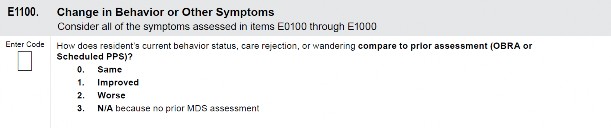
Review responses provided to items E0100-E1000 on the current MDS assessment.
Compare with responses provided on prior MDS assessment.
Taking all of these MDS items into consideration, make a global assessment of the change in behavior from the most recent to the current MDS.
Rate the overall behavior as same, improved, or worse.
Code 0, same: if overall behavior is the same (unchanged).
Code 1, improved: if overall behavior is improved.
Code 2, worse: if overall behavior is worse.
Code 3, N/A: if there was no prior MDS assessment of this resident.
For residents with multiple behavioral symptoms, it is possible that different behaviors will vary in different directions over time. That is, one behavior may improve while another worsens or remains the same. Using clinical judgment, this item should be rated to reflect the overall direction of behavior change, estimating the net effects of multiple behaviors.
E1100: Change in Behavior or Other Symptoms (cont.)
On the prior assessment, the resident was reported to wander on 4 out of 7 days. Because of elopement, the behavior placed the resident at significant risk of getting to a dangerous place. On the current assessment, the resident was found to wander on the unit 2 of the last 7 days but has not attempted to exit the unit. Because the resident is no longer attempting to exit the unit, they are at decreased risk for elopement and getting to a dangerous place. However, the resident is now wandering into the rooms of other residents, intruding on their privacy. This requires occasional redirection by staff.
Coding: E1100 would be coded 1, improved.
Rationale: Although one component of this resident’s wandering behavior is worse because it has begun to intrude on the privacy of others, it is less frequent and less dangerous (without recent elopement) and is therefore improved overall since the last assessment. The fact that the behavior requires less intense surveillance or intervention by staff also supports the decision to rate the overall behavior as improved.
At the time of the last assessment, the resident was ambulatory and would threaten and hit other residents daily. They recently suffered a hip fracture and is not ambulatory. They are not approaching, threatening, or assaulting other residents. However, the resident is now combative when staff try to assist with dressing and bathing, and is hitting staff members daily.
Coding: E1100 would be coded 0, same.
Rationale: Although the resident is no longer assaulting other residents, they have begun to assault staff. Because the danger to others and the frequency of these behaviors is the same as before, the overall behavior is rated as unchanged.
On the prior assessment, a resident with Alzheimer’s disease was reported to wander on 2 out of 7 days and has responded well to redirection. On the most recent assessment, it was noted that the resident has been wandering more frequently for 5 out of 7 days and has also attempted to elope from the building on two occasions.
This behavior places the resident at significant risk of personal harm. The resident has been placed on more frequent location checks and has required additional redirection from staff. They were also provided with an elopement bracelet so that staff will be alerted if the resident attempts to leave the building. The intensity required of staff surveillance because of the dangerousness and frequency of the wandering behavior has significantly increased.
Coding: E1100 would be coded 2, worse.
Rationale: Because the danger and the frequency of the resident’s wandering behavior have increased and there were two elopement attempts, the overall behavior is rated as worse.