Intent: The items in this section address mood distress and social isolation. Mood distress is a serious condition that is underdiagnosed and undertreated in the nursing home and is associated with significant morbidity. It is particularly important to identify signs and symptoms of mood distress among nursing home residents because these signs and symptoms can be treatable.
Social isolation refers to an actual or perceived lack of contact with other people and tends to increase with age. It is a risk factor for physical and mental illness, is a predictor of mortality, and is important to assess in order to identify engagement strategies.
D0100: Should Resident Mood Interview Be Conducted?

Most residents who are capable of communicating can answer questions about how they feel.
Obtaining information about mood directly from the resident, sometimes called “hearing the resident’s voice,” is more reliable and accurate than observation alone for identifying a mood disorder.
Symptom-specific information from direct resident interviews will allow for the incorporation of the resident’s voice in the individualized care plan.

If a resident cannot communicate, then Staff Mood Interview (D0500 A-J) should be conducted, unless the assessment being completed is a stand-alone Part A PPS Discharge; if that is the case, then skip to D0700. Social Isolation.
D0100: Should Resident Mood Interview Be Conducted? (cont.)
Interact with the resident using their preferred language. Be sure they can hear you and/or have access to their preferred method for communication. If the resident appears unable to communicate, offer alternatives such as writing, pointing, sign language, or cue cards.
Determine whether the resident is rarely/never understood verbally, in writing, or using another method. If rarely/never understood, skip to D0500, Staff Assessment of Resident Mood (PHQ-9-OV©), unless the assessment being completed is a stand-alone Part A PPS Discharge; if that is the case, then skip to D0700. Social Isolation.
Review Language item (A1110) to determine if the resident needs or wants an interpreter to communicate with doctors or health care staff (A1110 = 1).
If the resident needs or wants an interpreter, complete the interview with an interpreter.
Code 0, no: if the interview should not be conducted because the resident is rarely/never understood or cannot respond verbally, in writing, or using another method, or an interpreter is needed but not available. Skip to item D0500, Staff Assessment of Resident Mood (PHQ-9-OV©), unless the assessment being completed is a stand-alone Part A PPS Discharge; if that is the case, then skip to D0700. Social Isolation.
Code 1, yes: if the resident interview should be conducted because the resident is at least sometimes understood verbally, in writing, or using another method, and if an interpreter is needed, one is available. Continue to item D0150, Resident Mood Interview (PHQ-2 to 9©).
Attempt to conduct the interview with ALL residents. This interview is conducted during the look-back period of the Assessment Reference Date (ARD) and is not contingent upon item B0700, Makes Self Understood.
D0100 serves as a gateway item for the Resident Mood Interview (PHQ-2 to 9©) and D0500, Staff Assessment of Resident Mood (PHQ-9-OV©). The assessor will complete the Staff Assessment only when D0100 is coded 0, No. The assessor does not complete the Staff Assessment based on resident performance during the Resident Mood Interview.
If the resident needs an interpreter, every effort should be made to have an interpreter present for the PHQ-2 to 9© interview. If it is not possible for a needed interpreter to be present on the day of the interview, code D0100 = 0 to indicate that an interview was not attempted and complete items D0500-D0600, unless the assessment being completed is a stand-alone Part A PPS Discharge; if that is the case, then skip to D0700. Social Isolation.
Includes residents who use American Sign Language (ASL).
D0100: Should Resident Mood Interview Be Conducted? (cont.)
If the resident interview was not conducted within the look-back period of the ARD, item D0100 must be coded 1, Yes, and the standard “no information” code (a dash “-”) entered in the resident interview items.
Do not complete the Staff Assessment of Resident Mood items (D0500) if the resident interview should have been conducted but was not done, or if the assessment being completed is a stand-alone Part A PPS Discharge assessment.
Resident refusal or unwillingness to participate in the interview would result in Item D0100 being coded 1, Yes, and code 9, No response being entered in Column 1. Symptom Presence. Assessors should proceed to Item D0700, Social Isolation in the case of resident refusal or unwillingness to participate.
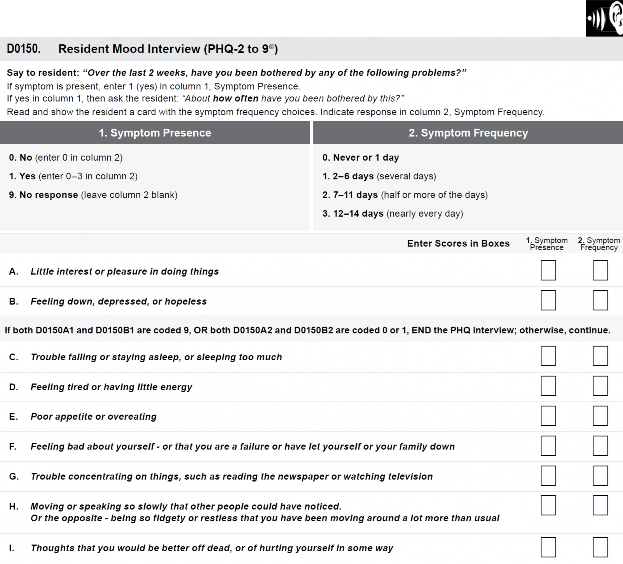
D0150: Resident Mood Interview (PHQ-2 to 9©)
Copyright © Pfizer Inc. All rights reserved. Reproduced with permission.
It is important to note that coding the presence of clinical signs and symptoms of depressed mood does not automatically mean that the resident has a diagnosis of depression or other mood disorder. Assessors do not make or assign a diagnosis based on these findings; they simply record the presence or absence of specific clinical signs and symptoms of depressed mood. Facility staff should recognize these signs and symptoms and consider them when developing the resident’s individualized care plan.
DEFINITION
PATIENT HEALTH QUESTIONNAIRE (PHQ-2 to 9©)
A validated interview that screens for symptoms of depression. It provides a standardized severity score and a rating for evidence of a depressive disorder.
DEFINITION
PATIENT HEALTH QUESTIONNAIRE (PHQ-2 to 9©)
A validated interview that screens for symptoms of depression. It provides a standardized severity score and a rating for evidence of a depressive disorder.
Depression can be associated with:
psychological and physical distress,
decreased participation in therapy and activities,
decreased functional status, and
poorer outcomes.
Mood disorders are common in nursing homes and are often underdiagnosed and undertreated.
Findings suggesting mood distress could lead to:
identifying causes and contributing factors for symptoms and
identifying interventions (treatment, personal support, or environmental modifications) that could address symptoms.
Interview any resident when D0100 = 1.
Conduct the interview in a private setting.
If an interpreter is used during resident interviews, the interpreter should not attempt to determine the intent behind what is being translated, the outcome of the interview, or the meaning or significance of the resident’s responses.
Sit so that the resident can see your face. Minimize glare by directing light sources away from the resident’s face.
Be sure the resident can hear you.
Residents with a hearing impairment should be interviewed using their usual communication devices/techniques, as applicable, during the interview.
Try an external assistive device (headphones or hearing amplifier) if you have any doubt about hearing ability.
Minimize background noise.
If you are administering the PHQ-2 to 9© in paper form, be sure that the resident can see the print. Provide large print or assistive device (e.g., page magnifier) if necessary.
Explain the reason for the interview before beginning.
Suggested language: “I am going to ask you some questions about your mood and feelings over the past 2 weeks. I will also ask about some common problems that are known to go along with feeling down. Some of the questions might seem personal, but everyone is asked to answer them. This will help us provide you with better care.”
Explain and /or show the interview response choices. A cue card with the response choices clearly written in large print might help the resident comprehend the response choices.
Suggested language: “I am going to ask you how often you have been bothered by a particular problem over the last 2 weeks. I will give you the choices that you see on this card.” (Say while pointing to cue card): “0-1 days—never or 1 day, 2-6 days—several days, 7-11 days—half or more of the days, or 12-14 days—nearly every day.”
Ask the first two questions of the Resident Mood Interview (PHQ-2 to 9©).
Suggested language: “Over the last 2 weeks, have you been bothered by any of the following problems?”
For each of the questions:
Read the item as it is written.
Do not provide definitions because the meaning must be based on the resident’s interpretation. For example, the resident defines for themself what “tired” means; the item should be scored based on the resident’s interpretation.
Each question must be asked in sequence to assess Symptom Presence (column 1) and Symptom Frequency (column 2) before proceeding to the next question.
Enter code 9 in Column 1 and leave Column 2 blank if the resident was unable or chose not to complete the assessment or responded nonsensically. A nonsensical response is one that is unrelated, incomprehensible, or incoherent or if the resident’s response is not informative with respect to the item being rated (e.g., when asked the question about “poor appetite or overeating,” the resident answers, “I always win at poker.”).
For a yes response, ask the resident to tell you how often they were bothered by the symptom over the last 2 weeks. Use the response choices in D0150 Column 2, Symptom Frequency. Start by asking the resident the number of days that they were bothered by the symptom and read and show cue card with frequency categories/descriptions (0-1 days— never or 1 day, 2-6 days—several days, 7-11 days—half or more of the days, or 12-14 days—nearly every day).
Determine whether to ask the remaining seven questions (D0150C to D0150I) of the Resident Mood Interview (PHQ-2 to 9©). Whether or not further evaluation of a resident’s mood is needed depends on the resident’s responses to the first two questions (D0150A and D0150B) of the Resident Mood Interview.
If both D0150A1 and D0150B1 are coded 9, OR both D0150A2 and D0150B2 are coded 0 or 1, end the PHQ interview; otherwise continue.
If both D0150A1 and D0150B1 are coded 9, leave D0150A2 and D0150B2 blank, then end the PHQ-2©, leave D0160, Total Severity Score blank, and skip to D0700, Social Isolation.
If both D0150A2 and D0150B2 are coded 0 or 1, then end the PHQ-2© and enter the total score from D0150A2 and D0150B2 in D0160, Total Severity Score.
For all other scenarios, proceed to ask the remaining seven questions (D0150C to D0150I of the PHQ-9©) and complete D0160, Total Severity Score.
Code 0, no: if resident indicates symptoms listed are not present. Enter 0 in Column 2 as well.
Code 1, yes: if resident indicates symptoms listed are present. Enter 0, 1, 2, or 3 in Column 2, Symptom Frequency.
Code 9, no response: if the resident was unable or chose not to complete the assessment or responded nonsensically. Leave Column 2, Symptom Frequency, blank.
Enter a Dash in Column 1 if the symptom presence was not assessed.
Record the resident’s responses as they are stated, regardless of whether the resident or the assessor attributes the symptom to something other than mood. Further evaluation of the clinical relevance of reported symptoms should be explored by the responsible clinician.
Record the resident’s responses as they are stated, regardless of whether the resident or the assessor attributes the symptom to something other than mood. Further evaluation of the clinical relevance of reported symptoms should be explored by the responsible clinician.
Code 0, never or 1 day: if the resident indicates that during the past 2 weeks they have never been bothered by the symptom or have only been bothered by the symptom on 1 day.
Code 1, 2-6 days (several days): if the resident indicates that during the past 2 weeks they have been bothered by the symptom for 2-6 days.
Code 2, 7-11 days (half or more of the days): if the resident indicates during the past 2 weeks they have been bothered by the symptom for 7-11 days.
Code 3, 12-14 days (nearly every day): if the resident indicates during the past 2 weeks they have been bothered by the symptom for 12-14 days.
Attempt to conduct the interview with ALL residents.
If both D0150A1 and D0150B1 are coded 9, leave D0150A2 and D0150B2 blank, then end the PHQ-2©, leave D0160, Total Severity Score blank, and skip to D0700, Social Isolation.
If Column 1 equals 0, enter 0 in Column 2.
If Column 1 equals 9 or dash, leave Column 2 blank.
For question D0150I, Thoughts That You Would Be Better Off Dead or of Hurting Yourself in Some Way:
If the resident uses their own words to describe a symptom, this should be briefly explored. If you determine that the resident is reporting the intended symptom but using their own words, ask them to tell you how often they were bothered by that symptom.
Select only one frequency response per item.
If the resident has difficulty selecting between two frequency responses, code for the higher frequency.
Some items (e.g., item D0150F) contain more than one phrase. If a resident gives different frequencies for the different parts of a single item, select the highest frequency as the score for that item.
In the rare situation that the resident cannot provide a frequency, following a yes response to a symptom in Column 1, enter a dash in Column 2. CMS expects a dash response to be rare.
Residents may respond to questions:
Repeat a question if you think that it has been misunderstood or misinterpreted.
Some residents may be eager to talk with you and will stray from the topic at hand. When a person strays, you should gently guide the conversation back to the topic.
Example: Say, “That’s interesting, now I need to know…”; “Let’s get back to…”; “I understand, can you tell me about….”
Example: Say, “I think I hear you saying that…”; “Let’s see if I understood you correctly.”; “You said…. Is that right?”
If the resident has difficulty selecting a frequency response, start by offering a single frequency response and follow with a sequence of more specific questions. This is known as unfolding.
Example: Say, “Would you say [name symptom] bothered you more than half the days in the past 2 weeks?”
If the resident says “yes,” show the cue card and ask whether it bothered them nearly every day (12-14 days) or on half or more of the days (7-11 days).
If the resident says “no,” show the cue card and ask whether it bothered them several days (2-6 days) or never or 1 day (0-1 day).
Noncommittal responses such as “not really” should be explored. Residents may be reluctant to report symptoms and should be gently encouraged to tell you if the symptom bothered them, even if it was only some of the time. This is known as probing. Probe by asking neutral or nondirective questions such as:
“What do you mean?”
“Tell me what you have in mind.”
“Tell me more about that.”
“Please be more specific.”
“Give me an example.”
Sometimes respondents give a long answer to interview items. To narrow the answer to the response choices available, it can be useful to summarize their longer answer and then ask them which response option best applies. This is known as echoing.
Example: Item D0150E, Poor Appetite or Overeating. The resident responds “the food is always cold and it just doesn’t taste like it does at home. The doctor won’t let me have any salt.”
Example: Item D0150A, Little Interest or Pleasure in Doing Things. The resident, when asked how often they have been bothered by little interest or pleasure in doing things, responds, “There’s nothing to do here, all you do is eat, bathe, and sleep. They don’t do anything I like to do.”
Example: Item D0150B, Feeling Down, Depressed, or Hopeless. The resident, when asked how often they have been bothered by feeling down, depressed, or hopeless, responds: “How would you feel if you were here?”
Possible interview response: “You asked how I would feel, but it is important that I understand your feelings right now. How often would you say that you have been bothered by feeling down, depressed, or hopeless during the last 2 weeks?”
If the resident has difficulty with longer items, separate the item into shorter parts, and provide a chance to respond after each part. This method, known as disentangling, is helpful if a resident has moderate cognitive impairment but can respond to simple, direct questions.
Example: Item D0150E, Poor Appetite or Overeating.
Example: Item D0150C, Trouble Falling or Staying Asleep, or Sleeping Too Much.
Example: Item D0150H, Moving or Speaking So Slowly That Other People Could Have Noticed. Or the Opposite—Being So Fidgety or Restless That You Have Been Moving Around a Lot More than Usual.
Assessor: “Over the past 2 weeks, have you been bothered by any of the following problems? Little interest or pleasure in doing things?”
Resident: “I’m not interested in doing much. I just don’t feel like it. I used to enjoy visiting with friends, but I don’t do that much anymore. I’m just not interested.”
Assessor: “In the past 2 weeks, how often would you say you have been bothered by this? Would you say never or 1 day, 2-6 days, 7-11 days, or 12-14 days?
Resident: “7-11 days.”
Coding: D0150A1 (Symptom Presence) would be coded 1, yes and D0150A2 (Symptom Frequency) would be coded 2, 7-11 days.
Rationale: The resident indicates that they have lost interest in activities that they previously enjoyed. The resident indicates that the symptom has bothered them 7-11 days in the past 2 weeks.
Assessor: “Over the past 2 weeks, have you had trouble concentrating on things, such as reading the newspaper or watching television?”
Resident: “Television? I used to like watching the news. I can’t concentrate on that anymore.”
Assessor: “In the past 2 weeks, how often have you been bothered by having difficulty concentrating on things like television? Would you say never or 1 day, 2-6 days, 7-11 days, or 12-14 days?
Resident: “I’d say every day. It bothers me every day.”
Coding: D0150G1 (Symptom Presence) would be coded 1, yes and D0150G2 (Symptom Frequency) would be coded 3, 12-14 days.
Rationale: The resident states that they have trouble concentrating and that this bothers them every day.
D0160: Total Severity Score

The Total Severity Score is a summary of the frequency scores on the PHQ-2 to 9© that indicates the extent of potential depression symptoms.
The Total Severity Score does not diagnose a mood disorder or depression but provides a standard score which can be communicated to the resident’s physician, other clinicians and mental health specialists for appropriate follow up.
The PHQ-2 to 9© Total Severity Score also provides a way for health care providers and clinicians to easily identify and track symptoms and how they are changing over time.
1-4: minimal depression
5-9: mild depression
10-14: moderate depression
15-19: moderately severe depression 20-27: severe depression
After completing D0150 A–I
Add the numeric scores across all frequency items in Resident Mood Interview (D0150) Column 2.
Do not add up the score while you are interviewing the resident. Instead, focus your full attention on the interview.
The maximum resident score is 27 (3 x 9).
If only the PHQ-2© is completed because both D0150A1 and D0150B1 are coded 9, leave D0150A2 and D0150B2 blank, then end the PHQ-2©, leave D0160, Total Severity Score blank, and skip to D0700, Social Isolation.
If only the PHQ-2© is completed because both D0150A2 and D0150B2 are scored 0 or 1, add the numeric scores from these two frequency items and enter the value in D0160.
If the PHQ-9© was completed (that is, D0150C–I were not blank due to the responses in D0150A and B) and if the resident answered the frequency responses of at least 7 of the 9 items on the PHQ-9©, add the numeric scores from D0150A2–D0150I2, following the instructions in Appendix E, and enter in D0160.
If symptom frequency in items D0150A2 through D0150I2 is blank or dashed for 3 or more items, the interview is deemed NOT complete. Total Severity Score should be coded as “99,” do not complete the Staff Assessment of Mood, and skip to D0700, Social Isolation.
Enter the total score as a two-digit number. The Total Severity Score will be between 00
and 27 (or “99” if symptom frequency is blank for 3 or more items).
The software will calculate the Total Severity Score. For detailed instructions on manual calculations and examples, see Appendix E: PHQ-2 to 9© Total Severity Score Scoring Rules.
D0500: Staff Assessment of Resident Mood (PHQ-9-OV©)
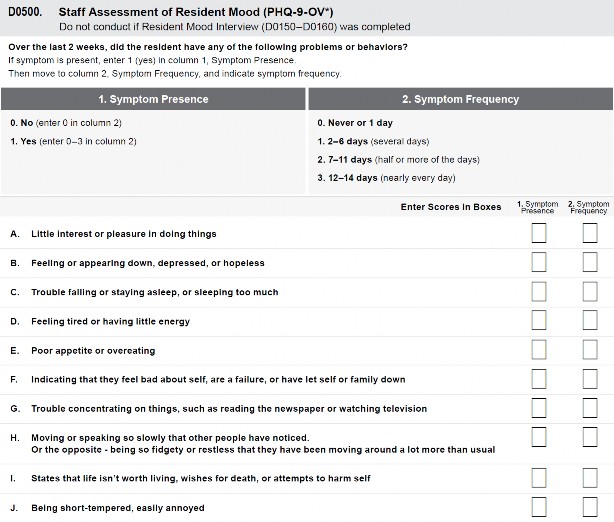
Conduct the interviews during the 7-day look-back period based on the ARD.
Interview staff from all shifts who know the resident best. Conduct the staff interview in a location that protects resident privacy.
Many of the same administration techniques outlined above for the PHQ-2 to 9© Resident Mood Interview and Interviewing Tips & Techniques can be followed when staff are interviewed.
Encourage staff to report symptom frequency, even if the staff believes the symptom to be unrelated to depression.
Explore unclear responses, focusing the discussion on the specific symptom listed on the assessment rather than expanding into a lengthy clinical evaluation.
If frequency cannot be determined by staff interview because the resident has been in the facility for less than 2 weeks, talk to family or significant other and review transfer records to inform the selection of a frequency code.
D0500: Staff Assessment of Resident Mood (PHQ-9-OV©) (cont.)
D0500A, Little Interest or Pleasure in Doing Things
D0500B, Feeling or Appearing Down, Depressed, or Hopeless
D0500C, Trouble Falling or Staying Asleep, or Sleeping Too Much
D0500D, Feeling Tired or Having Little Energy
D0500E, Poor Appetite or Overeating
They have not wanted to eat much of anything lately.
They have a voracious appetite, more so than last week.
D0500F, Indicating That They Feel Bad about Self, Are a Failure, or Have Let Self or Family Down
D0500G, Trouble Concentrating on Things, Such as Reading the Newspaper or Watching Television
D0500H, Moving or Speaking So Slowly That Other People Have Noticed. Or the Opposite—Being So Fidgety or Restless That They Have Been Moving Around a Lot More than Usual
Their arthritis slows them down.
They’re bored and always looking for something to do.
D0500: Staff Assessment of Resident Mood (PHQ-9-OV©) (cont.)
D0500I, States That Life Isn’t Worth Living, Wishes for Death, or Attempts to Harm Self
D0500J, Being Short-Tempered, Easily Annoyed
They’re OK if you know how to approach them.
They can snap but usually when their pain is bad.
Not with me.
They’re irritable.
Coding Instructions for Column 1. Symptom Presence
Code 0, no: if symptoms listed are not present. Enter 0 in Column 2, Symptom Frequency.
Code 1, yes: if symptoms listed are present. Enter 0, 1, 2, or 3 in Column 2,
Symptom Frequency.
Code 0, never or 1 day: if staff indicate that the resident has never or has experienced the symptom on only 1 day.
Code 1, 2-6 days (several days): if staff indicate that the resident has experienced the symptom for 2-6 days.
Code 2, 7-11 days (half or more of the days): if staff indicate that the resident has experienced the symptom for 7-11 days.
Code 3, 12-14 days (nearly every day): if staff indicate that the resident has experienced the symptom for 12-14 days.
Ask the staff member being interviewed to select how often over the past 2 weeks the symptom occurred. Use the descriptive and/or numeric categories on the form (e.g., “nearly every day” or 3 = 12-14 days) to select a frequency response.
If you separated a longer item into its component parts, select the highest frequency rating that is reported.
If the staff member has difficulty selecting between two frequency responses, code for the
higher frequency.
If the resident has been in the facility for less than 2 weeks, also talk to the family or significant other and review transfer records to inform selection of the frequency code.
D0600: Total Severity Score

Review Item Rationale for D0160, Total Severity Score.
The PHQ-9-OV© is adapted to allow the assessor to interview staff and identify a Total Severity Score for potential depressive symptoms.
The score can be communicated among health care providers and used to track symptoms and how they are changing over time.
The score is useful for knowing when to request additional assessment by providers or mental health specialists for underlying depression.
After completing the Staff Assessment of Resident Mood:
Add the numeric scores across all frequency items for Staff Assessment of Mood, Symptom Frequency (D0500) Column 2.
Maximum score is 30 (3 × 10).
The interview is successfully completed if the staff members were able to answer the frequency responses of at least 8 out of 10 items on the PHQ-9-OV©.
The interview is successfully completed if the staff members were able to answer the frequency responses of at least 8 out of 10 items on the PHQ-9-OV©.
The software will calculate the Total Severity Score. For detailed instructions on manual calculations and examples, see Appendix E: PHQ-9-OV© Total Severity Score Scoring Rules.
D0600: Total Severity Score (cont.)
Responses to PHQ-9-OV© can indicate possible depression. Responses can be interpreted as follows:
Major Depressive Syndrome is suggested if—of the 10 items, 5 or more items are identified at a frequency of half or more of the days (7-11 days) during the look-back period and at least one of these, (1) little interest or pleasure in doing things, or (2) feeling down, depressed, or hopeless is identified at a frequency of half or more of the days (7-11 days) during the look-back period.
Minor Depressive Syndrome is suggested if—of the 10 items, (1) feeling down, depressed or hopeless, (2) trouble falling or staying asleep, or sleeping too much, or
(3) feeling tired or having little energy are identified at a frequency of half or more of the days (7-11 days) during the look-back period and at least one of these, (1) little interest or pleasure in doing things, or (2) feeling down, depressed, or hopeless is identified at a frequency of half or more of the days (7-11 days).
In addition, PHQ-9-OV© Total Severity Score can be used to track changes in severity over time. Total Severity Score can be interpreted as follows:
1-4: minimal depression
5-9: mild depression
10-14: moderate depression

15-19: moderately severe depression 20-30: severe depression
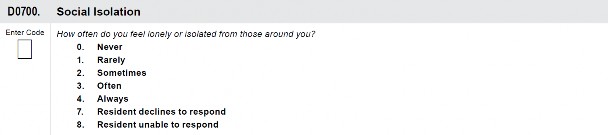
D0700: Social Isolation
DEFINITION
SOCIAL ISOLATION
Refers to an actual or perceived lack of contact with other people, such as living alone or residing in a remote area.
DEFINITION
SOCIAL ISOLATION
Refers to an actual or perceived lack of contact with other people, such as living alone or residing in a remote area.
Social isolation tends to increase with age and is a risk factor for physical and mental illness and a predictor of mortality.
Programs to increase residents’ social engagement should be designed and implemented, while also taking into account individual needs (e.g., disability, language) and preferences (e.g., cultural practices).
Assessing social isolation can facilitate the identification of residents who may feel lonely and therefore may benefit from engagement efforts.
Resident engagement in social interactions and activities of interest can greatly enhance quality of life. A resident’s individualized care plan should address activity planning if the resident states that they sometimes, often, or always feel lonely or isolated.
This item is intended to be a resident self-report item. No other source should be used to identify the response.
Ask the resident, “How often do you feel lonely or isolated from those around you?”
Code 0, Never: if the resident indicates never feeling lonely or isolated from others.
Code 1, Rarely: if the resident indicates rarely feeling lonely or isolated from others.
Code 2, Sometimes: if the resident indicates sometimes feeling lonely or isolated from others.
Code 3, Often: if the resident indicates often feeling lonely or isolated from others.
Code 4, Always: if the resident indicates always feeling lonely or isolated from others.
Code 7, Resident declines to respond: if the resident declines to respond.
Code 8, Resident unable to respond: if the resident is unable to respond.
The resident is speaking with the social worker about being admitted for extended rehabilitation and is hoping to see their family later on in the day. When asked how often the resident feels lonely or isolated from those around them, the resident replies that they live with their child and their child’s family but don’t always feel like being around so much activity and stay in their room alone. As a result, they report that they sometimes feel lonely or isolated even though others are almost always home.
Coding: D0700 would be coded 2, Sometimes.
Rationale: The resident states they sometimes feel lonely or isolated from those around them because they sometimes stay alone in their room.
The resident, upon being admitted to the facility, is asked about how often they feel lonely or isolated from those around them. They state that because they don’t have many family members left who live close by and they see their friends only a couple of times a month, they often feel isolated. They are hoping that being in the facility will help them feel less isolated and plan to attend activities regularly.
Coding: D0700 would be coded 3, Often.
Rationale: The resident states that because the family members they have don’t live close by and their friends only visit a couple of times a month that they often feel isolated.
During the observation period of resident F’s annual assessment, they are asked how often they feel lonely or isolated from those around them. Resident F responds that, even though they go to activities and have a few friends, they still feel alone. When asked how often they feel alone, Resident F responds every day.
Coding: D0700 would be coded 4, Always.
Rationale: Resident F stated that they feel alone (i.e., lonely) every day when asked.