Intent: The intent of this section is to obtain the reasons for assessment, administrative information, and key demographic information to uniquely identify each resident, potential care needs including access to transportation, and the home in which they reside.
A0050: Type of Record

Code 1, Add new record: if this is a new record that has not been previously submitted and accepted in iQIES. If this item is coded as 1, continue to A0100 Facility Provider Numbers.
If there is an existing database record for the same resident, the same facility, the same reasons for assessment/tracking, and the same date (assessment reference date, entry date, or discharge date), then the current record is a duplicate and not a new record. In this case, the submitted record will be rejected and not accepted in iQIES and a “fatal” error will be reported to the facility on the Final Validation Report.
Code 2, Modify existing record: if this is a request to modify the MDS items for a record that already has been submitted and accepted in the Internet Quality Improvement and Evaluation System (iQIES).
If this item is coded as 2, continue to A0100, Facility Provider Numbers. When a modification request is submitted, iQIES will take the following steps:
The system will attempt to locate the existing record in iQIES for this facility with the resident, reasons for assessment/tracking, and date (Assessment Reference Date (ARD), entry date, or discharge date) indicated in subsequent Section X items.
If the existing record is not found, the submitted modification record will be rejected and not accepted in iQIES. A “fatal” error will be reported to the facility on the Final Validation Report.
If the existing record is found, then the items in all sections of the submitted modification record will be edited. If there are any fatal errors, the modification record will be rejected and not accepted in iQIES. The “fatal” error(s) will be reported to the facility on the Final Validation Report.
If the modification record passes all the edits, it will replace the prior record being modified in iQIES. The prior record will be moved to a history file in iQIES.
A0050: Type of Record (cont.)
Code 3, Inactivate existing record: if this is a request to inactivate a record that already has been submitted and accepted in iQIES.
If this item is coded as 3, skip to X0150, Type of Provider.
When an inactivation request is submitted, iQIES will take the following steps:
The system will attempt to locate the existing record in iQIES for this facility with the resident, reasons for assessment/tracking, and date (ARD, entry date, or discharge date) indicated in subsequent Section X items.
If the existing record is not found in iQIES, the submitted inactivation request will be rejected and a “fatal” error will be reported to the facility on the Final Validation Report.
All items in Section X of the submitted record will be edited. If there are any fatal errors, the current inactivation request will be rejected and no record will be inactivated in iQIES.
If the existing record is found, it will be removed from the active records in iQIES and moved to a history file.
The Section X items from X0200 through X0700 identify the existing iQIES assessment or tracking record that is in error. In this section, reproduce the information EXACTLY as it appeared on the existing erroneous record, even if the information is incorrect. This information is necessary to locate the existing record in the database.
Example: A MDS assessment for Joan L. Smith is submitted and accepted by iQIES. A data entry error is then identified on the previously submitted and accepted record: The encoder mistakenly entered “John” instead of “Joan” when entering a prior assessment for Joan L. Smith. To correct this data entry error, the facility will modify the erroneous record and complete the items in Section X including items under Identification of Record to be Modified/Inactivated. When completing X0200A, the Resident First Name, “John” will be entered in this item. This will permit the MDS system to locate the previously submitted assessment that is being corrected. If the correct name “Joan” were entered, iQIES would not locate the prior assessment.
The correction to the name from “John” to “Joan” will be made by recording “Joan” in the “normal” A0500A, Resident First Name in the modification record. The modification record must include all items appropriate for that assessment, not just the corrected name. This modification record will then be submitted and accepted into iQIES, which causes the desired correction to be made.
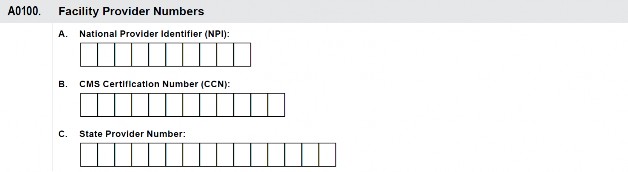
A0100: Facility Provider Numbers
DEFINITIONS
NATIONAL PROVIDER IDENTIFIER (NPI)
A unique Federal number that identifies providers of health care services. The NPI applies to the nursing home for all of its residents.
CMS CERTIFICATION NUMBER (CCN)
Replaces the term “Medicare/Medicaid Provider Number” in survey, certification, and assessment-related activities.
STATE PROVIDER NUMBER
Medicaid Provider Number established by a state.
DEFINITIONS
NATIONAL PROVIDER IDENTIFIER (NPI)
A unique Federal number that identifies providers of health care services. The NPI applies to the nursing home for all of its residents.
CMS CERTIFICATION NUMBER (CCN)
Replaces the term “Medicare/Medicaid Provider Number” in survey, certification, and assessment-related activities.
STATE PROVIDER NUMBER
Medicaid Provider Number established by a state.
Allows the identification of the facility submitting the assessment.
Coding Instructions
Enter the facility provider numbers:
National Provider Identifier (NPI).
CMS Certification Number (CCN) – If A0410 = 3 (federal required submission), then A0100B (facility CCN) must not be blank.
State Provider Number (optional). This number is assigned by the State survey agency and provided to the intermediary. When known, enter the State Provider Number in A0100C. Completion of this is not required; however, your State may require the completion of this item.
A0200: Type of Provider

DEFINITION
SWING BED
A rural non-critical access hospital with less than 100 beds that participates in the Medicare program that has CMS approval to provide post-hospital SNF care. The hospital may use its beds, as needed, to provide either acute or SNF care.
DEFINITION
SWING BED
A rural non-critical access hospital with less than 100 beds that participates in the Medicare program that has CMS approval to provide post-hospital SNF care. The hospital may use its beds, as needed, to provide either acute or SNF care.
A0200: Type of Provider (cont.)
Code 1, nursing home (SNF/NF): if a Medicare skilled nursing facility (SNF) or Medicaid nursing facility (NF).
Code 2, swing bed: if a non-critical access hospital with swing bed approval.
A0310: Type of Assessment
For all Federally required assessments and records as well as all PPS assessments.
A0310: Type of Assessment (cont.)
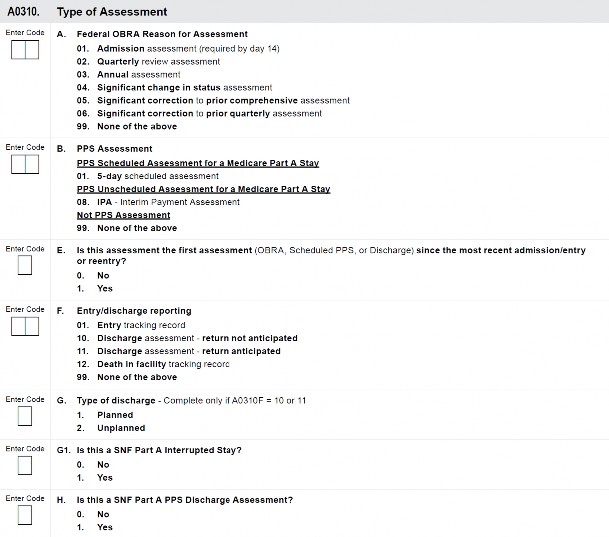
Enter the code corresponding to the reason or reasons for completing this assessment.
If the assessment is being completed for both Omnibus Budget Reconciliation Act (OBRA)– required clinical reasons (A0310A) and Prospective Payment System (PPS) reasons (A0310B), all requirements for both types of assessments must be met. See Chapter 2, Section 2.10, Combining PPS Assessments and OBRA Assessments, for details of these requirements.
Assessments completed for other reasons (e.g., to facilitate billing for Medicare Advantage Plans) are not coded in A0310 and are not submitted to iQIES.
Document the reason for completing the assessment, using the categories of assessment types. For detailed information on the requirements for scheduling and timing of the assessments, see Chapter 2 on assessment schedules.
Enter the number corresponding to the OBRA reason for assessment. This item contains 2 digits. For codes 01-06, enter “0” in the first box and place the correct number in the second box. If the assessment is not coded 01-06, enter code “99”.
Admission assessment (required by day 14)
Quarterly review assessment
Annual assessment
Significant change in status assessment
Significant correction to prior comprehensive assessment
Significant correction to prior quarterly assessment
99. None of the above
If a nursing home resident elects the hospice benefit, the nursing home is required to complete an MDS Significant Change in Status Assessment (SCSA). The nursing home is required to complete an SCSA when the resident comes off the hospice benefit (revoke). See Chapter 2 for details on this requirement.
It is a CMS requirement to have an SCSA completed EVERY time the hospice benefit has been elected, even if a recent MDS was done and the only change is the election of the hospice benefit.
A0310: Type of Assessment (cont.)
DEFINITION
PROSPECTIVE PAYMENT SYSTEM (PPS)
Method of reimbursement in which Medicare payment is made based on the classification system of that service.
DEFINITION
PROSPECTIVE PAYMENT SYSTEM (PPS)
Method of reimbursement in which Medicare payment is made based on the classification system of that service.
Assessment
Assessment
Enter the number corresponding to the PPS reason for completing this assessment. This item contains 2 digits. For codes 01 and 08, enter “0” in the first box and place the correct number in the second box. If the assessment is not coded as 01 or 08, enter code “99.”
See Chapter 2 on assessment schedules for detailed information on the timing of the assessments.
PPS Scheduled Assessment for Medicare Part A Stay
01. 5-day scheduled assessment
PPS Unscheduled Assessment for Medicare Part A Stay
08. IPA-Interim Payment Assessment
Not PPS Assessment
99. None of the above
Coding Instructions for A0310E, Is This Assessment the First Assessment (OBRA, Scheduled PPS, or OBRA Discharge) since the Most Recent Admission/Entry or Reentry?
Code 0, no: if this assessment is not the first of these assessments since the most recent admission/entry or reentry.
Code 1, yes: if this assessment is the first of these assessments since the most recent admission/entry or reentry.
• A0310E = 0 for:
Entry or Death in Facility tracking records (A0310F = 01 or 12);
A standalone Part A PPS Discharge assessment (A0310A = 99, A0310B = 99,
A0310F = 99, and A0310H = 1); or
An Interim Payment Assessment (A0310A = 99, A0310B = 08, A0310F = 99, and A0310H=0).
A0310E = 1 on the first OBRA, Scheduled PPS or OBRA Discharge assessment that is completed and submitted once a facility obtains CMS certification. Note: the first submitted assessment may not be an OBRA Admission assessment.
A0310: Type of Assessment (cont.)


DEFINITION
Part A PPS Discharge Assessment
A discharge assessment developed to inform current and future Skilled Nursing Facility Quality Reporting Program (SNF QRP) measures and the calculation of these measures. The
Part A PPS Discharge assessment is completed when a resident’s Medicare Part A stay ends, but the resident remains in the facility; and must be combined with an OBRA Discharge if the Part A stay ends on the same day or the day before the resident’s Discharge Date (A2000).
DEFINITION
Part A PPS Discharge Assessment
A discharge assessment developed to inform current and future Skilled Nursing Facility Quality Reporting Program (SNF QRP) measures and the calculation of these measures. The
Part A PPS Discharge assessment is completed when a resident’s Medicare Part A stay ends, but the resident remains in the facility; and must be combined with an OBRA Discharge if the Part A stay ends on the same day or the day before the resident’s Discharge Date (A2000).
Enter the number corresponding to the reason for completing this assessment or tracking record. This item contains 2 digits. For code 01, enter “0” in the first box and place “1” in the second box. If the assessment is not coded as “01” or “10 or “11” or “12,” enter “99”:
01. Entry tracking record
Discharge assessment-return not anticipated
Discharge assessment-return anticipated
Death in facility tracking record
99. None of the above
Coding Instructions for A0310G, Type of Discharge (complete only if A0310F = 10 or 11)
Enter the number corresponding to the type of discharge.
Code 1: if type of discharge is a planned discharge.
Code 2: if type of discharge is an unplanned discharge.
A0310: Type of Assessment (cont.)



DEFINITIONS
Interrupted Stay
Is a Medicare Part A SNF stay in which a resident is discharged from SNF care (i.e., the resident is discharged from a Medicare Part A-covered stay) and subsequently resumes SNF care in the same SNF for a Medicare Part A-covered stay during the interruption window.
Interruption Window
Is a 3-day period, starting with the calendar day of Part A discharge and including the 2 immediately following calendar days. In other words, if a resident in a Medicare Part A SNF stay is discharged from Part A, the resident must resume Part A services, or return to the same SNF (if physically discharged) to resume Part A services, by 11:59 p.m. at the end of the third calendar day after their Part A-covered stay ended. The interruption window begins with the first non-covered day following a Part A-covered stay and ends at 11:59 p.m. on the third consecutive non- covered day following a Part A-covered SNF stay. If these conditions are met, the subsequent stay is considered a continuation of the previous Medicare Part
A-covered stay for the purposes of both the variable per diem schedule and PPS assessment completion.
DEFINITIONS
Interrupted Stay
Is a Medicare Part A SNF stay in which a resident is discharged from SNF care (i.e., the resident is discharged from a Medicare Part A-covered stay) and subsequently resumes SNF care in the same SNF for a Medicare Part A-covered stay during the interruption window.
Interruption Window
Is a 3-day period, starting with the calendar day of Part A discharge and including the 2 immediately following calendar days. In other words, if a resident in a Medicare Part A SNF stay is discharged from Part A, the resident must resume Part A services, or return to the same SNF (if physically discharged) to resume Part A services, by 11:59 p.m. at the end of the third calendar day after their Part A-covered stay ended. The interruption window begins with the first non-covered day following a Part A-covered stay and ends at 11:59 p.m. on the third consecutive non- covered day following a Part A-covered SNF stay. If these conditions are met, the subsequent stay is considered a continuation of the previous Medicare Part
A-covered stay for the purposes of both the variable per diem schedule and PPS assessment completion.
Code 0, no: if the resident was discharged from SNF care (i.e., from a Medicare Part A-covered stay) but did not resume SNF care in the same SNF within the interruption window.
Code 1, yes: if the resident was discharged from SNF care (i.e., from a Medicare Part A-covered stay) but did resume SNF care in the same SNF within the interruption window.
Item A0310G1 indicates whether or not an interrupted stay occurred.
The interrupted stay policy applies to residents who either leave the SNF, then return to the same SNF within the interruption window, or to residents who are discharged from Part A-covered services and remain in the SNF, but then resume a Part A-covered stay within the interruption window.
A0310: Type of Assessment (cont.)
The following is a list of examples of an interrupted stay when the resident leaves the SNF and then returns to the same SNF to resume Part A-covered services within the interruption window. Examples include, but are not limited to, the following:
Resident transfers to an acute care setting for evaluation or treatment due to a change in condition and returns to the same SNF within the interruption window.
Resident transfers to a psychiatric facility for evaluation or treatment and returns to the same SNF within the interruption window.
Resident transfers to an outpatient facility for a procedure or treatment and returns to the same SNF within the interruption window.
Resident transfers to an assisted living facility or a private residence with home health services and returns to the same SNF within the interruption window.
Resident leaves against medical advice and returns to the same SNF within the interruption window.
The following is a list of examples of an interrupted stay when the resident under a Part A-covered stay remains in the facility but the stay stops being covered under the Part A PPS benefit, and then resumes Part A-covered services in the SNF within the interruption window. Examples include, but are not limited to, the following:
Resident elects the hospice benefit, thereby declining the SNF benefit, and then revokes the hospice benefit and resumes SNF-level care within the interruption window.
Resident refuses to participate in rehabilitation and has no other daily skilled need; this ends the Part A coverage. Within the interruption window, the resident decides to engage in the planned rehabilitation regime and Part A coverage resumes.
Resident changes payer sources from Medicare Part A to an alternate payer source (i.e., hospice, private pay or private insurance) and then wishes to resume their Medicare Part A stay, at the same SNF, within the interruption window.
If a resident is discharged from SNF care, remains in the facility, and resumes a Part A- covered stay in the SNF within the interruption window, this is an interrupted stay. No discharge assessment (OBRA or Part A PPS) is required, nor is an Entry Tracking Record or 5-Day required on resumption.
If a resident leaves the SNF and returns to resume Part A-covered services in the same SNF within the interruption window, this is an interrupted stay. Although this situation does not end the resident’s Part A PPS stay, the resident left the SNF, and therefore an OBRA Discharge assessment is required. On return to the SNF, no 5-Day would be required. An OBRA Admission would be required if the resident was discharged return not anticipated. If the resident was discharged return anticipated, no new OBRA Admission would be required.
A0310: Type of Assessment (cont.)
When an interrupted stay occurs, a 5-Day PPS assessment is not required upon reentry or resumption of SNF care in the same SNF, because an interrupted stay does not end the resident’s Part A PPS stay.
If a resident is discharged from SNF care, remains in the SNF and does not resume Part A-covered services within the interruption window, an interrupted stay did not occur. In this situation, a Part A PPS Discharge is required. If the resident qualifies and there is a resumption of Part A services within the 30-day window allowed by Medicare, a 5-Day would be required as this would be considered a new Part A stay. The OBRA schedule would continue from the resident’s original date of admission (item A1900).
If a resident leaves the SNF and does not return to resume Part A-covered services in the same SNF within the interruption window, an interrupted stay did not occur. In this situation, both the Part A PPS and OBRA Discharge assessments are required (and must be combined if the Medicare Part A stay ends on the day of, or one day before, the resident’s Discharge Date (A2000)). If the resident returns to the same SNF, this would be considered a new Part A stay. An Entry Tracking record and 5-Day would be required on return. An OBRA Admission would be required if the resident was discharged return not anticipated. If the resident was discharged return anticipated, no new OBRA Admission would be required.
The OBRA assessment schedule is unaffected by the interrupted stay policy. Please refer to Chapter 2 for guidance on OBRA assessment scheduling requirements.
Code 0, no: if this is not a Part A PPS Discharge assessment.
Code 1, yes: if this is a Part A PPS Discharge assessment.
A Part A PPS Discharge assessment (NPE Item Set) is required under the Skilled Nursing Facility Quality Reporting Program (SNF QRP) when the resident’s Medicare Part A stay ends (as documented in A2400C, End Date of Most Recent Medicare Stay) but the resident remains in the facility.
If the End Date of the Most Recent Medicare Stay (A2400C) occurs on the day of or one day before the Discharge Date (A2000), the OBRA Discharge assessment and Part A PPS Discharge assessment are both required and must be combined. When the OBRA and Part A PPS Discharge assessments are combined, the ARD (A2300) must be equal to the Discharge Date (A2000).
A0410: Unit Certification or Licensure Designation

In coding this item, the facility must consider its Medicare and/or Medicaid status as well as the state’s authority to collect MDS records. State regulations may require submission of MDS data to iQIES or directly to the state for residents residing in licensed-only beds.
Nursing homes must be certain they are submitting MDS assessments to iQIES for those residents who are on a Medicare and/or Medicaid certified unit. Swing bed facilities must be certain that they are submitting MDS assessments only for those residents whose stay is covered by Medicare Part A benefits. For those residents who are in licensed-only beds, nursing homes must be certain they are submitting MDS assessments either to iQIES or directly to the state in accordance with state requirements.
Payer source is not the determinant by which this item is coded. This item is coded solely according to the authority CMS has to collect MDS data for residents who are on a Medicare and/or Medicaid certified unit and the authority that the state may have to collect MDS data under licensure. Consult Chapter 5, page 5-1 of this Manual for a discussion of what types of records should be submitted to iQIES.
Ask the nursing home administrator or representative which units in the nursing home are Medicare certified, Medicaid certified or dually certified (Medicare/Medicaid).
If some or all of the units in the nursing home are neither Medicare nor Medicaid certified, ask the nursing home administrator or representative if there are units that are state licensed and if the state requires MDS submission for residents on that unit.
Identify all units in the nursing home that are not certified or licensed by the state, if any.
A0410: Unit Certification or Licensure Designation (cont.)
Code 1, Unit is neither Medicare nor Medicaid certified and MDS data is not required by the State: if the MDS record is for a resident on a unit that is neither Medicare nor Medicaid certified, and neither CMS nor the state has authority to collect MDS information for residents on this unit, the facility may not submit MDS records to iQIES. If any records are submitted under this certification designation, they will be rejected by iQIES.
Code 2, Unit is neither Medicare nor Medicaid certified but MDS data is required by the State: if the nursing home resident is on a unit that is neither Medicare nor Medicaid certified, but the state has authority under state licensure to collect MDS information for residents on such units, the facility should submit the resident’s MDS records per the state’s requirement to iQIES or directly to the state.
Note that this certification designation does not apply to swing-bed facilities. Assessments for swing-bed residents on which A0410 is coded “2” will be rejected by iQIES.
Code 3, Unit is Medicare and/or Medicaid certified: if the resident is on a Medicare and/or Medicaid certified unit, regardless of payer source (i.e., even if the resident is private pay or has their stay covered under Medicare Advantage, Medicare HMO, private insurance, etc.), the facility is required to submit MDS records (OBRA and SNF PPS only) to iQIES for these residents. Consult Chapter 5, page 5-1 of this Manual for a discussion of what types of records should be submitted to iQIES.
A0500: Legal Name of Resident

DEFINITION
LEGAL NAME
Resident’s name as it appears on the Medicare card. If the resident is not enrolled in the Medicare program, use the resident’s name as it appears on a Medicaid card or other government-issued document.
DEFINITION
LEGAL NAME
Resident’s name as it appears on the Medicare card. If the resident is not enrolled in the Medicare program, use the resident’s name as it appears on a Medicaid card or other government-issued document.
Allows identification of resident.
Also used for matching each of the resident’s records.
Ask resident, family, significant other, and/or guardian/legally authorized representative.
A0500: Legal Name of Resident (cont.)
Check the resident’s name on their Medicare card, or if not in the program, check a Medicaid card or other government-issued document.
Use printed letters. Enter in the following order:
First Name
Middle Initial (if the resident has no middle initial, leave Item A0500B blank; if the resident has two or more middle names, use the initial of the first middle name)
Last Name
Suffix (e.g., Jr./Sr.)
A0600: Social Security and Medicare Numbers

DEFINITIONS
SOCIAL SECURITY NUMBER
A tracking number assigned to an individual by the U.S. Federal government for taxation, benefits, and identification purposes.
MEDICARE NUMBER
An identifier assigned to an individual for participation in national health insurance program. The Medicare Health Insurance identifier is different from the resident’s Social Security Number (SSN) and may contain both letters and numbers.
DEFINITIONS
SOCIAL SECURITY NUMBER
A tracking number assigned to an individual by the U.S. Federal government for taxation, benefits, and identification purposes.
MEDICARE NUMBER
An identifier assigned to an individual for participation in national health insurance program. The Medicare Health Insurance identifier is different from the resident’s Social Security Number (SSN) and may contain both letters and numbers.
Allows identification of the resident.
Allows records for resident to be matched in system.
Enter the Social Security Number (SSN) in A0600A, one number per space starting with the leftmost space. If no SSN is available for the resident (e.g., if the resident is a recent immigrant or a child) the item may be left blank. Note: A valid SSN should be submitted in A0600A whenever it is available so that resident matching can be performed as accurately as possible.
Enter Medicare number in A0600B exactly as it appears on the resident’s documents.
For PPS assessments (A0310B = 01 or 08), the Medicare number (A0600B) must be present (i.e., may not be left blank).
A0600B must be a Medicare number.
A0700: Medicaid Number

Assists in correct resident identification.
Record this number if the resident is a Medicaid recipient.
Enter one number or letter per box beginning in the leftmost box.
Recheck the number to make sure you have entered the digits correctly.
Enter a “+” in the leftmost box if the number is pending. If you are notified later that the resident does have a Medicaid number, just include it on the next assessment.
If not applicable because the resident is not a Medicaid recipient, enter “N” in the leftmost box.
To obtain the Medicaid number, check the resident’s Medicaid card, admission or transfer records, or medical record.
Confirm that the resident’s name on the MDS matches the resident’s name on the Medicaid card.
It is not necessary to process an MDS correction to add the Medicaid number on a prior assessment. However, a correction may be a State-specific requirement.
A0810: Sex

Assists in correct identification.
Provides demographic sex specific health trend information.
Code 1: if resident is male.
Code 2: if resident is female.
Resident sex on the MDS must match what is in the Social Security system.
A0900: Birth Date

Assists in correct identification.
Allows determination of age.
Fill in the boxes with the appropriate birth date. If the complete birth date is known, do not leave any boxes blank. If the month or day contains only a single digit, fill the first box in with a “0.” For example: January 2, 1918, should be entered as 01-02-1918.
Sometimes, only the birth year or the birth year and birth month will be known. These situations are handled as follows:
— If only the birth year is known (e.g., 1918), then enter the year in the “year” portion of A0900, and leave the “month” and “day” portions blank. If the birth year and birth month are known, but the day of the month is not known, then enter the year in the “year” portion of A0900, enter the month in the “month” portion of A0900, and leave the “day” portion blank.

A1005: Ethnicity
DEFINITION
ETHNICITY
HISPANIC OR LATINO/A
A person of Cuban, Mexican, Puerto Rican, South or Central American or other Spanish culture or origin regardless of race. The term “Spanish Origin” can be used in addition to Hispanic or Latino/a.
DEFINITION
ETHNICITY
HISPANIC OR LATINO/A
A person of Cuban, Mexican, Puerto Rican, South or Central American or other Spanish culture or origin regardless of race. The term “Spanish Origin” can be used in addition to Hispanic or Latino/a.
Standardizing self-reported data collection for ethnicity allows for the comparison of data within and across multiple healthcare settings and is an important step in improving quality of care and health outcomes.
These categories are NOT used to determine eligibility for participation in any Federal program.
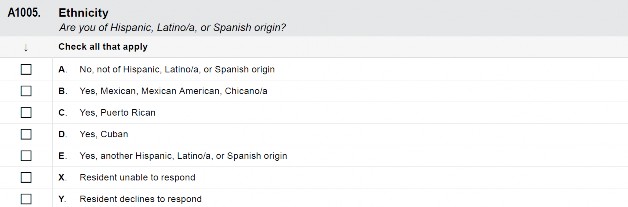
Ask the resident to select the category or categories that most closely correspond to their ethnicity from the list in A1005.
Ethnic category definitions are provided only if requested in order to answer the item.
Respondents should be offered the option of selecting one or more ethnic designations.
If the resident declines to respond, code Y, Resident declines to respond, and do not code based on other resources (family, significant other, or guardian/legally authorized representative or medical records).
If the resident is unable to respond, the assessor may ask a family member, significant other, and/or guardian/legally authorized representative.
Only use medical record documentation to code A1005, Ethnicity if the resident is unable to respond and no family member, significant other, and/or guardian/legally authorized representative provides a response for this item.
Check all that apply.
Resident R is admitted following an acute cerebral vascular accident (CVA) with mental status changes and is unable to respond to questions regarding their ethnicity. Their spouse informs the nurse that Resident R is Cuban.
Coding: A1005 would be coded as D. Yes, Cuban and X. Resident unable to respond.
Rationale: If Resident R is unable to respond but their family, significant other, or legally authorized representative provided the response, code both that response and
X. Resident unable to respond.
Resident K is admitted following a total hip arthroplasty and declines to respond when asked their ethnicity.
Coding: A1005, Ethnicity would be coded as Y. Resident declines to respond.
Rationale: If a resident declines to respond to this item, code only Y. Resident declines to respond. Do not use other resources (family, significant other, or legally authorized representative or medical record documentation) to complete A1005, Ethnicity when a resident declines to respond.
Standardizing self-reported data collection for race allows for the equal comparison of data across multiple healthcare settings and is an important step in improving quality of care and health outcomes.
These categories are NOT used to determine eligibility for participation in any Federal program.
DEFINITION
RACE
AMERICAN INDIAN OR ALASKAN NATIVE
A person having origins in any of the original peoples of North and South America (including Central America), and who maintains tribal affiliation or community attachment.
ASIAN
A person having origins in any of the original peoples of the Far East, Southeast Asia, or the Indian subcontinent including, for example, Cambodia, China, India, Japan, Korea, Malaysia, Pakistan, the Philippine Islands, Thailand, Vietnam.
BLACK OR AFRICAN AMERICAN
A person having origins in any of the black racial groups of Africa. Terms such as “Haitian” or “Negro” can be used in addition to “Black” or “African American.”
NATIVE HAWAIIAN OR OTHER PACIFIC ISLANDER
A person having origins in any of the original peoples of Hawaii, Guam, Samoa, or other Pacific Islands.
WHITE
A person having origins in any of the original peoples of Europe, the Middle East, or North Africa.
DEFINITION
RACE
AMERICAN INDIAN OR ALASKAN NATIVE
A person having origins in any of the original peoples of North and South America (including Central America), and who maintains tribal affiliation or community attachment.
ASIAN
A person having origins in any of the original peoples of the Far East, Southeast Asia, or the Indian subcontinent including, for example, Cambodia, China, India, Japan, Korea, Malaysia, Pakistan, the Philippine Islands, Thailand, Vietnam.
BLACK OR AFRICAN AMERICAN
A person having origins in any of the black racial groups of Africa. Terms such as “Haitian” or “Negro” can be used in addition to “Black” or “African American.”
NATIVE HAWAIIAN OR OTHER PACIFIC ISLANDER
A person having origins in any of the original peoples of Hawaii, Guam, Samoa, or other Pacific Islands.
WHITE
A person having origins in any of the original peoples of Europe, the Middle East, or North Africa.
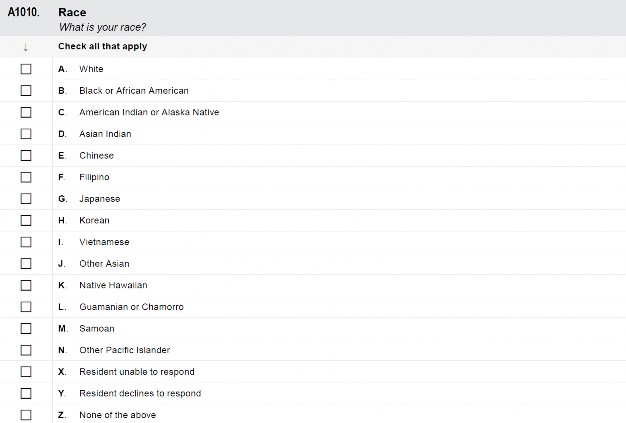
Ask the resident to select the category or categories that most closely correspond to the resident’s race from the list in A1010, Race.
Racial category definitions are provided only if requested in order to answer the item.
Respondents should be offered the option of selecting one or more racial designations.
If the resident declines to respond, code Y, Resident declines to respond, and do not code based on other resources (family, significant other, or legally authorized representative or medical records).
If the resident is unable to respond, the assessor may ask a family member, significant other, and/or guardian/legally authorized representative.
Only use medical record documentation to code A1010, Race if the resident is unable to respond and no family member, significant other, and/or guardian/legally authorized representative provides a response for this item.
Check all that apply.
If the resident provides a response, check the box(es) indicating the race category or categories identified by the resident.
Code X, Resident unable to respond: if the resident is unable to respond.
In the cases where the resident is unable to respond and the response is determined via family, significant other, or legally authorized representative input or medical records, check all boxes that apply, including X. Resident unable to respond.
If the resident is unable to respond and no other resources (family, significant other, or legally authorized representative or medical records) provided the necessary information, code as X. Resident unable to respond.
Code Y, Resident declines to respond: if the resident declines to respond.
When the resident declines to respond, code only Y. Resident declines to respond.
When the resident declines to respond do not code based on other resources (family, significant other, or legally authorized representative or medical records).
Code Z, None of the above: if the resident reports or it is determined from other resources (family, significant other, or legally authorized representative or medical records) that none of the listed races apply.
Resident W has severe dementia with agitation. During the Admission assessment, they are unable to provide their race. Their child informs the nurse that Resident W is Korean and African American.
Coding: A1010, Race would be coded as B. Black or African American, H. Korean, and
X. Resident unable to respond.
Rationale: If Resident W is unable to respond but their family, significant other, or legally authorized representative provided the response, code those responses and X. Resident unable to respond.
Resident Q declines to provide their race during the admission assessment stating “I’d rather not answer.”
Coding: A1010, Race would be coded as Y. Resident declines to respond.
Rationale: If a resident declines to respond to this item, then code only Y. Resident declines to respond. Do not make attempts to code A1010, Race when a resident declines to respond based on other resources (family, significant other, or legally authorized representative or medical records).
Resident V, who is admitted to the SNF following a recent CVA resulting in confusion, is unable to answer when asked their race. Their family member reports that none of the listed races apply.
Coding: A1010, Race would be coded as X. Resident unable to respond and Z. None of the above.
Rationale: If a resident is unable to respond, family, significant other, or legally authorized representative input may be used to code A1010, Race and the assessor should code both the information determined via family, significant other, or legally authorized representative input or medical records (in this case, Z. None of the above) and X. Resident unable to respond.

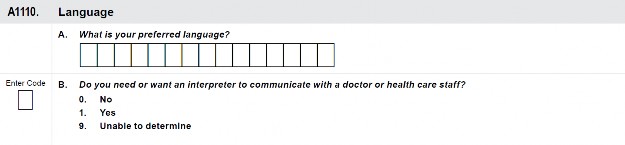
A1110: Language
Inability to make needs known and to engage in social interaction because of a language barrier can be very frustrating and can lead to social isolation, depression, resident safety issues, and unmet needs.
Language barriers can interfere with accurate assessment.
When a resident needs or wants interpreter services, the nursing home must ensure that an interpreter is available.
An alternate method of communication also should be made available to help ensure that basic needs can be expressed at all times (e.g., communication board with pictures on it for the resident to point to, if able).
Identifies residents who need interpreter services in order to answer interview items or participate in consent process.
Ask for the resident’s preferred language.
Ask the resident if they need or want an interpreter to communicate with a doctor or health care staff.
If the resident—even with the assistance of an interpreter—is unable to respond, a family member, significant other, and/or guardian/legally authorized representative should be asked.
If neither the resident nor a family member, significant other, nor guardian/legally authorized representative source is able to provide a response for this item, medical documentation may be used.
It is acceptable for a family member, significant other, and/or legally authorized representative to be the interpreter if the resident is comfortable with it and if the family member, significant other, and/or guardian/legally authorized representative will translate exactly what the resident says without providing their interpretation.

A1110: Language (cont.)
Enter the preferred language the resident primarily speaks or understands after interviewing the resident and family, significant other and/or guardian/legally authorized representative and/or reviewing the medical record.
If the resident, family member, significant other, guardian/legally authorized representative and/or medical record documentation cannot or does not identify preferred language, enter a dash (—) in the first box. A dash indicates “no information.” CMS expects dash use to be a rare occurrence.
Code 0, No: if the resident (family, significant other, guardian/legally authorized representative or medical record) indicates there is no need or want of an interpreter to communicate with a doctor or health care staff.
Code 1, Yes: if the resident (family, significant other, guardian/legally authorized representative or medical record) indicates the need or want of an interpreter to communicate with a doctor or health care staff. Ensure that preferred language is indicated.
Code 9, Unable to determine: if the resident is unable or declines to respond or any available source (family, significant other, guardian/legally authorized representative or medical records) cannot or does not identify the need or want of an interpreter.
An organized system of signing such as American Sign Language (ASL) can be reported as the preferred language if the resident needs or wants to communicate in this manner.
A1200: Marital Status

Allows understanding of the formal relationship the resident has and can be important for care and discharge planning.
Demographic information.
Ask the resident about their marital status.
If the resident is unable to respond, ask a family member or other significant other.
If neither the family member nor significant other can report, review the medical record for information.
Never Married
Married
Widowed
Separated
Divorced

A1255: Transportation

Transportation item has been derived from the national PRAPARE® social drivers of health assessment tool (2016), which was developed and is owned by the National Association of Community Health Centers (NACHC). This tool was developed in collaboration with the Association of Asian Pacific Community Health Organizations (AAPCHO) and the Oregon Primary Care Association (OPCA). For additional information, please visit www.prapare.org.
Complete only if A0310B = 01 and A2300 minus A1900 is less than 366 days.
Access to transportation for ongoing health care and medication access needs, particularly for those with chronic diseases, is essential for successful care management.
Understanding resident transportation needs can help organizations assess barriers to care and facilitate connections with available community resources.
Information regarding transportation barriers will help facilitate better care coordination and discharge planning.
Ask the resident, “In the past 12 months, has lack of reliable transportation kept you from medical appointments, meetings, work or from getting things needed for daily living?”
Ask the resident to select the response that most closely corresponds to the resident’s transportation status from the list in A1255.
If the resident declines to respond, code 7, Resident declines to respond, and do not code based on other resources (family, significant other, or legally authorized representative or medical records).
If the resident is unable to respond, the assessor may ask a family member, significant other, and/or guardian/legally authorized representative.
Only use medical record documentation to code A1255, Transportation if the resident is unable to respond and no family member, significant other, and/or guardian/legally authorized representative provides a response for this item.
Code 0, Yes: if the resident indicates that in the past 12 months, a lack of reliable transportation kept them from medical appointments, meetings, work or from getting things needed for daily living.
Code 1, No: if the resident indicates that in the past 12 months, a lack of reliable transportation has not kept them from medical appointments, meetings, work, or from getting things needed for daily living.
— When the resident declines to respond, do not code based on other resources (family, significant other, or legally authorized representative or medical records).
Code 8, Resident unable to respond: if the resident is unable to respond and no other resources (family, significant other, or legally authorized representative or medical records) provided the necessary information.
A dash (–) value is a valid response for this item; however, CMS expects dash use to be a rare occurrence.
If the resident is unable to respond and the response is determined via family, significant other, or legally authorized representative input or medical records, select the response that applies.
This item is only collected for residents whose episode of care is less than 366 days (i.e., A2300 minus A1900 is less than 366 days).
Resident E is admitted with Multiple Sclerosis. They are confused and unable to understand when asked if they have had a lack of transportation that has kept them from medical appointments, meetings, work, or from getting things needed for daily living. No family, significant other, or legally authorized representative with information about transportation is available, but their medical record indicates that in the past 12 months, their spouse used their car to transport Resident E wherever they needed to go.
Coding: A1255, Transportation would be coded as 1, No.
Rationale: Neither Resident E nor their family, significant other, or legally authorized representative was able to provide a response, but the medical record documentation provided the necessary information regarding transportation.
Resident B indicates that in the last 12 months, they have not had reliable transportation, which has occasionally kept them from attending medical appointments.
Coding: A1255, Transportation would be coded as 0, Yes.
Rationale: Resident B reported they have not had access to reliable transportation in the last 12 months, which has kept them from medical appointments, meetings, work or from getting things needed for daily living.
A1300: Optional Resident Items
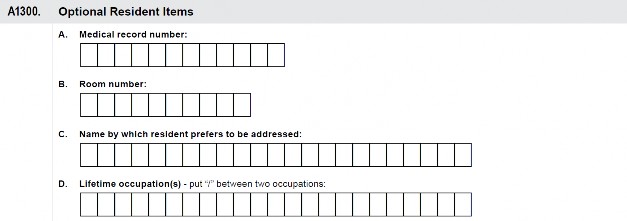
Some facilities prefer to include the nursing home medical record number on the MDS to facilitate tracking.
Some facilities conduct unit reviews of MDS items in addition to resident and nursing home level reviews. The unit may be indicated by the room number.
Preferred name and lifetime occupation help nursing home staff members personalize their interactions with the resident.
Many people are called by a nickname or middle name throughout their life. It is important to call residents by the name they prefer in order to establish comfort and respect between staff and resident. Also, some cognitively impaired or hearing impaired residents might have difficulty responding when called by their legal name, if it is not the name most familiar to them.
Others may prefer a more formal and less familiar address. For example, a physician might appreciate being referred to as “Doctor.”
Knowing a person’s lifetime occupation is also helpful for care planning and conversation purposes. For example, a carpenter might enjoy pursuing hobby shop activities.
These are optional items because they are not needed for CMS program function.
A1300: Optional Resident Items (cont.)
Enter the resident’s medical record number (from the nursing home medical record, admission office or Health Information Management Department) if the nursing home chooses to exercise this option.
Enter the resident’s room number if the nursing home chooses to exercise this option.
Enter the resident’s preferred name. This field captures a preferred nickname, middle name, or title that the resident prefers staff use.
Obtained from resident self-report or family or significant other if resident is unable to respond.
Enter the job title or profession that describes the resident’s main occupation(s) before retiring or entering the nursing home. When two occupations are identified, place a slash (/) between each occupation.
The lifetime occupation of a person whose primary work was in the home should be recorded as “homemaker.” For a resident who is a child or an intellectually disabled/developmentally disabled adult resident who has never had an occupation, record as “none.”
A1500: Preadmission Screening and Resident Review (PASRR)

All individuals who are admitted to a Medicaid certified nursing facility, regardless of the individual’s payment source, must have a Level I PASRR completed to screen for possible mental illness (MI), intellectual disability (ID), developmental disability (DD), or related conditions (please contact your local State Medicaid Agency for details regarding PASRR requirements and exemptions).
Individuals who have or are suspected to have MI or ID/DD or related conditions may not be admitted to a Medicaid-certified nursing facility unless approved through Level II PASRR determination. Those residents covered by Level II PASRR process may require certain care and services provided by the nursing home, and/or specialized services provided by the State.
A resident with MI or ID/DD must have a Resident Review (RR) conducted when there is a significant change in the resident’s physical or mental condition. Therefore, when an SCSA is completed for a resident with MI or ID/DD, the nursing home is required to notify the State mental health authority, intellectual disability or developmental disability authority (depending on which operates in their State) in order to notify them of the resident’s change in status. Section 1919(e)(7)(B)(iii) of the Social Security Act requires the notification or referral for a significant change.1
Each State Medicaid Agency might have specific processes and guidelines for referral, and which types of significant changes should be referred. Therefore, facilities should become acquainted with their own State requirements.
Please see https://www.medicaid.gov/medicaid/long-term-services-supports/institutional- long-term-care/preadmission-screening-and-resident-review for CMS information on PASRR.

The statute may also be referenced as 42 USC 1396r(e)(7)(B)(iii). Note that as of this revision date the statute supersedes Federal regulations at 42 CFR 483.114(c), which still reads as requiring annual resident review. The regulation has not yet been updated to reflect the statutory change to resident review upon significant change in condition.
A1500: Preadmission Screening and Resident Review (PASRR) (cont.)
The Level II PASRR determination and the evaluation report specify services to be provided by the nursing home and/or specialized services defined by the State.
The State is responsible for providing specialized services to individuals with MI or ID/DD. In some States specialized services are provided to residents in Medicaid- certified facilities (in other States specialized services are only provided in other facility types such as a psychiatric hospital). The nursing home is required to provide all other care and services appropriate to the resident’s condition.
The services to be provided by the nursing home and/or specialized services provided by the State that are specified in the Level II PASRR determination and the evaluation report should be addressed in the plan of care.
Identifies individuals who are subject to Resident Review upon change in condition.
Complete if A0310A = 01, 03, 04 or 05 (Admission assessment, Annual assessment, SCSA, Significant Correction to Prior Comprehensive Assessment).
Review the Level I PASRR form to determine whether a Level II PASRR was required.
Review the PASRR report provided by the State if Level II screening was required.
Code 0, no: and skip to A1550, Conditions Related to ID/DD Status, if any of the following apply:
PASRR Level I screening did not result in a referral for Level II screening, or
Level II screening determined that the resident does not have a serious MI and/or ID/DD or related conditions, or
PASRR screening is not required because the resident was admitted from a hospital after requiring acute inpatient care, is receiving services for the condition for which they received care in the hospital, and the attending physician has certified before admission that the resident is likely to require less than 30 days of nursing home care.
A1500: Preadmission Screening and Resident Review (PASRR) (cont.)
Code 1, yes: if PASRR Level II screening determined that the resident has a serious mental illness and/or ID/DD or related condition, and continue to A1510, Level II Preadmission Screening and Resident Review (PASRR) Conditions.
Code 9, not a Medicaid-certified unit: if bed is not in a Medicaid-certified nursing home. Skip to A1550, Conditions Related to ID/DD Status. The PASRR process does not apply to nursing home units that are not certified by Medicaid (unless a State requires otherwise) and therefore the question is not applicable.
Note that the requirement is based on the certification of the part of the nursing home the resident will occupy. In a nursing home in which some parts are Medicaid certified and some are not, this question applies when a resident is admitted, or transferred to, a Medicaid certified part of the building.
A1510: Level II Preadmission Screening and Resident Review (PASRR) Conditions

Complete if A0310A = 01, 03, 04 or 05 (Admission assessment, Annual assessment, SCSA, Significant Correction to Prior Comprehensive Assessment).
Check all that apply.
Code A, Serious mental illness: if resident has been diagnosed with a serious mental illness.
Code B, Intellectual Disability: if resident has been diagnosed with intellectual disability/developmental disability.
Code C, Other related conditions: if resident has been diagnosed with other related conditions.
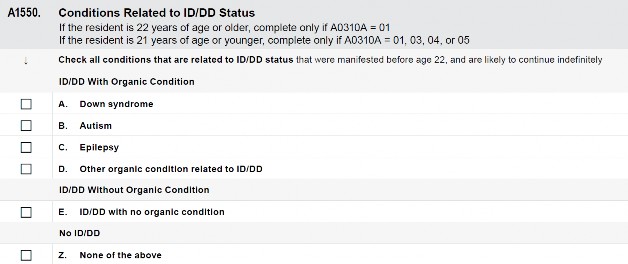
A1550: Conditions Related to Intellectual Disability/Developmental Disability (ID/DD) Status
DEFINITIONS
DOWN SYNDROME
A common genetic disorder in which a child is born with 47 rather than 46 chromosomes, resulting in developmental delays, intellectual disability, low muscle tone, and other possible effects.
AUTISM
A developmental disorder that is characterized by impaired social interaction, problems with verbal and nonverbal communication, and unusual, repetitive, or severely limited activities and interests.
EPILEPSY
A common chronic neurological disorder that is characterized by recurrent unprovoked seizures.
DEFINITIONS
DOWN SYNDROME
A common genetic disorder in which a child is born with 47 rather than 46 chromosomes, resulting in developmental delays, intellectual disability, low muscle tone, and other possible effects.
AUTISM
A developmental disorder that is characterized by impaired social interaction, problems with verbal and nonverbal communication, and unusual, repetitive, or severely limited activities and interests.
EPILEPSY
A common chronic neurological disorder that is characterized by recurrent unprovoked seizures.
To document conditions associated with intellectual or developmental disabilities.
If resident is 22 years of age or older on the ARD, complete only if A0310A = 01 (Admission assessment).
If resident is 21 years of age or younger on the ARD, complete if A0310A = 01, 03, 04, or 05 (Admission assessment, Annual assessment, SCSA, Significant Correction to Prior Comprehensive Assessment).
Check all conditions related to ID/DD status that were present before age 22.
When age of onset is not specified, assume that the condition meets this criterion AND is likely to continue indefinitely.
Code A: if Down syndrome is present.
Code B: if autism is present.
Code C: if epilepsy is present.
Code D: if other organic condition related to ID/DD is present.


DEFINITION
OTHER ORGANIC CONDITION RELATED TO ID/DD
Examples of diagnostic conditions include congenital syphilis, maternal intoxication, mechanical injury at birth, prenatal hypoxia, neuronal lipid storage diseases, phenylketonuria (PKU), neurofibromatosis, microcephalus, macroencephaly, meningomyelocele, congenital hydrocephalus, etc.
DEFINITION
OTHER ORGANIC CONDITION RELATED TO ID/DD
Examples of diagnostic conditions include congenital syphilis, maternal intoxication, mechanical injury at birth, prenatal hypoxia, neuronal lipid storage diseases, phenylketonuria (PKU), neurofibromatosis, microcephalus, macroencephaly, meningomyelocele, congenital hydrocephalus, etc.
A1550: Conditions Related to Intellectual Disability/Developmental Disability (ID/DD) Status (cont.)
Code E: if an ID/DD condition is present but the resident does not have any of the specific conditions listed.
Code Z: if ID/DD condition is not present.
A1600–A1805: Most Recent Admission/Entry or Reentry into this Facility
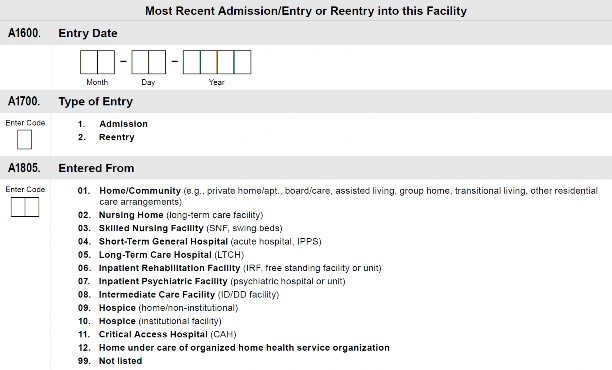
A1600: Entry Date

DEFINITION
ENTRY DATE
The initial date of admission to the facility, or the date the resident most recently returned to your facility after being discharged.
DEFINITION
ENTRY DATE
The initial date of admission to the facility, or the date the resident most recently returned to your facility after being discharged.
To document the date of admission/entry or reentry into the facility.
Enter the most recent date of admission/entry or reentry to this facility. Use the format: Month-Day-Year: XX- XX-XXXX. For example, October 12, 2010, would be entered as 10-12-2010.
In the case of an interrupted stay, the return date (i.e., date of continuation of Medicare Part A stay in the same SNF) is entered in A1600 using the format above.
A1700: Type of Entry

Captures whether date in A1600 is an admission/entry or reentry date.
Code 1, admission: when one of the following occurs:
resident has never been admitted to this facility before; OR
resident has been in this facility previously and was discharged return not anticipated; OR
resident has been in this facility previously and was discharged return anticipated and did not return within 30 days of discharge.
Code 2, reentry: when all three of the following occurred prior to this entry; the resident was:
admitted to this facility, AND
discharged return anticipated, AND
returned to facility within 30 days of discharge.
A1805: Entered From
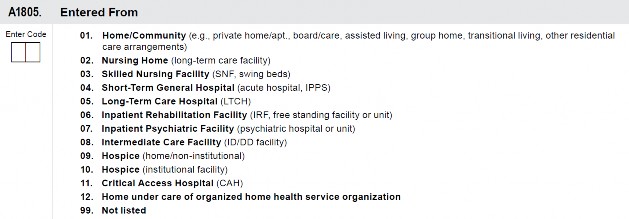
Knowing the setting the individual was in immediately prior to facility admission/entry or reentry informs the delivery of services and care planning that the resident receives during their stay and may also inform discharge planning. See the Glossary and Common Acronyms in Appendix A for additional descriptions of these settings.
Demographic information.
DEFINITIONS
PRIVATE HOME OR APARTMENT
Any house, condominium, or apartment in the community whether owned by the resident or another person. Also included in this category are retirement communities and independent housing for the elderly.
BOARD AND CARE/ ASSISTED LIVING/ GROUP HOME
A non-institutional community residential setting that includes services of the following types: home health services, homemaker/ personal care services, or meal services.
DEFINITIONS
PRIVATE HOME OR APARTMENT
Any house, condominium, or apartment in the community whether owned by the resident or another person. Also included in this category are retirement communities and independent housing for the elderly.
BOARD AND CARE/ ASSISTED LIVING/ GROUP HOME
A non-institutional community residential setting that includes services of the following types: home health services, homemaker/ personal care services, or meal services.
Review transfer and admission records.
Ask the resident and/or family member, significant other, and/or guardian/legally authorized representative.
Enter the two-digit code that best describes the setting the resident was in immediately preceding this admission/entry or reentry.
Enter the two-digit code that best describes the setting the resident was in immediately preceding this admission/entry or reentry.
Code 01, Home/Community: if the resident was admitted from a private home, apartment, board and care, assisted living facility, group home, transitional living, or adult foster care. A community residential setting is defined as any house, condominium, or apartment in the community, whether owned by the resident or another person; retirement communities; or independent housing for the elderly.
Code 02, Nursing Home (long-term care facility): if the resident was admitted from an institution that is primarily engaged in providing medical and non-medical care to people who have a chronic illness or disability.
A1805: Entered From (cont.)
Code 03, Skilled Nursing Facility (SNF, swing bed): if the resident was admitted from a nursing facility with staff and equipment for the provision of skilled nursing services, skilled rehabilitative services, and/or other related health services. This category also includes residents admitted from a SNF swing bed in a swing bed hospital. A swing bed hospital is a hospital or critical access hospital (CAH) participating in Medicare that has CMS approval to provide posthospital SNF care and meets certain requirements.
Code 04, Short-Term General Hospital (acute hospital/IPPS): if the resident was admitted from a hospital that is contracted with Medicare to provide acute inpatient care and accepts a predetermined rate as payment in full.
Code 05, Long-Term Care Hospital (LTCH): if the resident was admitted from a Medicare certified acute care hospital that focuses on patients who stay, on average, more than 25 days. Most patients in LTCHs are chronically and critically ill and have been transferred there from an intensive or critical-care unit.
Code 06, Inpatient Rehabilitation Facility (IRF, free standing facility or unit): if the resident was admitted from a rehabilitation hospital or a distinct rehabilitation unit of a hospital that provides an intensive rehabilitation program to inpatients. This category also includes residents admitted from a rehabilitation unit of a critical access hospital.
Code 07, Inpatient Psychiatric Facility (psychiatric hospital or unit): if the resident was admitted from an institution that provides, by or under the supervision of a physician, psychiatric services for the diagnosis and treatment of mentally ill patients. This category also includes residents admitted from a psychiatric unit of a critical access hospital.
Code 08, Intermediate Care Facility (ID/DD): if the resident was admitted from an institution that is engaged in providing, under the supervision of a physician, any health and rehabilitative services for individuals with intellectual disabilities (ID) or developmental disabilities (DD).
Code 09, Hospice (home/non-institutional): if the resident was admitted from a community-based program for terminally ill persons.
Code 10, Hospice (institutional facility): if the resident was admitted from an inpatient program for terminally ill persons where an array of services is necessary for the palliation and management of terminal illness and related conditions. The hospice must be licensed by the State as a hospice provider and/or certified under the Medicare program as a hospice provider.
Code 11, Critical Access Hospital (CAH): if the resident was admitted from a Medicare-participating hospital located in a rural area or an area that is treated as rural and that meets all of the criteria to be designated by CMS as a CAH and was receiving acute care services from the CAH at the time of discharge.
Code 12, Home under care of organized home health service organization: if the resident was admitted from home under care of an organized home health service organization. This includes only skilled services provided by a home health agency.
A1805: Entered From (cont.)
Code 99, Not listed: if the resident was admitted from none of the above.
If an individual was enrolled in a home-based hospice program enter 09, Hospice, instead of 01, Home/Community.
A1900: Admission Date (Date this episode of care in this facility began)

To document the date this episode of care in this facility began.
Enter the date this episode of care in this facility began. Use the format: Month-Day- Year: XX-XX-XXXX. For example, October 12, 2010, would be entered as 10-12-2010.
The Admission Date may be the same as the Entry Date (A1600) for the entire stay (i.e., if the resident is never discharged).
Examples
Resident H was admitted to the facility from an acute care hospital on 09/14/2020 for rehabilitation after a hip replacement. In completing their Admission assessment, the facility entered 09/14/2020 in A1600, Entry Date; coded A1700 = 1, Admission; chose Code 04, Short-Term General Hospital (acute hospital, IPPS) in item A1805, Entered From; and entered 09/14/2020 in item A1900, Admission Date.
The facility received communication from an acute care hospital discharge planner stating that Resident H, a former resident of the facility who was discharged home return not anticipated on 11/02/2020 after a successful recovery and rehabilitation, was admitted to their hospital on 2/8/2021 and wished to return to the facility for rehabilitation after hospital discharge. Resident H returned to the facility on 2/15/2021. Although Resident H was a resident of the facility in September of 2020, they were discharged home return not anticipated; therefore, the facility rightly considered Resident H as a new admission. In completing their Admission assessment, the facility entered 02/15/2021 in A1600, Entry Date; coded A1700 = 1, Admission; chose Code 04, Short-Term General Hospital (acute hospital, IPPS) in item A1805, Entered From; and entered 02/15/2021 in item A1900, Admission Date.
A1900: Admission Date (Date this episode of care in this facility began) (cont.)
Resident K was admitted to the facility on 10/05/2020 and was discharged to the hospital, return anticipated, on 10/20/2020. They returned to the facility on 10/26/2020. Since Resident K was a resident of the facility, was discharged return anticipated, and returned within 30 days of discharge, Resident K was considered as continuing in their current stay. Therefore, when the facility completed Resident K’s Entry Tracking Record on return from the hospital, they entered 10/26/2020 in A1600, Entry Date; coded A1700 = 2, Reentry; chose Code 04, Short-Term General Hospital (acute hospital, IPPS) in item A1805; and entered 10/05/2020 in item A1900, Admission Date.
Approximately a month after their return, Resident K was again sent to the hospital, return anticipated on 11/05/2020. They returned to the facility on 11/22/2020. Again, since Resident K was a resident of the facility, was discharged return anticipated, and returned within 30 days of discharge, Resident K was considered as continuing in their current stay. Therefore, when the facility completed Resident K’s Entry Tracking Record, they entered 11/22/2020 in A1600, Entry Date; coded A1700 = 2, Reentry; chose Code 04, Short-Term General Hospital (acute hospital, IPPS) in item A1805; and entered 10/05/2020 in item A1900, Admission Date.
Resident S was admitted to the facility on 8/26/2021 for rehabilitation after a total knee replacement. Three days after admission, Resident S spiked a fever and their surgical site was observed to have increased drainage, was reddened, swollen and extremely painful. The facility sent Resident S to the emergency room and completed their OBRA Discharge assessment as return anticipated. The hospital called the facility to inform them Resident S was admitted. A week into their hospitalization, Resident S developed a blood clot in their affected leg, further complicating their recovery. The facility was contacted to readmit Resident S for rehabilitative services following discharge from the hospital on 10/10/2021. Even though Resident S was a former patient in the facility’s rehabilitation unit and was discharged return anticipated, they did not return within 30 days of discharge to the hospital. Therefore, Resident S is considered a new admission to the facility. On their return, when the facility completed Resident S’s Admission assessment, they entered 10/10/2021 in A1600, Entry Date; coded A1700 = 1, Admission; chose Code 04, Short-Term General Hospital (acute hospital, IPPS) in item A1805, Entered From; and entered 10/10/2021 in item A1900, Admission Date.
Both swing bed facilities and nursing homes must apply the above instructions for coding items A1600 through A1900 to determine whether a patient or resident is an admission/entry or reentry.
In determining if a patient or resident returns to the facility within 30 days, the day of discharge from the facility is not counted in the 30 days. For example, a resident discharged return anticipated on December 1 would need to return to the facility by December 31 to meet the “within 30 days” requirement.
A1900: Admission Date (Date this episode of care in this facility began) (cont.)
If the Type of Entry for this assessment is an Admission (A1700 = 1), the Admission Date (A1900) and the Entry Date (A1600) must be the same.
If the Type of Entry for this assessment is a Reentry (A1700 = 2), the Admission Date (A1900) will remain the same, and the Entry Date (A1600) must be later than the date in A1900.
Item A1900 (Admission Date) is tied to items A1600 (Entry Date), A1700 (Type of Entry), and A1805 (Entered From). It is also tied to the concepts of a “stay” and an “episode.” A stay is a set of contiguous days in the facility and an episode is a series of one or more stays that may be separated by brief interruptions in the resident’s time in the facility. An episode continues across stays until one of three events occurs: the resident is discharged with return not anticipated, the resident is discharged with return anticipated but is out of the facility for more than 30 days, or the resident dies in the facility.
A1900 (Admission Date) should remain the same on all assessments for a given episode even if it is interrupted by temporary discharges from the facility. If the resident is discharged and reenters within the course of an episode, that will start a new stay. The date in item A1600 (Entry Date) will change, but the date in item A1900 (Admission Date) will remain the same. If the resident returns after a discharge return not anticipated or after a gap of more than 30 days outside of the facility, a new episode would begin and a new admission would be required.
When a resident is first admitted to a facility, item A1600 (Entry Date) should be coded with the date the person first entered the facility, and A1700 (Type of Entry) should be coded as 1, Admission. The place where the resident was admitted from should be documented in A1805 (Entered From), and the date in item A1900 (Admission Date) should match the date in A1600 (Entry Date). These items would be coded the same way for all subsequent assessments within the first stay of an episode. If the resident is briefly discharged (e.g., brief hospitalization) and then reenters the facility, a new (second) stay would start, but the current episode would continue. On the Entry Tracking Record and on subsequent assessments for the second stay, the date in A1600 (Entry Date) would change depending on the date of reentry, and item A1700 (Type of Entry) would be coded as 2, Reentry. Item A1805 (Entered From) would reflect where the resident was prior to this reentry, and item A1900 (Admission Date) would continue to show the original admission date (the date that began their first stay in the episode).
A2000: Discharge Date

Closes the episode in iQIES.
Enter the date the resident was discharged (whether or not return is anticipated). This is the date the resident leaves the facility.
For OBRA Discharge assessments, the Discharge Date (A2000) and ARD (A2300) must be the same date.
Do not include leave of absence or hospital observational stays less than 24 hours unless admitted to the hospital.
Obtain data from the medical, admissions or transfer records.
A Part A PPS Discharge assessment (NPE Item Set) is required under the SNF QRP when the resident’s Medicare Part A stay ends, but the resident does not leave the facility.
The PPS Discharge assessment is completed whenever a Medicare Part A stay ends. The PPS Discharge assessment must be combined with the OBRA Discharge assessment when the Medicare Part A stay ends on or one day prior to the day of discharge from the facility. When the OBRA and Part A discharge assessments are combined, the ARD (A2300) must be equal to the day of discharge from the facility (A2000).
The PPS Discharge assessment is also completed when the resident’s Medicare Part A stay ends, but the resident remains in the facility. When this occurs, the ARD (A2300) of the PPS Discharge assessment must be the last Medicare Part A covered day. The PPS Discharge assessment may be combined with most OBRA-required assessments when requirements for all assessments are met (please see Section 2.10 Combining PPS Assessments and OBRA Assessments).
A2105: Discharge Status
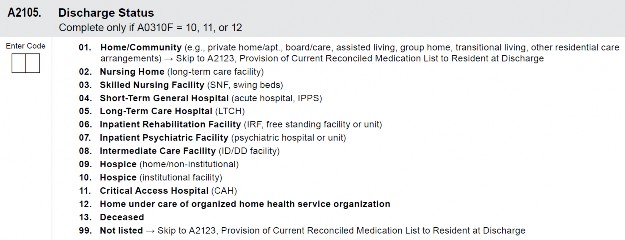
This item documents the location to which the resident is being discharged at the time of discharge. Knowing the setting to which the individual was discharged helps to inform discharge planning. See the Glossary and Common Acronyms in Appendix A for additional descriptions of these settings.
Demographic and outcome information.
Review the medical record including the discharge plan and discharge orders for documentation of discharge location.
Select the two-digit code that corresponds to the resident’s discharge status.
Code 01, Home/Community: if the resident was discharged to a private home, apartment, board and care, assisted living facility, group home, transitional living, or adult foster care. A community residential setting is defined as any house, condominium, or apartment in the community, whether owned by the resident or another person; retirement communities; or independent housing for the elderly.
Code 02, Nursing Home (long-term care facility): if the resident was discharged to an institution that is primarily engaged in providing medical and non- medical care to people who have a chronic illness or disability.
A2105: Discharge Status (cont.)
Code 03, Skilled Nursing Facility (SNF, swing beds): if the resident was discharged to a nursing facility with staff and equipment for the provision of skilled nursing services, skilled rehabilitative services, and/or other related health services. This category also includes patients admitted from a SNF swing bed in a swing bed hospital. A swing bed hospital is a hospital or critical access hospital (CAH) participating in Medicare that has CMS approval to provide posthospital SNF care and meets certain requirements.
Code 04, Short-Term General Hospital (acute hospital/IPPS): if the resident was discharged to a hospital that is contracted with Medicare to provide acute, inpatient care and accepts a predetermined rate as payment in full.
Code 05, Long-Term Care Hospital (LTCH): if the resident was discharged to a Medicare certified acute care hospital that focuses on patients who stay, on average, more than 25 days. Most patients in LTCHs are chronically and critically ill and have been transferred there from an intensive or critical-care unit.
Code 06, Inpatient Rehabilitation Facility (IRF, free standing facility or unit): if the resident was discharged to a rehabilitation hospital or a distinct rehabilitation unit of a hospital that provides an intensive rehabilitation program to inpatients. This category also includes residents discharged to a rehabilitation unit of a critical access hospital.
Code 07, Inpatient Psychiatric Facility (psychiatric hospital or unit): if the resident was discharged to an institution that provides, by or under the supervision of a physician, psychiatric services for the diagnosis and treatment of mentally ill residents. This category also includes residents discharged to a psychiatric unit of a critical access hospital.
Code 08, Intermediate Care Facility (ID/DD): if the resident was discharged to an institution that is engaged in providing, under the supervision of a physician, any health and rehabilitative services for individuals who have intellectual disabilities (ID) or developmental disabilities (DD).
Code 09, Hospice (home/non-institutional): if the resident was discharged to a community-based program for terminally ill persons.
Code 10, Hospice (institutional facility): if the resident was discharged to an inpatient program for terminally ill persons where an array of services is necessary for the palliation and management of terminal illness and related conditions. The hospice must be licensed by the State as a hospice provider and/or certified under the Medicare program as a hospice provider.
Code 11, Critical Access Hospital (CAH): if the resident was discharged to a Medicare-participating hospital located in a rural area or an area that is treated as rural and that meets all of the criteria to be designated by CMS as a CAH and was receiving acute care services from the CAH at the time of discharge.
A2105: Discharge Status (cont.)
Code 12, Home under care of organized home health service organization: if the resident was discharged home under care of an organized home health service organization. This includes only skilled services provided by a home health agency.
Code 13, deceased: if resident is deceased.
Code 99, Not listed: if the resident was discharged to none of the above.
A2121: Provision of Current Reconciled Medication List to Subsequent Provider at Discharge
Complete only if A0310H = 1 and A2105 = 02-12.

The transfer of a current reconciled medication list at the time of discharge can improve care coordination and quality of care and help subsequent providers reconcile medications, and it may mitigate adverse outcomes related to medications. Communication of medication information at discharge is critical to ensure safe and effective transitions from one health care setting to another.
Determine whether the resident was discharged to one of the subsequent providers defined below under Coding Tips, based on discharge location item A2105.
If yes, determine whether, at the time of discharge, your facility provided a current reconciled medication list to the resident’s subsequent provider.
Code 0, No: if at discharge to a subsequent provider, your facility did not provide the resident’s current reconciled medication list to the subsequent provider, or the resident was not discharged to a subsequent provider.
Code 1, Yes: if at discharge to a subsequent provider, your facility did provide the resident’s current reconciled medication list to the subsequent provider.
A2121: Provision of Current Reconciled Medication List to Subsequent Provider at Discharge (cont.)
Subsequent provider—For the purposes of coding this item, a subsequent provider is based on the discharge locations in A2105 and defined as any of the following:
Nursing home (long-term care facility)
Skilled nursing facility (SNF, swing beds)
Short-term general hospital (acute hospital, IPPS)
Long-term care hospital (LTCH)
Inpatient rehabilitation facility (IRF, free standing facility or unit)
Inpatient psychiatric facility (psychiatric hospital or unit)
Intermediate care facility (ID/DD facility)
DEFINITION
MEANS OF PROVIDING A CURRENT RECONCILED MEDICATION LIST
Providing the current reconciled medication list at the time of transfer or discharge can be accomplished by any means, including active means (e.g., by mail, electronically, or verbally) and more passive means (e.g., a common electronic health record [EHR]), giving providers access to a portal).2
DEFINITION
MEANS OF PROVIDING A CURRENT RECONCILED MEDICATION LIST
Providing the current reconciled medication list at the time of transfer or discharge can be accomplished by any means, including active means (e.g., by mail, electronically, or verbally) and more passive means (e.g., a common electronic health record [EHR]), giving providers access to a portal).2
Hospice (home/non-institutional)
Hospice (institutional facility)
Critical access hospital (CAH)
Home under care of organized home health service organization
While the resident may receive care from other providers after discharge from your facility, such as primary care providers, other outpatient providers, and residential treatment centers, these locations are not considered to be a subsequent provider for the purpose of coding this item.
Current Reconciled Medication list—This refers to a list of the resident’s current medications at the time of discharge that was reconciled by the facility prior to the resident’s discharge.

A portal is a secure online website that gives providers, patients, and others convenient, 24-hour access to personal health information from anywhere with an Internet connection. Using a secure username and password, providers and patients can view health information such as current medications, recent doctor visits and discharge summaries. Retrieved from https://www.healthit.gov/faq/what-patient-portal April 2, 2019.
A2121: Provision of Current Reconciled Medication List to Subsequent Provider at Discharge (cont.)
The following information on the important content that may be included in a reconciled medication list is provided as guidance. This guidance does not dictate what information should be included in your facility’s current reconciled medication list in order to code 1, Yes, that a current reconciled medication list was provided to the subsequent provider. The completeness of this reconciled medication list is left to the discretion of the providers who are coordinating this care with the resident. Examples of information that could be part of a reconciled medication list can be, but are not limited to:
Types of medications—Current prescribed and over-the-counter (OTC) medications, nutritional supplements, vitamins, and homeopathic and herbal products administered by any route at the time of discharge. Medications may also include total parenteral nutrition (TPN) and oxygen.
The list of reconciled medications could include those that are:
active, including those that are scheduled to be discontinued after discharge;
held during the stay and planned to be continued/resumed after discharge; and
discontinued during the stay, if potentially relevant to the resident’s subsequent care.
Information included—A reconciled medication list often includes important information about (1) the resident—including their name, date of birth, active diagnoses, known medication and other allergies, and known drug sensitivities and reactions; and (2) each medication, including the name, strength, dose, route of medication administration, frequency or timing, purpose/indication, and any special instructions (e.g., crush medications). For any held medications, it may include the reason for holding the medication and when medication should resume. This information can improve medication safety. Additional information may be applicable and important to include in the medication list, such as the resident’s weight and date taken, preferred language, and ability to self-administer medication; when the last dose of the medication was administered by the discharging provider; and when the final dose should be administered (e.g., end of treatment).
A2121: Provision of Current Reconciled Medication List to Subsequent Provider at Discharge (cont.)
Resident B is being discharged from the SNF to an acute care hospital in the same health care system that uses the same electronic health record (EHR), also sometimes referred to as an electronic medical record (EMR) (see Definitions: EHR/EMR and definition in the glossary). Resident B’s current reconciled medication list at the time of discharge from the SNF is accessible to the subsequent acute care hospital staff admitting Resident B, and this is how the medication list is shared.
Coding: A2121 would be coded 1, Yes.
Rationale: Having access to Resident B’s medication list through the same EHR system is one way to transfer a medication list. This code of 1, Yes, is used for this passive means of transferring the medication list when the sending and receiving provider can access the same EHR system.
Resident D is not taking any prescribed or over-the-counter medications at the time of discharge.
Coding: If the lack of any medications for a resident is clearly documented and communicated to the subsequent provider when the resident is discharged, code 1, Yes, that the medication list was transferred. If this information is not communicated to the subsequent provider, code 0, No.
Rationale: Information confirming that the resident is not taking any medications at discharge is important for the subsequent provider.
Resident F was transferred to an acute care hospital with a reconciled medication list that included a list of their current medications, but with less additional information than is usually provided by the SNF at discharge because of the urgency of the situation. Some of the contraindications for the medications, as well as resident weight and height and dates taken, were omitted from the medication list.
Coding: A2121 would be coded 1, Yes.
Rationale: As long as a current reconciled list of medications is provided to the admitting provider, this item should be coded 1, Yes.
Resident G’s reconciled medication list was electronically faxed to the subsequent provider, and this action is documented in their clinical record. However, the subsequent provider’s records do not show documentation that the fax was successfully received.
Coding: A2121, would be coded 1, Yes.
Rationale: Documentation of the subsequent provider’s successful receipt of the reconciled medication list is not a required component for this item.
A2122: Route of Current Reconciled Medication List Transmission to Subsequent Provider
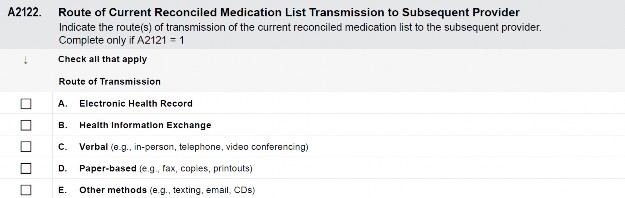
The guidance below addresses coding A2122. Route of Current Reconciled Medication List Transmission to Subsequent Provider. Assessors should apply this same guidance to A2124. Route of Current Reconciled Medication List Transmission to Resident.
The guidance below addresses coding A2122. Route of Current Reconciled Medication List Transmission to Subsequent Provider. Assessors should apply this same guidance to A2124. Route of Current Reconciled Medication List Transmission to Resident.
This item collects important data to monitor how medication lists are transmitted at discharge.
Identify all routes of transmission that were used to provide the resident’s current reconciled medication list to the subsequent provider.
A2122: Route of Current Reconciled Medication List Transmission to Subsequent Provider (cont.)
DEFINITIONS
EHR/EMR
An electronic health record (EHR), sometimes referred to as an electronic medical record (EMR), is an electronic version of a resident’s medical history that is maintained by the provider over time.3
PORTAL
A portal is a secure online website that gives providers, residents, and others convenient, 24-hour access to personal health information from anywhere with an Internet connection.4
DEFINITIONS
EHR/EMR
An electronic health record (EHR), sometimes referred to as an electronic medical record (EMR), is an electronic version of a resident’s medical history that is maintained by the provider over time.3
PORTAL
A portal is a secure online website that gives providers, residents, and others convenient, 24-hour access to personal health information from anywhere with an Internet connection.4
Select the codes that correspond to the routes of transmission used to provide the medication list to the subsequent provider.
Check A2122A, Electronic Health Record: if your facility has an EHR, sometimes referred to as an electronic medical record (EMR), and used it to transmit or provide access to the reconciled medication list to the subsequent provider. This would include situations in which both the discharging and receiving provider have direct access to a common EHR system. Checking this route does not require confirmation that the subsequent provider has accessed the common EHR system for the medication list.
Check A2122B, Health Information Exchange: if your facility participates in a Health Information Exchange (HIE) and used the HIE to electronically exchange the current reconciled medication list with the subsequent provider.
Check A2122C, Verbal: if the current reconciled medication list information was verbally communicated
(e.g., in-person, telephone, video conferencing) to the subsequent provider.
Check A2122D, Paper-Based: if the current reconciled medication list was transmitted to the subsequent provider using a paper-based method such as a printout, fax, or eFax.
Check A2122E, Other Methods: if the current reconciled medication list was transmitted to the subsequent provider using another method not listed above (e.g., texting, email, CDs).

https://www.healthit.gov/topic/health-it-and-health-information-exchange-basics/what-are-electronic-health- records-ehrs.
Office of the National Coordinator, What is a patient portal? Available from https://www.healthit.gov/faq/what- patient-portal, Accessed June 10, 2019.
A2123: Provision of Current Reconciled Medication List to Resident at Discharge
Complete only if A0310H = 1 and A2105 = 01, 99.

Communication of medication information to the resident at discharge is critical to ensuring safe and effective discharges. The item, collected at the time of discharge, can improve care coordination and quality of care, aids in medication reconciliation, and may mitigate adverse outcomes related to medications.
It is recommended that a reconciled medication list that is provided to the resident, family member, guardian/legally authorized representative, or caregiver use consumer-friendly terminology and plain language to ensure that the information provided is clear and understandable.5
Determine whether the resident was discharged to a home setting, 01, defined below under Coding Tips, or 99, Not Listed based on discharge location item A2105.
If yes, determine whether, at discharge, your facility provided the resident’s medication list to the resident, family member, guardian/legally authorized representative, and/or caregiver.
Code 0, No: if at discharge to a home setting (A2105 = 01) or a not listed location (A2105 = 99), your facility did not provide the resident’s current reconciled medication list to the resident, family, guardian/legally authorized representative, and/or caregiver.
Code 1, Yes: if at discharge to a home setting (A2105 = 01) or a not listed location (A2105 = 99), your facility did provide the resident’s current reconciled medication list to the resident, family, guardian/legally authorized representative, and/or caregiver.

For examples of plain language resources for healthcare information see: https://www.plainlanguage.gov/resources/content-types/healthcare/
A2123: Provision of Current Reconciled Medication List to Resident at Discharge (cont.)
Resident, family, significant other, guardian/legally authorized representative and/or caregiver—The recipient of the current reconciled medication list can be the resident, family member, significant other, guardian/legally authorized representative, and/or caregiver in order to code 1, Yes, a current reconciled medication list was transferred. It is not necessary to provide the current reconciled medication list to all of these recipients in order to code 1, Yes.
Resident D does not take any prescribed or over-the-counter medications at the time of discharge.
Coding: If it is clearly documented that the resident is taking no medications and this is then clearly communicated to the resident, family member, significant other, and/or caregiver when the resident is discharged, A2123 would be coded 1, Yes, that the medication list was transferred. If this information is not communicated to the resident, family member, significant other, guardian/legally authorized representative, and/or caregiver, code 0, No.
Rationale: Information confirming that the resident is not taking any medications at discharge is important for the resident, family member, significant other, guardian/legally authorized representative, and/or caregiver.
Resident F is cognitively impaired and unable to manage their medications after discharge. Their medication list is provided to their sibling, who will be their primary caregiver.
Coding: A2123 would be coded 1, Yes.
Rationale: The medication list must be provided to the resident, family member, significant other, guardian/legally authorized representative, and/or a caregiver in order to code 1, Yes. In this example, Resident F’s sibling is a family member and a caregiver, so code 1, Yes.
Resident P chooses to leave the facility before their treatment is completed. They tell the charge nurse on their way out the door that their ride is waiting for them and they are going home. The charge nurse explains that they have not completed their course of treatment and are not ready to be discharged, but they insist that they are leaving now and proceed out of the facility.
Coding: A2123 would be coded 0, No.
Rationale: No medication list review was completed, and no medication list was provided to Resident P as they left against medical advice and did not want to keep their ride waiting.
A2124: Route of Current Reconciled Medication List Transmission to Resident
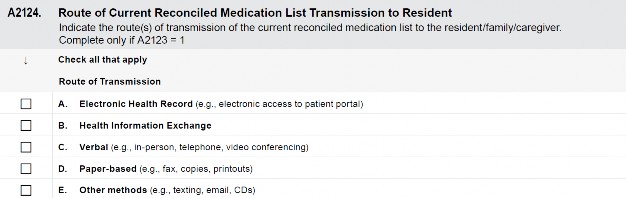
This item collects important data to monitor how medication lists are transmitted at discharge.
Identify all routes of transmission that were used to provide the resident’s current reconciled medication list to the resident, family member, significant other, guardian/legally authorized representative, and/or caregiver.
Please refer to the coding instructions for A2122. Route of Current Reconciled Medication List Transmission to Subsequent Provider.
The route of transmission usually is established with each subsequent provider, depending on how it is able to receive information from your facility. The route(s) may not always be documented in the resident’s record. It will be helpful to understand and document how your facility typically transmits information to each subsequent provider at discharge to prepare for coding this item.
More than one route of transmission may apply. Check all that apply.
A2124: Route of Current Reconciled Medication List Transmission to Resident (cont.)
A SNF is discharging and sending a resident to a hospital by ambulance. The driver obtains a printout and brings the resident’s medication list to the hospital. The facility follows up with a call to the subsequent provider and discusses the resident’s medications.
Coding: Check paper-based (D) and verbal (C) for A2122.
Rationale: Two routes for transmitting the medication list information were used—a paper copy of the list (D) and follow up verbal discussion (C). Both of these occurred at the time of discharge.
One of a SNF’s referral HHAs is preparing to admit a resident who will discharge soon. The HHA intake nurse has secure access to the SNF’s EHR to obtain important care planning information from the resident’s records, including the medication list.
Coding: Check Electronic Health Record (A) for A2122.
Rationale: The SNF provided access to the resident’s medication list through its EHR. Even if there is no confirmation that the intake nurse accessed the medication list from the SNF’s EHR system, code EHR (A) because it was made available by the SNF.
Resident P receives a paper copy of their medication list, receives education about their medications from the SNF nurse at discharge, and is notified that the SNF’s patient portal is another means by which they can obtain their discharge medication list.
Coding: Check Electronic Health Record (A), verbal (C), and paper-based (D) for A2124.
Rationale: The copy of the medication list is paper-based (D). The information about Resident P’s medication list was also communicated verbally by the nurse at the time of discharge (C). The resident portal uses the SNF’s EHR to provide access to the medication list (A). It is not necessary to confirm that Resident P is a registered user of and accessed the patient portal in order to code EHR (A) as a route.
A2124: Route of Current Reconciled Medication List Transmission to Resident (cont.)
A SNF participates in a regional HIE as does a local acute care hospital. When residents are discharged to this acute care hospital, the SNF’s discharge medication list is included in the medications section of a transfer summary document from its EHR, which is electronically exchanged through the HIE. The acute care hospital is then able to obtain and integrate the medication information into its EHR.
Coding: Check Electronic Health Record (A) and Health Information Exchange (B) for A2122.
Rationale: The medication information is exchanged by the regional HIE through health IT standards. Sending the medication information in transfer summary allows the acute care hospital to integrate the medication information into its EHR. Code as EHR (A), since it was used to generate and exchange the information, and as HIE (B), since it is the means through which information exchange is possible with external providers.
A SNF has developed an interface that allows documents from its EHR to be electronically faxed to the subsequent provider. The SNF’s EHR connects via a phone line to a designated receiver’s secure email at the subsequent provider.
Coding: Check paper-based (D) for A2122.
Rationale: Faxing information is considered paper-based as faxed documents are comparable to hard-copy documents and not computable.
A SNF generates the current reconciled medication list electronically from the medication administration record (MAR) and treatment administration record (TAR) and electronically sends via secure email to the subsequent provider.
Coding: Check Other Method (E) for A2122.
Rationale: Providing the medication list through secure email is considered “Other Method” for coding this item. The source of the medication list is not the EHR, and the list is not transmitted directly to the subsequent provider’s EHR, so do NOT check EHR (A).
A2200: Previous Assessment Reference Date for Significant Correction

To identify the ARD of a previous comprehensive (A0310 = 01, 03, or 04) or Quarterly assessment (A0310A = 02) in which a significant error is discovered.
Complete only if A0310A = 05 (Significant Correction to Prior Comprehensive Assessment) or A0310A = 06 (Significant Correction to Prior Quarterly Assessment).
Enter the ARD of the prior comprehensive or Quarterly assessment in which a significant error has been identified and a correction is required.
A2300: Assessment Reference Date

Designates the end of the observation period so that all assessment items refer to the resident’s status during the same period of time.
As the last day of the observation period, the ARD serves as the reference point for determining the care and services captured on the MDS assessment. Anything that happens after the ARD will not be captured on that MDS. For example, for an MDS item with a 7-day observation period, assessment information is collected for a 7-day period ending on and including the ARD which is the 7th day of this observation period. For an item with a 14-day observation period, the information is collected for a 14-day period ending on and including the ARD. The observation period includes observations and events through the end of the day (midnight) of the ARD.
A2300: Assessment Reference Date (cont.)
DEFINITION
ASSESSMENT REFERENCE DATE (ARD)
The specific end-point for the observation periods in the MDS assessment process.
Almost all MDS items refer to the resident’s status over a designated time period referring back in time from the Assessment Reference Date (ARD). Most frequently, this observation period, also called the look-back or assessment period, is a 7- day period ending on the ARD. Observation periods may cover the 7 days ending on this date, 14 days ending on this date, etc.
DEFINITION
ASSESSMENT REFERENCE DATE (ARD)
The specific end-point for the observation periods in the MDS assessment process.
Almost all MDS items refer to the resident’s status over a designated time period referring back in time from the Assessment Reference Date (ARD). Most frequently, this observation period, also called the look-back or assessment period, is a 7- day period ending on the ARD. Observation periods may cover the 7 days ending on this date, 14 days ending on this date, etc.


Interdisciplinary team members should select the ARD based on the reason for the assessment and compliance with all timing and scheduling requirements outlined in
Chapter 2.
Enter the appropriate date on the lines provided. Do not leave any spaces blank. If the month or day contains only a single digit, enter a “0” in the first space. Use four digits for the year. For example, October 2, 2010, should be entered as: 10-02-2010.
For detailed information on the timing of the assessments, see Chapter 2 on assessment schedules.
For discharge assessments, the discharge date item (A2000) and the ARD item (A2300) must contain the same date.
When the resident dies or is discharged prior to the end of the observation period for a required assessment, the ARD must be adjusted to equal the discharge date.
The observation period may not be extended simply because a resident was out of the nursing home during part of the observation period (e.g., a home visit, therapeutic leave, or hospital observation stay less than 24 hours when resident is not admitted). For example, if the ARD is set at day 13 and there is a 2-day temporary leave during the observation period, the 2 leave days are still considered part of the observation period.
When collecting assessment information, data from the time period of the leave of absence is captured as long as the particular MDS item permits. For example, if the family takes the resident to their home for a holiday and the resident falls, the assessor will capture the fall in J1900: Number of Falls Since Admission/Entry or Reentry or Prior Assessment (OBRA or Scheduled PPS), whichever is more recent. This requirement applies to all assessments, regardless of whether they are being completed for clinical or payment purposes.
A2400: Medicare Stay
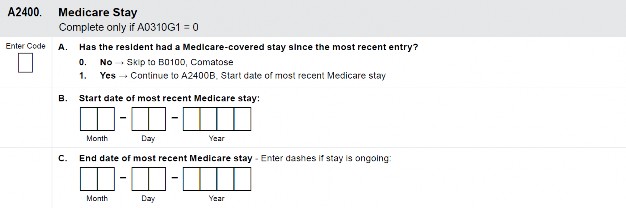
Identifies when a resident is receiving services under the scheduled PPS.
Identifies when a resident’s Medicare Part A stay begins and ends.
DEFINITIONS
MOST RECENT MEDICARE STAY
This is a Medicare Part A covered stay that has started on or after the most recent admission/entry or reentry to the nursing facility.
MEDICARE-COVERED STAY
Skilled Nursing Facility stays billable to Medicare Part A. Does not include stays billable to Medicare Advantage HMO plans.
CURRENT MEDICARE STAY
NEW ADMISSION: Day 1 of
Medicare Part A stay.
READMISSION: Day 1 of
Medicare Part A coverage after readmission following a discharge.
DEFINITIONS
MOST RECENT MEDICARE STAY
This is a Medicare Part A covered stay that has started on or after the most recent admission/entry or reentry to the nursing facility.
MEDICARE-COVERED STAY
Skilled Nursing Facility stays billable to Medicare Part A. Does not include stays billable to Medicare Advantage HMO plans.
CURRENT MEDICARE STAY
NEW ADMISSION: Day 1 of
Medicare Part A stay.
READMISSION: Day 1 of
Medicare Part A coverage after readmission following a discharge.
Coding Instructions for A2400A, Has the Resident Had a Medicare-covered Stay since the Most Recent Entry?
Code 0, no: if the resident has not had a Medicare Part A covered stay since the most recent admission/entry or reentry. Skip to B0100, Comatose.
Code 1, yes: if the resident has had a Medicare Part A covered stay since the most recent admission/entry or reentry. Continue to A2400B.
Code the date of day 1 of this Medicare stay if A2400A is coded 1, yes.
Code the date of last day of this Medicare stay if A2400A is coded 1, yes.
A2400: Medicare Stay (cont.)
If the Medicare Part A stay is ongoing, there will be no end date to report. Enter dashes to indicate that the stay is ongoing.
The end of Medicare date is coded as follows, whichever occurs first:
Date SNF benefit exhausts (i.e., the 100th day of the benefit); or
Date of last day covered as recorded on the effective date from the Notice of Medicare Non-Coverage (NOMNC); or
The last paid day of Medicare A when payer source changes to another payer (regardless if the resident was moved to another bed or not); or
Date the resident was discharged from the facility (see Item A2000, Discharge Date).
When a resident on Medicare Part A returns following a therapeutic leave of absence or a hospital observation stay of less than 24 hours (without hospital admission), this is a continuation of the Medicare Part A stay, not a new Medicare Part A stay.
When a resident on Medicare Part A has an interrupted stay (i.e., is discharged from SNF care and subsequently readmitted to the same SNF within the interruption window after the discharge), this is a continuation of the Medicare Part A stay, not a new Medicare Part A stay.
The End Date of the Most Recent Medicare Stay (A2400C) may be earlier than the actual Discharge Date (A2000) from the facility. If this occurs, the Part A PPS Discharge assessment is required. If the resident subsequently physically leaves the facility, the OBRA Discharge assessment would be required.
If the End Date of Most Recent Medicare Stay (A2400C) occurs on the day of or one day before the Discharge Date (A2000), the OBRA Discharge assessment and Part A PPS Discharge assessment are both required and must be combined. When the OBRA and Part A PPS Discharge assessments are combined, the ARD (A2300) must be equal to the Discharge Date (A2000).
If the End Date of Most Recent Medicare Stay (A2400C) occurs on the same day that the resident dies, a Death in Facility Tracking Record is completed, with the Discharge Date (A2000) equal to the date the resident died. In this case, a Part A PPS Discharge assessment is not required.
For a standalone Part A PPS Discharge assessment, the End Date of the Most Recent Medicare Stay (A2400C) must be equal to the ARD (Item A2300).
A2400: Medicare Stay (cont.)
Resident G. began receiving services under Medicare Part A on October 14, 2021. Due to their stable condition and ability to manage their medications and dressing changes, the facility determined that they no longer qualified for Part A SNF coverage and began planning their discharge. An Advanced Beneficiary Notice (ABN) and an NOMNC with the last day of coverage as November 23, 2021 were issued. Resident G. was discharged home from the facility on November 24, 2021. Code the following on their combined OBRA and Part A PPS Discharge assessment:
• A0310F = 10
• A0310G = 1
• A0310H = 1
• A2000 = 11-24-2021
• A2105 = 01
• A2300 = 11-24-2021
• A2400A = 1
• A2400B = 10-14-2021
• A2400C = 11-23-2021
Rationale: Because Resident G’s last day covered under Medicare was one day before their physical discharge from the facility, a combined OBRA and Part A PPS Discharge was completed.
Resident N began receiving services under Medicare Part A on December 11, 2021. They were unexpectedly sent to the emergency department on December 19, 2021 at 8:30 p.m. and were not admitted to the hospital. They returned to the facility on December 20, 2021, at 11:00 a.m. Upon Resident N’s return, their physician’s orders included significant changes in their treatment regime. The facility staff determined that an Interim Payment Assessment (IPA) was indicated as the PDPM nursing component was impacted. They completed the IPA with an ARD of December 24, 2021. Code the following on the IPA:
• A2400A = 1
• A2400B = 12-11-2021
• A2400C = ----------
Rationale: Resident N was out of the facility at midnight but returned in less than 24 hours and was not admitted to the hospital, so was considered LOA. Therefore, no Discharge assessment was required. Their Medicare Part A Stay is considered ongoing; therefore, the date in A2400C is dashed.
A2400: Medicare Stay (cont.)
Resident R. began receiving services under Medicare Part A on October 15, 2021. Due to complications from their recent surgery, they were unexpectedly discharged to the hospital for emergency surgery on October 20, 2021, but are expected to return within 30 days. Code the following on their OBRA Discharge assessment:
• A0310F = 11
• A0310G = 2
• A0310H = 1
• A2000 = 10-20-2021
• A2105 = 03
• A2300 = 10-20-2021
• A2400A = 1
• A2400B = 10-15-2021
• A2400C = 10-20-2021
Rationale: Resident R’s physical discharge to the hospital was unplanned, yet it is anticipated that they will return to the facility within 30 days. Therefore, only an OBRA Discharge was required. Even though only an OBRA Discharge was required, when the Date of the End of the Medicare Stay is on the day of or one day before the Date of Discharge, MDS specifications require that A0310H be coded as 1.
Resident K began receiving services under Medicare Part A on October 4, 2021. They were discharged from Medicare Part A services on December 17, 2021. They and their family had already decided that Resident K would remain in the facility for long-term care services, and they were moved into a private room (which was dually certified) on December 18, 2021. Code the following on their Part A PPS Discharge assessment:
• A0310F = 99
• A0310G = ^
• A0310H = 1
• A2000 = ^
• A2105 = ^
• A2300 = 12-17-2021
• A2400A = 1
• A2400B = 10-04-2021
• A2400C = 12-17-2021
Rationale: Because Resident K’s Medicare Part A stay ended, and they remained in the facility for long-term care services, a standalone Part A PPS Discharge was required.
A2400: Medicare Stay (cont.)
Resident W began receiving services under Medicare Part A on November 15, 2021. Their Medicare Part A stay ended on November 25, 2021, and they were unexpectedly discharged to the hospital on November 26, 2021. However, they are expected to return to the facility within 30 days. Code the following on their OBRA Discharge assessment:
• A0310F = 11
• A0310G = 2
• A0310H = 1
• A2000 = 11-26-2021
• A2105 = 03
• A2300 = 11-26-2021
• A2400A = 1
• A2400B = 11-15-2021
• A2400C = 11-25-2021
Rationale: Resident W’s Medicare stay ended the day before discharge and they are expected to return to the facility within 30 days. Because their discharge to the hospital was unplanned, only an OBRA Discharge assessment was required. Even though only an OBRA Discharge was required, when the Date of the End of the Medicare Stay is on the day of or one day before the Date of Discharge, MDS specifications require that A0310H be coded as 1.
Medicare Stay End Date Algorithm A2400C


Is the resident's Medicare stay ongoing?
Is the resident's Medicare stay ongoing?
Enter dashes
Enter dashes
Yes

No


Did the resident's SNF benefit exhaust?
Did the resident's SNF benefit exhaust?
Enter the date of the last covered day, i.e., the 100th day
Enter the date of the last covered day, i.e., the 100th day
Yes

No


Was a generic notice issued to the resident?
Was a generic notice issued to the resident?
Enter the effective date on the Generic Notice for last covered day*
Enter the effective date on the Generic Notice for last covered day*
Yes

No


Did the resident's payer source change from Part A to another payer?
Did the resident's payer source change from Part A to another payer?
Enter the date of the last paid day of Medicare A
Enter the date of the last paid day of Medicare A
Yes

No

Enter the date resident was discharged from facility
Enter the date resident was discharged from facility
*if resident leaves facility prior to last covered day as recorded on the generic notice, enter date resident left facility.