physician documentation of a medical symptom that supports the use of the restraint,
a physician’s order for the type of restraint and parameters of use, and
a care plan and a process in place for systematic and gradual restraint reduction (and/or elimination, if possible), as appropriate.
P0100: Physical Restraints (cont.)
“Remove easily” means that the manual method or physical or mechanical device, material, or equipment can be removed intentionally by the resident in the same manner as it was applied by the staff (e.g., side rails are put down or not climbed over, buckles are intentionally unbuckled, ties or knots are intentionally untied), considering the resident’s physical condition and ability to accomplish their objective (e.g., transfer to a chair, get to the bathroom in time).
“Freedom of movement” means any change in place or position for the body or any part of the body that the person is physically able to control or access.
“Medical symptoms/diagnoses” are defined as an indication or characteristic of a physical or psychological condition. Objective findings derived from clinical evaluation of the resident’s subjective symptoms and medical diagnoses should be considered when determining the presence of medical symptom(s) that might support restraint use. The resident’s subjective symptoms may not be used as the sole basis for using a restraint. In addition, the resident’s medical symptoms/diagnoses should not be viewed in isolation; rather, the medical symptoms identified should become the context in which to determine the most appropriate method of treatment related to the resident’s condition, circumstances, and environment, and not a way to justify restraint use.
The identification of medical symptoms should assist the nursing home in determining if the specific medical symptom can be improved or addressed by using other, less restrictive interventions. The nursing home should perform all due diligence and document this process to ensure that they have exhausted alternative treatments and less restrictive measures before a physical restraint is employed to treat the medical symptom, protect the resident’s safety, help the resident attain or maintain their highest level of physical or psychological well-being and support the resident’s goals, wishes, independence, and self-direction.
Physical restraints as an intervention do not treat the underlying causes of medical symptoms. Therefore, as with other interventions, physical restraints should not be used without also seeking to identify and address the physical or psychological condition causing the medical symptom.
Physical restraints may be used, if warranted, as a temporary symptomatic intervention while the actual cause of the medical symptom is being evaluated and managed. Additionally, physical restraints may be used as a symptomatic intervention when they are immediately necessary to prevent a resident from injuring themself or others and/or to prevent the resident from interfering with life-sustaining treatment when no other less restrictive or less risky interventions exist.
P0100: Physical Restraints (cont.)
Therefore, a clear link must exist between physical restraint use and how it benefits the resident by addressing the specific medical symptom. If it is determined, after thorough evaluation and attempts at using alternative treatments and less restrictive methods, that a physical restraint must still be employed, the medical symptoms that support the use of the restraint must be documented in the resident’s medical record, ongoing assessments, and care plans. There also must be a physician’s order reflecting the use of the physical restraint and the specific medical symptom being treated by its use. The physician’s order alone is not sufficient to employ the use of a physical restraint. CMS will hold the nursing home ultimately accountable for the appropriateness of that determination.
Identify all physical restraints that were used at any time (day or night) during the 7-day look- back period.
Identify all physical restraints that were used at any time (day or night) during the 7-day look- back period.
After determining whether or not an item listed in (P0100) is a physical restraint and was used during the 7-day look-back period, code the frequency of use:
Code 0, not used: if the item was not used during the 7-day look-back period or it was used but did not meet the definition.
Code 1, used less than daily: if the item met the definition and was used less than daily during the observation period.
Code 2, used daily: if the item met the definition and was used on a daily basis during the look-back period.
Any manual method or physical or mechanical device, material or equipment, that does not fit into the listed categories but that meets the definition of a physical restraint, and has not been excluded from this section, should be coded in items P0100D or P0100H, Other. These devices, although not coded on the MDS, must be assessed, care-planned, monitored, and evaluated.
In classifying any manual method or physical or mechanical device, material or equipment as a physical restraint, the assessor must consider the effect it has on the resident, not the purpose or intent of its use. It is possible that a manual method or physical or mechanical device, material or equipment may improve a resident’s mobility but also have the effect of physically restraining them.
Exclude from this section items that are typically used in the provision of medical care, such as catheters, drainage tubes, casts, traction, leg, arm, neck, or back braces, abdominal binders, and bandages that are serving in their usual capacity to meet medical need(s).
When coding this section, do not consider as a restraint a locked/secured unit or building in which the resident has the freedom to move about the locked/secured unit or building. Additional guidance regarding locked/secured units is provided in the section “Considerations Involving Secured/Locked Areas” of F603 in Appendix PP of the State Operations Manual.
P0100: Physical Restraints (cont.)
Bed rails include any combination of partial or full rails (e.g., one-side half-rail, one-side full rail, two-sided half-rails or quarter-rails, rails along the side of the bed that block three-quarters to the whole length of the mattress from top to bottom, etc.). Include in this category enclosed bed systems.
Bed rails used as positioning devices. If the use of bed rails (quarter-, half- or three- quarter, one or both, etc.) meet the definition of a physical restraint even though they may improve the resident’s mobility in bed, the nursing home must code their use as a restraint at P0100A.
Bed rails used with residents who are immobile. If the resident is immobile and cannot voluntarily get out of bed because of a physical limitation or because proper assistive devices were not present, the bed rails do not meet the definition of a physical restraint.
For residents who have no voluntary movement, the staff need to determine if there is an appropriate use of bed rails. Bed rails may create a visual barrier and deter
physical contact from others. Some residents have no ability to carry out voluntary movements, yet they exhibit involuntary movements. Involuntary movements, resident weight, and gravity’s effects may lead to the resident’s body shifting toward the edge of the bed. When bed rails are used in these cases, the resident could be at risk for entrapment. For this type of resident, clinical evaluation of alternatives (e.g., a concave mattress to keep the resident from going over the edge of the bed), coupled with frequent monitoring of the resident’s position, should be considered. While the bed rails may not constitute a physical restraint, they may affect the resident’s quality of life and create an accident hazard.
Trunk restraints include any manual method or physical or mechanical device, material or equipment attached or adjacent to the resident’s body that the resident cannot easily remove such as, but not limited to, vest or waist restraints or belts used in a wheelchair that either restricts freedom of movement or access to their body.
Limb restraints include any manual method or physical or mechanical device, material or equipment that the resident cannot easily remove, that restricts movement of any part of an upper extremity (i.e., hand, arm, wrist) or lower extremity (i.e., foot, leg) that either restricts freedom of movement or access to their own body. Hand mitts/mittens are included in this category.
Trunk or limb restraints, if used in both bed and chair, should be marked in both sections.
P0100: Physical Restraints (cont.)
Chairs that prevent rising include any type of chair with a locked lap board, that places the resident in a recumbent position that restricts rising, chairs that are soft and low to the floor, chairs that have a cushion placed in the seat that prohibit the resident from rising, geriatric chairs, and enclosed-frame wheeled walkers.
For residents who have the ability to transfer from other chairs, but cannot transfer from a geriatric chair, the geriatric chair would be considered a restraint to that individual, and should be coded as P0100G–Chair Prevents Rising.
For residents who have no ability to transfer independently, the geriatric chair does not meet the definition of a restraint, and should not be coded at P0100G–Chair Prevents Rising.
Geriatric chairs used for residents who are immobile. For residents who have no voluntary or involuntary movement, the geriatric chair does not meet the definition of a restraint.
Enclosed-frame wheeled walkers, with or without a posterior seat, and other devices like it should not automatically be classified as a physical restraint. These types of walkers are only classified as a physical restraint if the resident cannot exit the walker via opening a gate, bar, strap, latch, removing a tray, etc. When deemed a physical restraint, these walkers should be coded at P0100G–Chair Prevents Rising.
Restraints used in emergency situations. If the resident needs emergency care, physical restraints may be used for brief periods to permit medical treatment to proceed, unless the resident or legal representative has previously made a valid refusal of the treatment in question. The resident's right to participate in care planning and the right to refuse treatment are addressed at 42 CFR 483.10(c)(6) and 483.21(b)(ii)(A)–(F) respectively. The use of physical restraints in this instance should be limited to preventing the resident from interfering with life-sustaining procedures only and not for routine care.
A resident who is injuring themself or is threatening physical harm to others may be physically restrained in an emergency to safeguard the resident and others. A resident whose unanticipated violent or aggressive behavior places them or others in imminent danger does not have the right to refuse the use of physical restraints, as long as those restraints are used as a last resort to protect the safety of the resident or others and use is limited to the immediate episode.
Restraint reduction/elimination. It is further expected, for residents whose care plan indicates the need for physical restraints, that the nursing home engages in a systematic and gradual process towards reducing (or eliminating, if possible) the restraints (e.g., gradually increasing the time for ambulation and strengthening activities). This systematic process also applies to recently-admitted residents for whom physical restraints were used in the previous setting.
P0100: Physical Restraints (cont.)
Restraints as a fall prevention approach. Although physical restraints have been traditionally used as a fall prevention approach, they have major drawbacks and can contribute to serious injuries. Falls do not constitute self-injurious behavior nor a medical symptom supporting the use of physical restraints. There is no evidence that the use of physical restraints, including but not limited to side rails, will prevent, reduce, or eliminate falls. In fact, in some instances, reducing the use of physical restraints may actually decrease the risk of falling. Additionally, falls that occur while a person is physically restrained often result in more severe injuries.
Request for restraints. While a resident, family member, legal representative, or surrogate may request use of a physical restraint, the nursing home is responsible for evaluating the appropriateness of that request, just as they would for any medical treatment. As with other medical treatments, such as the use of prescription drugs, a resident, family member, legal representative, or surrogate has the right to refuse treatment, but not to demand its use when it is not deemed medically necessary.
According to 42 CFR 483.10(e)(1) and 483.12, “The resident has the right to be free from any physical or chemical restraints imposed for the purposes of discipline or convenience and not required to treat the resident’s medical symptoms.” CMS expects that no resident will be physically restrained for discipline or convenience. Prior to employing any physical restraint, the nursing home must perform a prescribed resident assessment to properly identify the resident’s needs and the medical symptom(s) the physical restraint is being employed to address. The guidelines in the State Operations Manual (SOM) state, “...the legal surrogate or representative cannot give permission to use restraints for the sake of discipline or staff convenience or when the restraint is not necessary to treat the resident’s medical symptoms. That is, the facility may not use restraints in violation of regulation solely based on a resident, legal surrogate or representative’s request or approval.” The SOM goes on to state, “While Federal regulations affirm the resident’s right to participate in care planning and to refuse treatment, the regulations do not create the right for a resident, legal surrogate or representative to demand that the facility use specific medical interventions or treatment that the facility deems inappropriate. Statutory requirements hold the facility ultimately accountable for the resident’s care and safety, including clinical decisions.”
P0200: Alarms
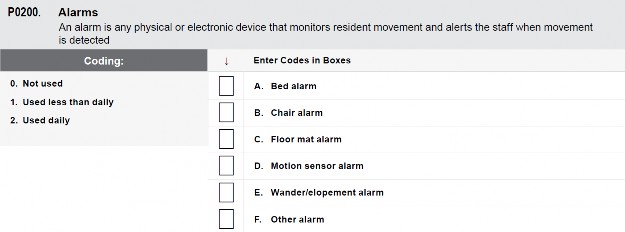
An alarm is any physical or electronic device that monitors resident movement and alerts the staff, by either audible or inaudible means, when movement is detected, and may include bed, chair and floor sensor pads, cords that clip to the resident’s clothing, motion sensors, door alarms, or elopement/wandering devices.
While often used as an intervention in a resident’s fall prevention strategy, the efficacy of alarms to prevent falls has not been proven; therefore, alarm use must not be the primary or sole intervention in the plan.
The use of an alarm as part of the resident’s plan of care does not eliminate the need for adequate supervision, nor does the alarm replace individualized, person-centered care planning.
Adverse consequences of alarm use include, but are not limited to, fear, anxiety, or agitation related to the alarm sound; decreased mobility; sleep disturbances; and infringement on freedom of movement, dignity, and privacy.
P0200: Alarms (cont.)
Individualized, person-centered care planning surrounding the resident’s use of an alarm is important to the resident’s overall well-being.
When the use of an alarm is considered as an intervention in the resident’s safety strategy, use must be based on the assessment of the resident and monitored for efficacy on an ongoing basis, including the assessment of unintended consequences of the alarm use and alternative interventions.
There are times when the use of an alarm may meet the definition of a restraint, as the alarm may restrict the resident’s freedom of movement and may not be easily removed by the resident.
When an alarm is used as an intervention in the resident’s safety strategy, the effect the alarm has on the resident must be evaluated individually for that resident.