Intent: This item is intended to record any dental problems present in the 7-day look-back period.
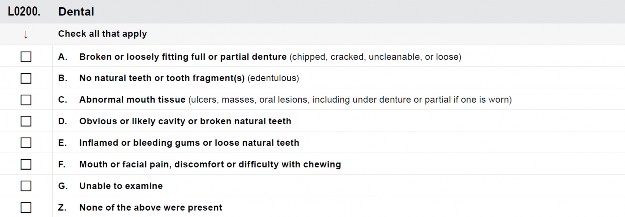
L0200: Dental
DEFINITIONS
CAVITY
A tooth with a discolored hole or area of decay that may have debris in it.
BROKEN NATURAL TEETH OR TOOTH FRAGMENT
Very large cavity, tooth broken off or decayed to gum line, or broken teeth (from a fall or trauma).
ORAL LESIONS
A discolored area of tissue (red, white, yellow, or darkened) on the lips, gums, tongue, palate, cheek lining, or throat.
EDENTULOUS
Having no natural permanent teeth in the mouth.
Complete tooth loss.
DEFINITIONS
CAVITY
A tooth with a discolored hole or area of decay that may have debris in it.
BROKEN NATURAL TEETH OR TOOTH FRAGMENT
Very large cavity, tooth broken off or decayed to gum line, or broken teeth (from a fall or trauma).
ORAL LESIONS
A discolored area of tissue (red, white, yellow, or darkened) on the lips, gums, tongue, palate, cheek lining, or throat.
EDENTULOUS
Having no natural permanent teeth in the mouth.
Complete tooth loss.
Poor oral health has a negative impact on:
quality of life
overall health
nutritional status
Assessment can identify periodontal disease that can contribute to or cause systemic diseases and conditions, such as aspiration, malnutrition, pneumonia, endocarditis, and poor control of diabetes.
Planning for Care
Assessing dental status can help identify residents who may be at risk for aspiration, malnutrition, pneumonia, endocarditis, and poor control of diabetes.
DEFINITIONS
ORAL MASS
A swollen or raised lump, bump, or nodule on any oral surface. May be hard or soft, and with or without pain.
ULCER
Mouth sore, blister or eroded area of tissue on any oral surface.
DEFINITIONS
ORAL MASS
A swollen or raised lump, bump, or nodule on any oral surface. May be hard or soft, and with or without pain.
ULCER
Mouth sore, blister or eroded area of tissue on any oral surface.
L0200: Dental (cont.)
Ask the resident about the presence of chewing problems or mouth or facial pain/discomfort.
Ask the resident, family, or significant other whether the resident has or recently had dentures or partials. (If resident or family/significant other reports that the resident recently had dentures or partials, but they do not have them at the facility, ask for a reason.)
If the resident has dentures or partials, examine for loose fit. Ask them to remove, and examine for chips, cracks, and
cleanliness. Removal of dentures and/or partials is necessary for adequate assessment.
Conduct exam of the resident’s lips and oral cavity with dentures or partials removed, if applicable. Use a light source that is adequate to visualize the back of the mouth. Visually observe and feel all oral surfaces including lips, gums, tongue, palate, mouth floor, and cheek lining. Check for abnormal mouth tissue, abnormal teeth, or inflamed or bleeding gums. The assessor should use their gloved fingers to adequately feel for masses or loose teeth.
If the resident is unable to self-report, then observe them while eating with dentures or partials, if indicated, to determine if chewing problems or mouth pain are present.
Oral examination of residents who are uncooperative and do not allow for a thorough oral exam may result in medical conditions being missed. Referral for dental evaluation should be considered for these residents and any resident who exhibits dental or oral issues.
Coding Instructions
Check L0200A, broken or loosely fitting full or partial denture: if the denture or partial is chipped, cracked, uncleanable, or loose. A denture is coded as loose if the resident complains that it is loose, the denture visibly moves when the resident opens their mouth, or the denture moves when the resident tries to talk.
Check L0200B, no natural teeth or tooth fragment(s) (edentulous): if the resident is edentulous/lacks all natural teeth or parts of teeth.
Check L0200C, abnormal mouth tissue (ulcers, masses, oral lesions):
select if any ulcer, mass, or oral lesion is noted on any oral surface.
Check L0200D, obvious or likely cavity or broken natural teeth: if any cavity or broken tooth is seen.
Check L0200E, inflamed or bleeding gums or loose natural teeth: if gums appear irritated, red, swollen, or bleeding. Teeth are coded as loose if they readily move when light pressure is applied with a fingertip.
Check L0200F, mouth or facial pain or discomfort with chewing: if the resident reports any pain in the mouth or face, or discomfort with chewing.
Check L0200G, unable to examine: if the resident’s mouth cannot be examined.
Check L0200Z, none of the above: if none of conditions A through F is present.
L0200: Dental (cont.)
Mouth or facial pain coded for this item should also be coded in Section J, items J0100 through J0850, in any items in which the coding requirements of Section J are met.
The dental status for a resident who has some, but not all, of their natural teeth that do not appear damaged (e.g., are not broken, loose, with obvious or likely cavity) and who does not have any other conditions in L0200A–G, should be coded in L0200Z, none of the above.
Many residents have dentures or partials that fit well and work properly. However, for individualized care planning purposes, consideration should be taken for these residents to make sure that they are in possession of their dentures or partials and that they are being utilized properly for meals, snacks, medication pass, and social activities. Additionally, the dentures or partials should be properly cared for with regular cleaning and by assuring that they continue to fit properly throughout the resident’s stay.